

About
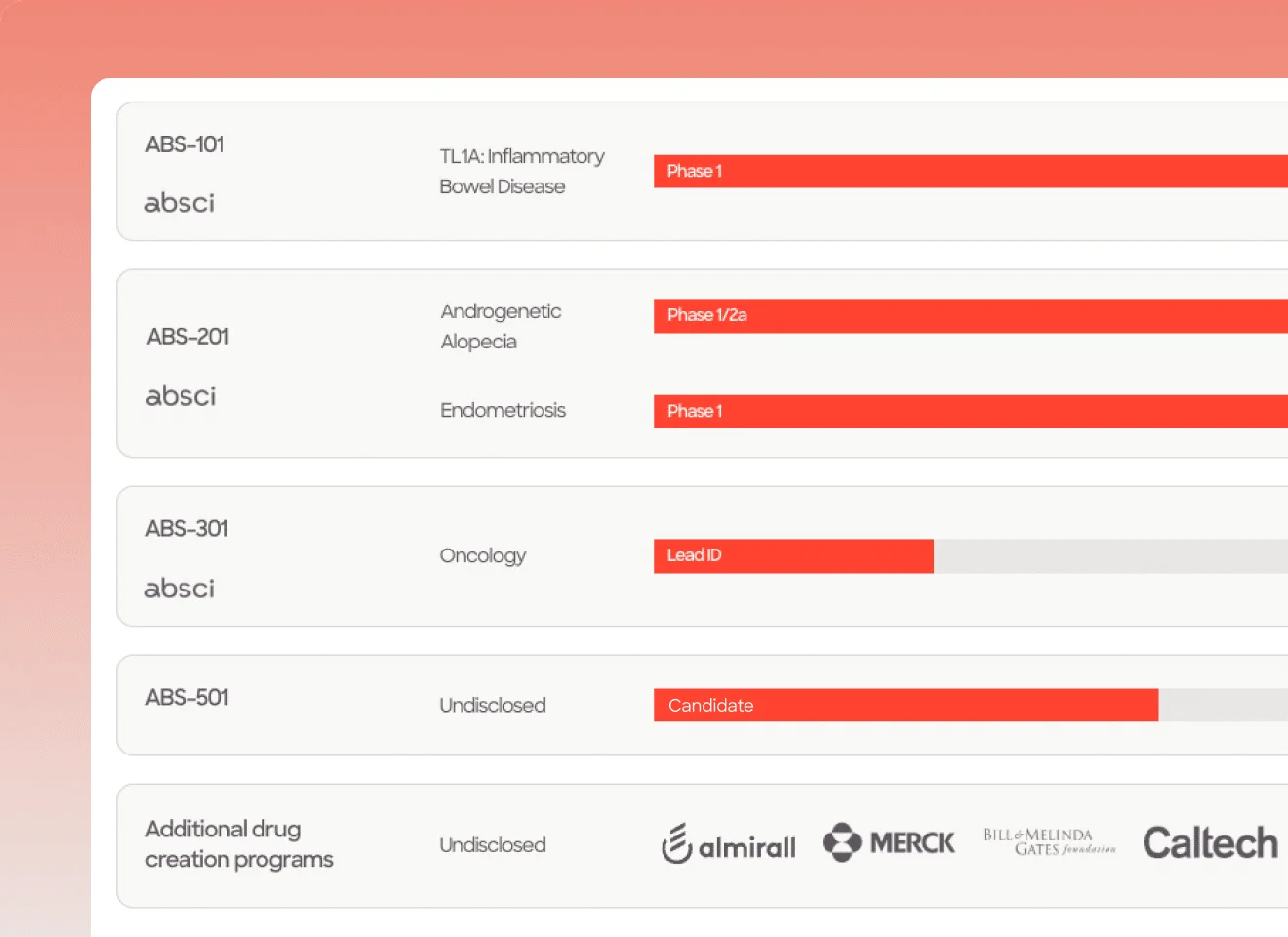
Absci is a clinical-stage biopharmaceutical company pioneering the use of generative AI to unlock novel biology and create superior biologics. At the core of their approach is the AI Drug Creation Platform, which tightly integrates computational AI models with wet lab experimentation in iterative cycles — generating data, training models, designing candidates de novo, and validating results in approximately six-week sprints. Absci's platform enables multi-parametric lead optimization, allowing scientists to simultaneously tune binding affinity, selectivity, manufacturability, and other drug-like properties. Their AI Target Discovery capability uses Reverse Immunology — identifying antibodies produced by 'super immune responders' — to uncover novel targets alongside ready-to-optimize antibody/target pairs. A flagship example is ABS-201, an antibody designed to target prolactin receptors for androgenetic alopecia (hair loss), developed from concept to clinical pipeline in just 24 months. Absci's Origin-1 model further advances de novo antibody design by unlocking 'Zero-Prior' epitopes not previously targetable. Absci partners with leading pharmaceutical companies, technology firms, and academic institutions, offering co-development programs against high-value biological targets. The platform is best suited for enterprise R&D organizations seeking to compress timelines, reduce attrition, and discover truly differentiated biologic therapeutics with AI.
Key Features
- AI Drug Creation Platform: An integrated platform combining generative AI models and wet lab validation in iterative ~6-week cycles for de novo biologics design and lead optimization.
- De Novo Antibody Design: Design antibodies from scratch using generative AI, including the Origin-1 model capable of unlocking 'Zero-Prior' epitopes not accessible by traditional methods.
- Multi-Parametric Lead Optimization: Simultaneously optimize multiple drug properties — affinity, selectivity, stability, and manufacturability — reducing iteration time and attrition rates.
- AI Target Discovery via Reverse Immunology: Identify novel biological targets by studying antibodies from super immune responders, yielding ready-to-optimize antibody/target pairs for IND-enabling studies.
- Pharma & Academic Partnerships: Collaborative programs with leading pharma, biotech, and academic institutions to develop differentiated biologics against challenging therapeutic targets.
Use Cases
- Pharmaceutical companies seeking to accelerate antibody drug discovery against high-value or previously undruggable biological targets.
- Biotech organizations aiming to design best-in-class biologics with improved selectivity, stability, and manufacturability using generative AI.
- Research institutions collaborating on novel target identification using AI-powered reverse immunology approaches.
- Drug developers looking to reduce time-to-clinic for biologic therapeutics by compressing traditional multi-year discovery timelines into months.
- Therapeutic programs requiring de novo antibody design against novel or unconventional epitopes not accessible via traditional hybridoma or phage display methods.
Pros
- Dramatically Compressed Timelines: The AI-driven iterative approach enables drug candidates to move from concept to clinical pipeline in as little as 24 months, far faster than traditional discovery workflows.
- Novel Target & Epitope Access: Reverse Immunology and Origin-1's Zero-Prior capability unlock targets and epitopes that are inaccessible to conventional antibody discovery platforms.
- Integrated Wet Lab Validation: Unlike purely computational approaches, Absci validates AI designs with in-house wet lab capabilities, ensuring real-world feasibility and reducing risk.
Cons
- Enterprise-Only Access: Absci's platform is not available as a self-serve tool; access is through partnership agreements suited for large pharma or well-funded biotech organizations.
- Narrow Domain Focus: The platform is specialized for antibody-based biologics, making it less applicable to small-molecule drug discovery or other therapeutic modalities.
- Limited Public Pricing Transparency: Partnership terms, costs, and program structures are not publicly disclosed, requiring direct engagement with Absci's business development team.
Frequently Asked Questions
What is Absci's AI Drug Creation Platform?
It is an integrated system that combines generative AI model development with wet lab experimentation in iterative cycles. Data generated in the lab trains AI models, which then design new biologics candidates, which are validated in the lab — repeating in approximately 6-week cycles.
How does Absci's Reverse Immunology approach work?
Absci analyzes antibodies produced by individuals with exceptional immune responses ('super immune responders') to identify novel biological targets. This yields both the target and an initial antibody candidate, which can then be further optimized using the AI platform.
What is Origin-1 and what are 'Zero-Prior' epitopes?
Origin-1 is Absci's advanced de novo antibody design model capable of generating antibodies against epitopes with no prior structural or sequence information — so-called 'Zero-Prior' epitopes — expanding the druggable target space significantly.
Who can partner with Absci?
Absci partners with leaders across the pharmaceutical industry, technology sector, and academia. Partnerships are designed to co-develop differentiated biologics against challenging targets using Absci's generative AI capabilities.
What is ABS-201 and why is it significant?
ABS-201 is an antibody designed by Absci targeting prolactin receptors for androgenetic alopecia (hair loss). It was developed from concept through clinical trial pipeline in 24 months, demonstrating hair follicle regeneration in vivo — serving as a proof point for Absci's AI-accelerated drug creation process.