

About
Arcweave is a collaborative branching narrative design platform built for game studios, serious games developers, educators, and narrative designers. It provides a centralized visual workspace where writers, designers, and developers can co-author dialogue trees, quests, lore, and branching scenarios in real time — eliminating the scattered documents and time-consuming handoffs that slow down production. The platform's visual editor lets teams map choices, conditions, and consequences in an intuitive flow diagram, making complex narrative logic easy to review, iterate, and communicate. Built-in prototyping and playtesting tools allow designers to test interactive experiences instantly without requiring new game engine builds, cutting revision cycles by up to 50%. Arcweave integrates directly with Unity, Unreal, Godot, and other frameworks via open-source engine plugins and a RESTful API, enabling structured JSON narrative data to flow seamlessly into production pipelines. Lore management features let teams organize characters, locations, items, and their relationships in one structured source of truth. For serious games and corporate learning, Arcweave supports scenario-based training with outcome tracking, flags, and score reporting. For educators, it offers tools to teach interactive storytelling and game design. Producers benefit from scope tracking, dependency monitoring, and stakeholder communication tools. With over 38,000 creators and 4,000+ exports per month, Arcweave is trusted by studios worldwide as their narrative production backbone.
Key Features
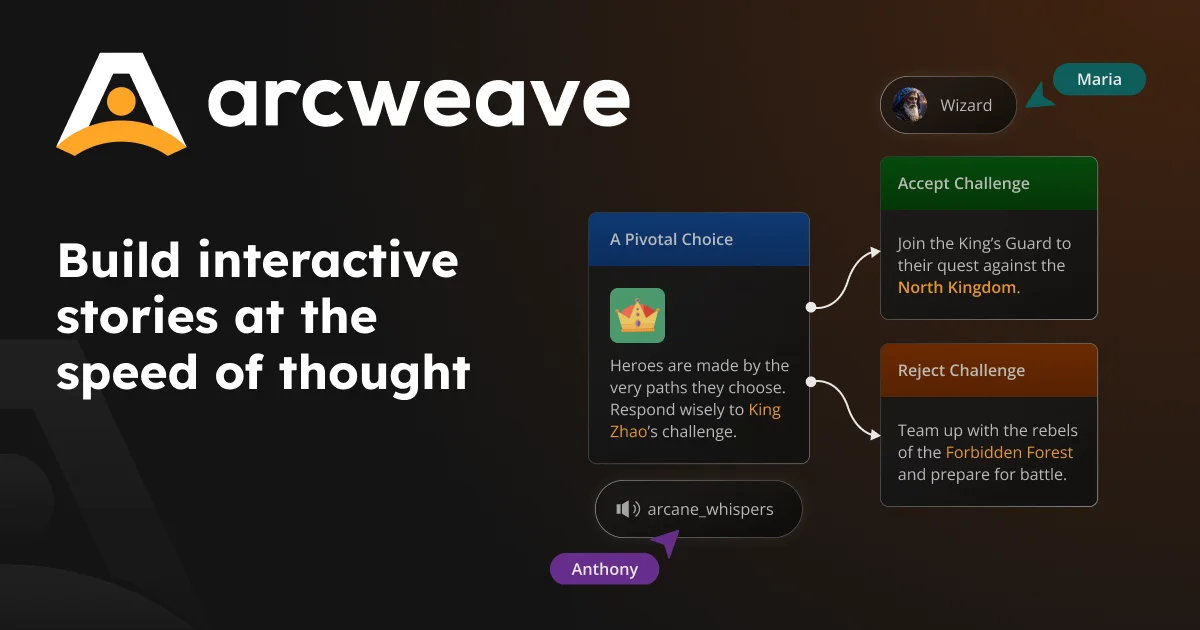
- Visual Branching Editor: Design dialogue trees, quests, and narrative flows in an intuitive visual canvas, mapping choices, conditions, and consequences with your entire team.
- Real-Time Collaboration & Version Control: Writers, designers, and developers work together in a single source of truth with live collaboration, feedback in context, and version history.
- Instant Prototyping & Playtesting: Test interactive narrative experiences directly within the app without requiring new game engine builds, enabling rapid iteration independent of engineering resources.
- Game Engine Integrations: Ship narrative data into Unity, Unreal, Godot, and other frameworks via open-source plugins, structured JSON exports, and a RESTful API.
- Lore & Asset Management: Organize characters, locations, items, and backstory in a centralized hub, keeping all narrative assets structured and accessible across your team.
Use Cases
- Game studios designing complex branching dialogue systems and multi-path quest structures for RPGs and narrative-driven games.
- Corporate L&D teams building scenario-based training simulations with branching decision trees, outcome tracking, and score reporting.
- Educators teaching interactive storytelling, game design courses, and branching narrative theory using a hands-on visual tool.
- Producers and project managers tracking narrative scope, team dependencies, and delivery milestones across large game productions.
- Developers integrating finalized narrative data directly into Unity, Unreal, or Godot builds via plugins or the REST API.
Pros
- Unified Production Hub: Consolidates story, dialogue, lore, and assets in one place, eliminating scattered documents and reducing miscommunication between departments.
- Engine-Agnostic Integration: Works with Unity, Unreal, Godot, and custom platforms via a REST API, making it adaptable to virtually any development pipeline.
- Dramatically Fewer Revision Cycles: Built-in playtesting and real-time collaboration have helped studios cut revision cycles by up to 50%, accelerating narrative production timelines.
- Versatile Across Industries: Equally suited to video games, corporate training, and academic education, making it a flexible long-term investment for diverse teams.
Cons
- Web-Only Platform: Arcweave is primarily browser-based, which may limit offline use or performance for very large projects compared to native desktop tools.
- Learning Curve for Complex Narratives: Designing highly intricate branching logic with many conditions and flags can take time to master, especially for non-technical writers.
- Free Tier Limitations: The free plan may have project or export restrictions, requiring a paid upgrade for studio-scale or commercial production use.
Frequently Asked Questions
What is Arcweave used for?
Arcweave is used to design branching narratives, dialogue trees, quests, and interactive training scenarios. It is popular in video game development, serious games and corporate eLearning, and educational settings for teaching interactive storytelling.
Does Arcweave integrate with game engines?
Yes. Arcweave offers open-source plugins for Unity, Unreal, and Godot, as well as a RESTful API that outputs structured JSON data for integration into any custom pipeline or game framework.
Is Arcweave free to use?
Arcweave offers a free tier with no credit card required so you can get started immediately. Paid plans unlock additional features, higher project limits, and advanced collaboration tools suited for professional studios.
Can multiple team members collaborate in Arcweave?
Yes. Arcweave is built for team collaboration, allowing writers, narrative designers, developers, and producers to work simultaneously in a shared visual editor with version control and contextual feedback.
Who is Arcweave designed for?
Arcweave is designed for narrative designers and writers, game producers, developers, serious games and eLearning creators, and educators. Over 38,000 creators across studios worldwide use it to manage interactive narrative production.