

About
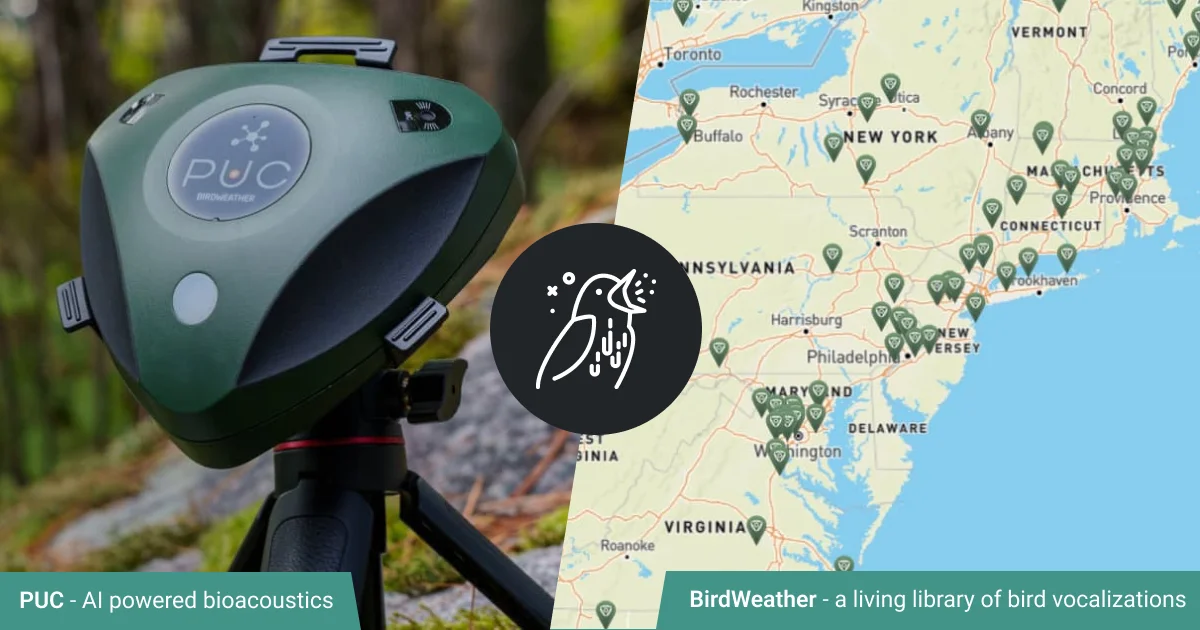
BirdWeather is a living library of bird vocalizations built for backyard birders, field researchers, and citizen scientists. The platform centers around PUC (Portable Universe Codec), a compact, weatherproof AI-powered device packed with dual microphones, WiFi/BLE, GPS, and a suite of environmental sensors (temperature, humidity, pressure, air quality, tVOC, CO2, and spectral light). PUC continuously listens to its surroundings and automatically identifies bird songs in real-time using the BirdNET neural network — a joint project from the Cornell Lab of Ornithology and Chemnitz University of Technology — covering more than 6,000 global bird species, non-avian wildlife, and even man-made sound sources. Whether mounted in your backyard, carried on a hike, or deployed remotely for long-term habitat monitoring, PUC uploads all soundscape data to the BirdWeather cloud for fully automated analysis. No manual sorting or approval is needed. Users can explore detections, listen to soundscapes, and contribute to a shared global live map via the iOS and Android mobile apps. For researchers and conservationists, BirdWeather offers flexible data extraction options and supports extended field deployments via mobile hotspot or onboard microSD storage. It is an ideal tool for environmental education, ecological research, wildlife monitoring, and anyone passionate about connecting with the natural world through sound.
Key Features
- Real-Time Bird Identification: Uses the BirdNET neural network to automatically identify 6,000+ global bird species, non-avian wildlife, and man-made sounds from continuous audio input.
- PUC Hardware Device: A weatherproof, portable device with dual microphones, WiFi/BLE, GPS, onboard neural engine, and microSD storage — designed for both backyard and field deployments.
- Automated Cloud Processing: All soundscapes are uploaded and analyzed automatically in the cloud with no manual sorting, tagging, or approval required.
- Environmental Sensor Suite: PUC captures local weather and environmental data including temperature, humidity, air pressure, air quality, tVOC, CO2, and spectral light alongside audio.
- Global Live Map & Community: Contribute detections to and explore a worldwide live map of bird sightings, with iOS and Android apps for sharing soundscapes with the citizen science community.
Use Cases
- Backyard birders connecting a PUC to home WiFi to automatically log and listen to bird songs around their property in real-time.
- Hikers and travelers taking PUC on trips to record and identify local wildlife soundscapes, later synced to the BirdWeather platform.
- Ecologists and conservation researchers deploying PUC in the field for long-term, automated habitat monitoring and biodiversity assessments.
- Educators and students using BirdWeather as a hands-on citizen science tool to study local bird populations and contribute to global data.
- Environmental consultants tracking wildlife presence and acoustic biodiversity on land survey sites using automated soundscape analysis.
Pros
- Fully Automated Analysis: Recordings are processed end-to-end by the cloud with zero manual effort, making it accessible to non-experts and efficient for researchers.
- Broad Species Coverage: Identifies over 6,000 bird species worldwide plus non-avian animals and man-made sounds, making it versatile across global habitats.
- Versatile Deployment Options: Works equally well for backyard monitoring, mobile hiking use, and long-term remote field deployments with multiple power and connectivity options.
- Citizen Science Community: Data contributes to a shared global map, enabling collective ecological monitoring and research at scale.
Cons
- Hardware Purchase Required: Full functionality requires buying the PUC device, which adds an upfront cost barrier compared to software-only solutions.
- WiFi/Connectivity Dependent for Live Features: Real-time cloud upload and live map features require WiFi or a mobile hotspot; offline deployments must sync later.
- Niche Use Case: Primarily designed for birding and ecological monitoring, limiting its appeal to a specialized audience rather than general consumers.
Frequently Asked Questions
What is PUC and how does it work?
PUC (Portable Universe Codec) is BirdWeather's AI-powered bioacoustics device. It continuously listens to its surroundings using dual microphones, processes audio with a built-in neural engine, and uploads soundscape data to the BirdWeather cloud for automatic species identification using the BirdNET neural network.
How many bird species can BirdWeather identify?
BirdWeather uses the BirdNET neural network to identify over 6,000 global bird species, as well as non-avian animals (coyotes, frogs, insects) and man-made sounds like fireworks or engines.
Can I use PUC away from home WiFi?
Yes. PUC has a built-in microSD card slot for local recording during hikes, camping trips, or remote deployments. Once you return to WiFi range, it automatically uploads and processes everything to your BirdWeather account.
Is there a mobile app for BirdWeather?
Yes. BirdWeather offers apps for both iOS and Android that let you listen to soundscapes, view detections, and share your findings on the global BirdWeather live map.
Who developed the AI behind BirdWeather?
BirdWeather is powered by BirdNET, a neural network jointly developed by the K. Lisa Yang Center for Conservation Bioacoustics at the Cornell Lab of Ornithology and the Chemnitz University of Technology in Germany.