
About
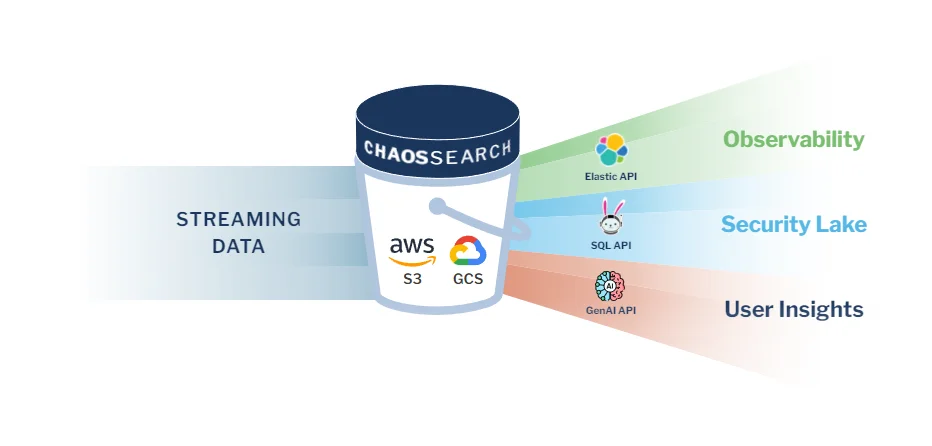
ChaosSearch is a cloud-native data analytics platform that enables organizations to run Search, SQL, and AI-powered queries directly on data stored in Amazon S3 or similar cloud object storage — without moving, duplicating, or transforming the data first. Designed as a drop-in complement or replacement for costly stacks like ELK, OpenSearch, Splunk, and Datadog, ChaosSearch dramatically reduces operational overhead and infrastructure costs while increasing analytical flexibility. The platform supports native Elasticsearch APIs and tooling, meaning existing dashboards and integrations continue to work out of the box. At the same time, it extends capabilities with SQL querying, machine learning, and GenAI-assisted analytics — all powered by the durability and scalability of your existing data lake. ChaosSearch is available as a SaaS deployment or natively within Databricks Lakehouse environments, making it suitable for enterprise observability pipelines, security operations centers (SOC), user behavior analytics, and embedded analytics products. It integrates with AWS services (S3, CloudTrail, Security Lake, VPC), Cloudflare, Cribl, Databricks, Fastly, and more. Key benefits include unlimited data retention at S3 costs, no schema-on-write requirement (schema is applied at query time), and minimal management overhead. ChaosSearch is particularly well-suited for data engineering, platform operations, and security teams at mid-to-large enterprises looking to consolidate log and event analytics at scale.
Key Features
- Query Data In-Place on S3: Run Search, SQL, and AI queries directly on data stored in Amazon S3 — no data movement, duplication, or transformation required.
- Native Elasticsearch API Compatibility: Supports Elasticsearch and OpenSearch APIs, allowing teams to reuse existing tooling, dashboards, and integrations without modification.
- GenAI-Assisted Analytics: Integrated GenAI capabilities allow teams to query and explore log and event data using natural language, accelerating insight discovery.
- Databricks Lakehouse Integration: Deploy natively within Databricks to bring observability and security log analytics into a unified lakehouse with world-class SQL, ML, and AI.
- 50–80% Cost Savings: By leveraging S3 as the storage layer and eliminating data duplication, ChaosSearch delivers dramatic cost reductions versus traditional observability stacks.
Use Cases
- Security operations teams centralizing log and event data from AWS, Cloudflare, and network sources for threat detection and investigation without expensive SIEM storage costs.
- Platform and SRE teams replacing their self-managed ELK stack with a fully managed, S3-backed observability solution that scales automatically and requires no cluster tuning.
- Data engineering teams at enterprises consolidating log analytics into their Databricks Lakehouse to enable SQL, ML, and AI analysis on operational data alongside business data.
- Product and growth teams running user behavior analytics and embedded analytics use cases on event streams stored in S3, without needing a separate analytical database.
- Managed Detection & Response (MDR) providers and financial services firms needing unlimited log retention at low cost for compliance, audit, and forensic investigation workflows.
Pros
- Massive Cost Reduction: Organizations consistently report 50–80% savings over legacy ELK, Splunk, or Datadog deployments by leveraging cheap, durable cloud object storage.
- No Data Movement Required: Schema is applied at query time, so data never needs to be pre-transformed or moved — enabling flexible, retroactive analysis of any dataset.
- Elastic API Compatibility: Teams can migrate from ELK or OpenSearch with minimal friction, keeping their existing Kibana dashboards and Elasticsearch tooling intact.
- Unlimited Retention: Data stays in S3 indefinitely at object storage costs, eliminating the hot/warm/cold tiering complexity of traditional log management platforms.
Cons
- Enterprise-Focused Pricing: ChaosSearch is primarily priced for mid-to-large enterprises; there is no self-serve free tier, which can be a barrier for smaller teams evaluating the platform.
- AWS-Centric Architecture: The platform is tightly integrated with AWS S3 and AWS services; teams running primarily on GCP or Azure may face additional complexity.
- Learning Curve for Advanced Features: While Elasticsearch API compatibility lowers the migration bar, fully leveraging GenAI analytics and Databricks integration may require dedicated engineering investment.
Frequently Asked Questions
What is ChaosSearch and how does it work?
ChaosSearch is a cloud analytics platform that indexes data stored in Amazon S3 and makes it queryable via Elasticsearch/OpenSearch APIs, SQL, and GenAI tools — all without moving or copying the data. It creates a virtual analytical layer on top of your existing data lake.
Can ChaosSearch replace my ELK stack?
Yes. ChaosSearch is purpose-built as an ELK/OpenSearch replacement. It supports native Elasticsearch APIs so your existing Kibana dashboards and integrations continue to work, while offering significantly lower storage costs and unlimited retention via S3.
How does ChaosSearch integrate with Databricks?
ChaosSearch can be deployed natively within Databricks Lakehouse environments, allowing security and observability teams to consolidate log and event analytics alongside Databricks' SQL, ML, and AI capabilities in a single governed platform.
What kind of cost savings can I expect?
Customers typically report 50–80% cost savings compared to running ELK, Splunk, or Datadog at scale. Savings come from using S3 as the primary storage layer, eliminating data duplication, and removing the need to manage complex Elasticsearch cluster infrastructure.
What data sources and integrations does ChaosSearch support?
ChaosSearch integrates with AWS services (S3, CloudTrail, Security Lake, VPC, CloudFront, ELB, SQS), Cloudflare, Cribl, Databricks, Fastly, and Spark. It also supports Amazon Bedrock for GenAI-assisted analytics workflows.