
About
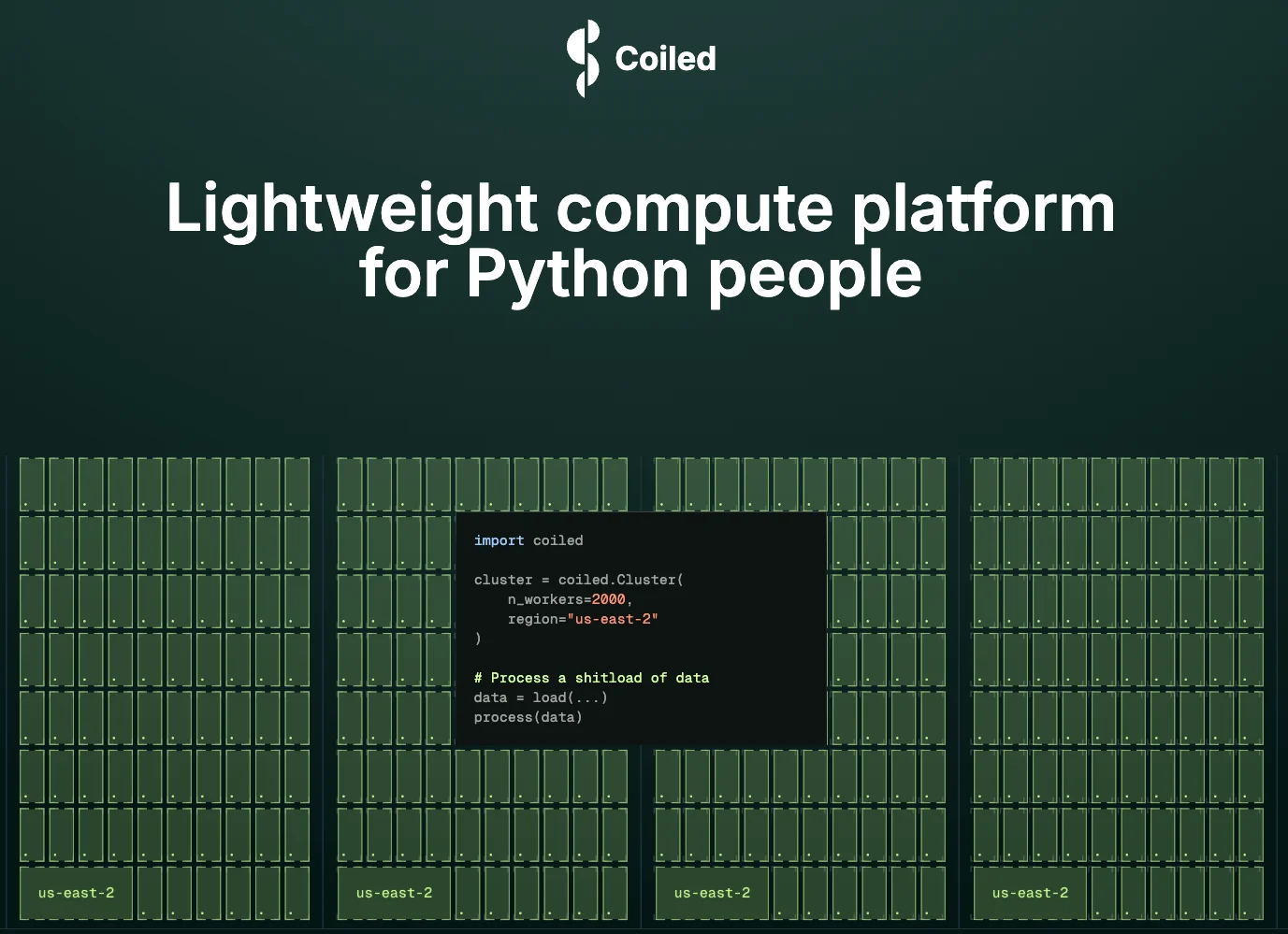
Coiled is a developer-obsessed cloud compute platform designed specifically for Python data engineers and scientists who need to scale workloads without wrestling with DevOps complexity. With a single Python function call, users can provision clusters of up to thousands of machines on any major cloud region and VM type in about a minute. There's no Docker configuration or Kubernetes manifests required — Coiled automatically mirrors your local Python environment (including packages like PyTorch, Pandas, and more) directly to remote machines. Coiled integrates natively with the Python data ecosystem: it supports Dask for distributed dataframes, Xarray for multi-dimensional arrays, Prefect for workflow orchestration, and raw batch jobs for arbitrary workloads including shell scripts and legacy code. Developers can drive computation from their laptop or favorite IDE like VSCode, maintaining the exact same coding experience they have locally — just with dramatically more compute power. Once a job is complete, Coiled automatically cleans up all cloud resources, ensuring zero idle infrastructure costs. Teams also benefit from a web UI for monitoring, debugging, and access control, plus usage dashboards for cost management. Coiled is trusted by companies like Moderna, KoBold Metals, and Floodbase to reduce multi-day data processing jobs to hours, enabling petabyte-scale analytics without dedicated platform engineering teams.
Key Features
- Instant Cloud Cluster Provisioning: Spin up clusters of up to 2,000+ cloud VMs across any region or instance type in about a minute using a single Python function call — no infrastructure configuration needed.
- Zero-Config Environment Replication: Coiled automatically installs your local Python environment on remote machines, eliminating the need to write Dockerfiles or manage container images.
- Native Python Ecosystem Integration: Works seamlessly with Dask, Pandas, Xarray, Prefect, and arbitrary batch jobs — letting teams scale existing code without rewrites.
- Ephemeral Infrastructure: All cloud resources are automatically torn down when jobs complete, ensuring zero idle costs and no ongoing infrastructure maintenance burden.
- Team Web UI & Access Controls: A visual dashboard enables job monitoring, debugging, cost tracking, and team access management without needing the AWS console or Kubernetes tooling.
Use Cases
- Processing terabytes of climate or geospatial data with Xarray across hundreds of cloud VMs in hours instead of days.
- Running large-scale Pandas or Dask dataframe transformations on petabyte-sized datasets as part of an ETL pipeline.
- Executing parallelized machine learning preprocessing or hyperparameter search jobs without setting up a Kubernetes cluster.
- Running batch simulation or scientific computing jobs at scale, including legacy Fortran or shell-script workloads, via Coiled Batch Jobs.
- Enabling data science teams at startups and enterprises to burst to the cloud from local laptops without platform engineering support.
Pros
- No DevOps Expertise Required: Data scientists and engineers can scale to massive compute without learning Docker, Kubernetes, or cloud infrastructure — the full workflow stays in Python.
- Identical Local and Remote Dev Experience: Code runs the same way locally and on thousands of cloud machines, so there's no context switching or environment mismatch to debug.
- Cost-Efficient Ephemeral Compute: Infrastructure exists only while jobs run, so teams pay only for what they use and never maintain idle clusters or over-provisioned resources.
- Fast Time-to-Results: Users report reducing multi-day data processing jobs to under an hour, enabling faster experimentation and analysis cycles.
Cons
- Python-Centric Platform: Coiled is optimized for Python workflows; teams using other languages or non-Dask frameworks may find integration more limited.
- Cloud Costs at Scale: While ephemeral clusters reduce waste, spinning up thousands of large VMs can accumulate significant cloud spend quickly without careful cost monitoring.
- Dask Dependency for Distributed Dataframes: To take full advantage of distributed Pandas/Xarray operations, teams need familiarity with Dask's API, which has a learning curve for newcomers.
Frequently Asked Questions
What is Coiled and who is it for?
Coiled is a cloud compute platform built specifically for Python data engineers and scientists. It allows teams to scale data processing workloads to thousands of cloud machines without needing DevOps expertise, Docker, or Kubernetes.
Do I need to know Docker or Kubernetes to use Coiled?
No. Coiled is designed to eliminate that complexity. You simply write Python code, and Coiled handles provisioning machines and replicating your local environment automatically.
What Python libraries and frameworks does Coiled support?
Coiled integrates natively with Dask, Pandas, Xarray, and Prefect. It also supports arbitrary batch jobs, including shell scripts and non-Python workloads via container images.
How does Coiled handle infrastructure cleanup?
Coiled automatically tears down all cloud resources when your job completes or your session ends. This means zero infrastructure at rest and no manual cleanup required.
Is Coiled free to use?
Coiled offers a free tier to get started, with paid plans for higher usage and team features. You can sign up on coiled.io and view detailed pricing on their pricing page.