

About
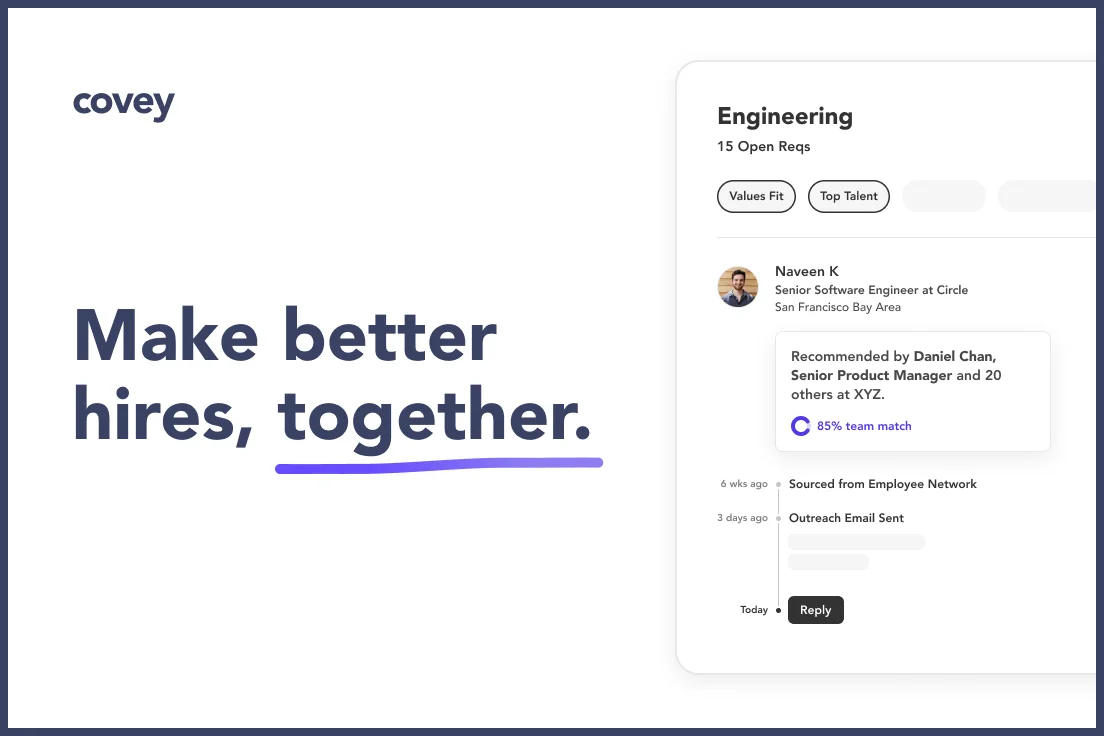
Covey AI Recruiting is an AI-native talent acquisition platform built for enterprise teams that need to scale hiring without scaling headcount. Its flagship product, Covey Scout, offers two integrated modules: Scout Inbound and Scout Outbound. Scout Inbound automatically screens inbound job applications using custom AI bots trained per open position. Recruiters describe their ideal candidate in plain language, and Covey's algorithms—powered by enterprise-grade large language models (LLMs) and natural language processing—evaluate profiles with human-like nuance, surfacing only the top 5% for review. The workflow integrates directly into existing ATS systems, enabling quick shortlisting and interview scheduling. Scout Outbound extends the same trained AI bots to proactively source candidates from a database of millions, then launches personalized outreach campaigns automatically. Key outcomes reported by enterprise customers include an 80% reduction in cost-per-hire, an 80% decrease in time-to-hire, and a 90% improvement in inbound pipeline efficiency. Customers like Deel, DoorDash, and Engine have used Covey to dramatically reduce recruiter screening time, increase inbound hire rates, and improve candidate NPS scores. Covey also features an AI-Trained Org Glossary that builds a shared hiring language across teams, compounding in accuracy over time. The platform is designed to keep human recruiters in the strategic decision-making role while offloading repetitive screening and sourcing work to AI.
Key Features
- Scout Inbound – AI Applicant Screening: Trains a custom AI bot per open role that evaluates every inbound application and surfaces the top 5% of candidates, reducing manual review by up to 90%.
- Scout Outbound – AI Candidate Sourcing: Extends the same trained AI bots to proactively search and engage millions of candidate profiles, then launches personalized outreach campaigns automatically.
- Enterprise-Grade LLM Evaluation: Uses large language models and NLP to assess candidate profiles with human-like nuance, ensuring evaluations reflect each company's unique hiring criteria.
- ATS Integration & Workflow Automation: Seamlessly integrates with existing applicant tracking systems to enable quick shortlisting and interview scheduling within the recruiter's current workflow.
- AI-Trained Org Glossary: Builds a shared hiring language across the entire talent team that compounds in accuracy with each use, ensuring consistent and calibrated candidate evaluations.
Use Cases
- Enterprise talent teams managing high-volume inbound applications who need to quickly identify the top 5% of candidates without manual screening.
- Recruiting teams struggling to find niche or hard-to-fill candidates who need AI-powered outbound sourcing across millions of profiles.
- Companies looking to scale monthly hires without growing the recruiting headcount, by automating repetitive screening and sourcing tasks.
- HR leaders who want to standardize and calibrate hiring criteria across a distributed recruiting team using a shared AI-trained org glossary.
- Recruiters seeking to improve candidate experience and NPS scores by reducing time-to-response and focusing human attention on qualified finalists.
Pros
- Dramatic efficiency gains: Customers report up to 90% reduction in screening time and 80% drops in both cost-per-hire and time-to-hire, with proven results at companies like Deel and DoorDash.
- Human-like AI nuance: Custom bots trained on each company's specific criteria evaluate candidates with the contextual judgment of an experienced recruiter, not just keyword matching.
- Unified inbound and outbound recruiting: A single trained bot can power both inbound screening and outbound sourcing, compounding value from any AI configuration investment.
- ATS-native workflow: Integrates directly into existing ATS platforms so recruiters don't need to change their core tools or processes.
Cons
- Enterprise-only pricing: Covey is positioned as an enterprise product with no publicly listed pricing, making it inaccessible or unclear for smaller teams and startups.
- Requires onboarding and calibration: Getting the AI bots to perform at their best requires an upfront investment in training and defining role-specific criteria, which takes time and internal alignment.
- Limited public transparency on integrations: Specific ATS integrations and third-party compatibility details are not fully disclosed on the public-facing site, requiring a sales conversation to confirm fit.
Frequently Asked Questions
What is the difference between Scout Inbound and Scout Outbound?
Scout Inbound screens candidates who have already applied to your open roles, surfacing the top 5% for recruiter review. Scout Outbound uses the same trained AI bot to proactively search millions of external candidate profiles and send personalized outreach campaigns.
How does Covey train its AI bots?
Recruiters describe their ideal candidate in plain language. Covey's algorithms—powered by enterprise-grade LLMs—learn from this input and the company's hiring history to evaluate profiles with human-like nuance. The AI also improves through the Org Glossary, which compounds accuracy as the team uses the platform.
Does Covey integrate with my existing ATS?
Yes. Covey Scout is designed to integrate with existing applicant tracking systems, embedding shortlisting and scheduling actions directly into your current workflow.
What kind of results can enterprise teams expect?
Based on published customer outcomes, teams have reported an 80% reduction in cost-per-hire, an 80% decrease in time-to-hire, a 90% increase in inbound pipeline efficiency, and recruiter screening time reductions of up to 90%.
Is Covey suitable for smaller companies or startups?
Covey is built and positioned specifically for enterprise talent teams with high-volume hiring needs. Smaller companies or startups may find the platform over-engineered for their needs or face pricing barriers, as it is an enterprise product.