
About
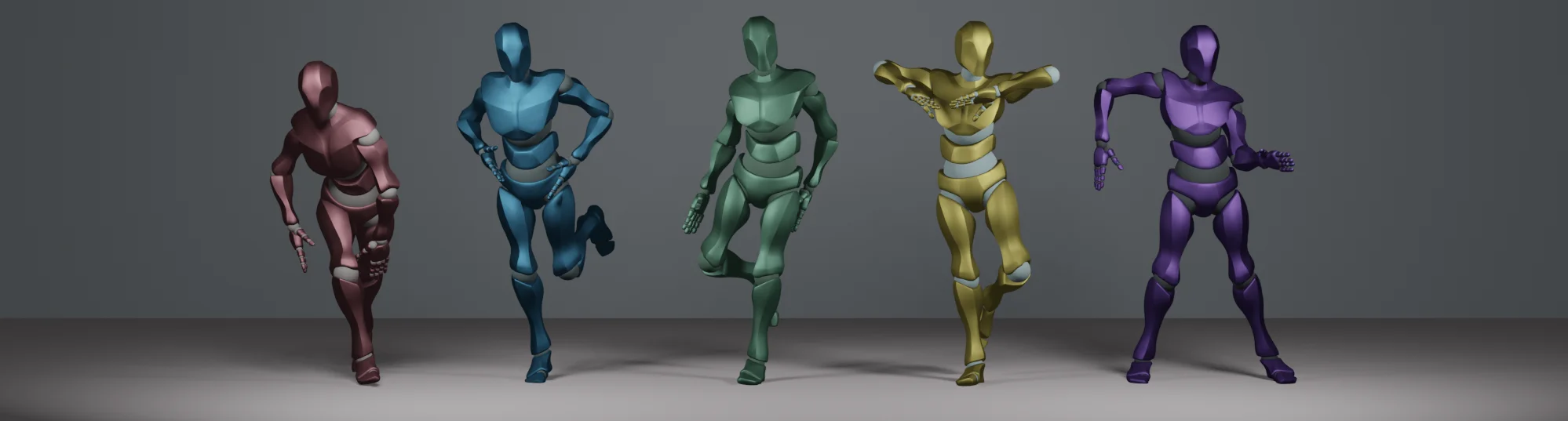
EDGE is a cutting-edge research system from Stanford University, presented at CVPR 2023, that automatically generates realistic and physically plausible dance choreographies from any music track. At its core, EDGE combines a transformer-based diffusion model with Jukebox — a powerful music feature extractor — enabling the system to deeply understand music and translate it into fluid, high-quality movement. What sets EDGE apart from previous approaches like Bailando and FACT is its extensive editing capability. Users can impose joint-wise spatial constraints (e.g., generate lower-body movement given upper-body motion, or vice versa), apply temporal constraints for motion in-betweening and dance continuation, and extend dances to arbitrary lengths by enforcing temporal continuity across batches of 5-second clips. EDGE also prioritizes physical realism through its novel Contact Consistency Loss, which teaches the model when feet should and shouldn't slide — a critical factor for believable dance. Human evaluations show that raters strongly prefer EDGE-generated dances over those from competing methods. Ideal for researchers in computer vision, animation, and generative AI, as well as developers building creative tools around music-driven motion synthesis, EDGE provides an open-source foundation for exploring AI choreography, virtual character animation, and interactive music visualization.
Key Features
- Music-Conditioned Dance Synthesis: Leverages Jukebox music embeddings to understand a wide range of music styles and generate synchronized, high-quality choreographies even for unseen tracks.
- Joint-Wise Spatial Constraints: Supports generating upper-body motion from lower-body input or vice versa, enabling fine-grained control over individual body parts during dance creation.
- Temporal Editing (In-Betweening & Continuation): Allows users to specify start and/or end poses and have the model fill in the motion, or continue a dance from a given initial sequence.
- Arbitrary-Length Dance Generation: Though trained on 5-second clips, EDGE can produce dances of any length by applying temporal consistency constraints across batches of sequences.
- Physical Plausibility via Contact Consistency Loss: A custom training loss that teaches the model to distinguish intentional sliding from foot-skating artifacts, yielding more realistic foot-ground contact.
Use Cases
- Researchers exploring music-conditioned motion synthesis and generative AI for human animation.
- Game developers and animators using AI to prototype character dance sequences from custom music tracks.
- Music video creators generating AI choreography to visualize new songs or soundtracks.
- Virtual reality and metaverse developers building interactive avatars that dance responsively to live or recorded music.
- Academic labs benchmarking new dance generation or motion synthesis models against a strong CVPR baseline.
Pros
- Strong Editing Capabilities: Offers spatial and temporal constraints that go far beyond simple music-to-dance generation, giving users precise creative control.
- Physically Realistic Output: The Contact Consistency Loss significantly reduces unnatural foot sliding, producing dances that look believable in real-world physics.
- Open Source & Research-Backed: Published at top-tier venue CVPR 2023 with code available, making it accessible for researchers and developers to build upon.
- Human-Preferred Results: Human evaluators strongly prefer EDGE-generated dances over those from prior state-of-the-art methods like Bailando and FACT.
Cons
- Research Prototype: As an academic project, EDGE lacks a polished user interface or production-ready deployment pipeline, requiring technical expertise to set up and use.
- Limited to Human Dance Motions: The model is trained on human dance datasets and may not generalize well to non-humanoid characters or highly unconventional movement styles.
- Compute-Intensive Inference: Diffusion models and the Jukebox encoder are resource-heavy, requiring significant GPU compute for generating and editing dance sequences.
Frequently Asked Questions
What is EDGE and how does it work?
EDGE (Editable Dance Generation from Music) is a transformer-based diffusion model that takes music as input and generates realistic dance choreographies. It uses Jukebox to encode music into feature embeddings, then maps those embeddings to sequences of human body poses.
Can EDGE generate dances for any song?
Yes. EDGE uses the powerful Jukebox model to extract broad musical features, allowing it to generate choreographies for a wide variety of music genres and even previously unseen 'in-the-wild' tracks.
What kinds of edits can I make to generated dances?
EDGE supports joint-wise constraints (e.g., fix upper body, generate lower body), temporal constraints like in-betweening (specify start and end poses) and continuation (specify only the start pose), and arbitrary-length generation by stitching sequences together.
Is EDGE open source?
Yes. EDGE was published at CVPR 2023 and its code is publicly available on GitHub, enabling researchers and developers to use, modify, and build upon the system.
How does EDGE handle physical realism in generated dances?
EDGE is trained with a Contact Consistency Loss that teaches the model when feet should contact the ground versus slide intentionally, significantly reducing unnatural foot-skating artifacts common in other dance generation methods.