

About
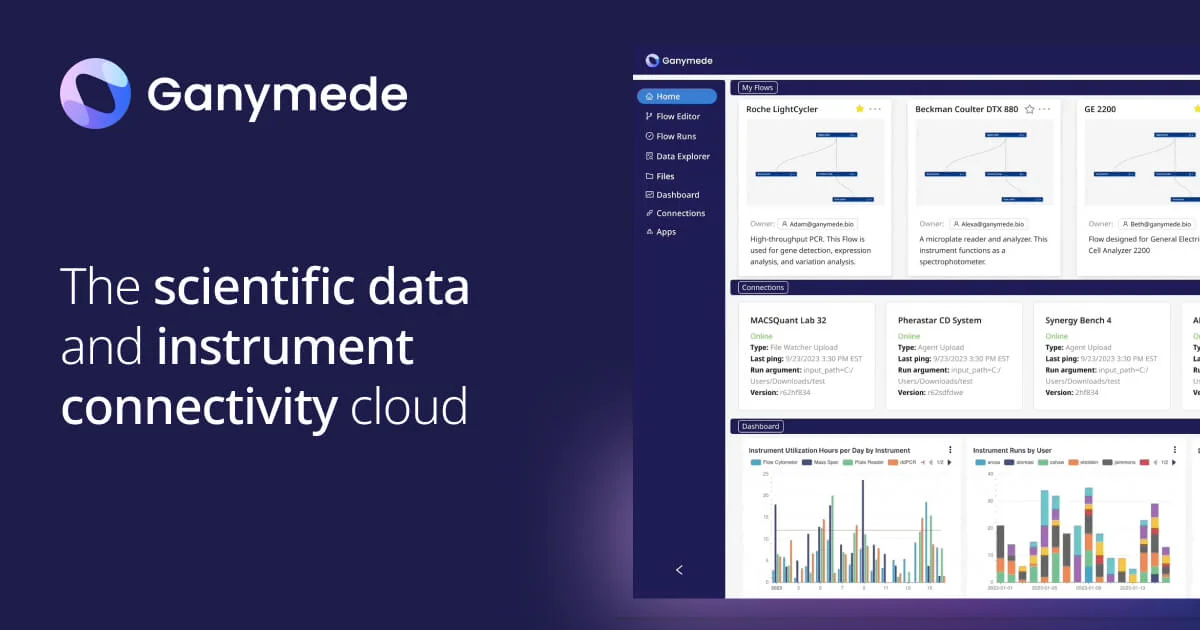
Ganymede Bio is an enterprise-grade, modular platform built for life science and biotech labs that need to unify fragmented instrument data, automate repetitive analysis, and accelerate scientific decision-making. By connecting to hundreds of lab instruments, ELNs, LIMS, MES, and third-party apps through pre-built and custom connectors, Ganymede creates a single FAIR (Findable, Accessible, Interoperable, Reusable) data layer across wet and dry lab operations. At its core, Ganymede uses a Lab-as-Code paradigm — scientists and developers can write automation pipelines directly against integrated data using a flow-based web IDE. Results can be automatically written back into ELNs or LIMS with no manual intervention. Modular Analysis tools allow teams to configure, adapt, and scale analytical workflows — including curve fitting, peak finding, cross-batch modeling, and DOE — without heavy IT involvement. Ganymede targets multiple scientific disciplines: biologics, cell and gene therapies, small molecules, and synthetic biology. It supports roles from bench scientists automating data capture to IT teams managing lab data infrastructure and leaders seeking data-driven insights. GxP-compliant infrastructure makes it suitable for regulated environments. Customers have reported saving 2,500+ hours annually through AI-powered automation and achieving 2-month faster bioprocess scale-up. Now part of Apprentice.io, Ganymede continues to expand its AI-native capabilities for labs scaling from R&D to commercial production.
Key Features
- Universal Instrument Connectivity: Hundreds of pre-built connectors plus custom connector tooling allow Ganymede to integrate with virtually any lab instrument, ELN, LIMS, MES, or third-party app.
- Lab-as-Code Automation: A flow-based web IDE lets scientists and developers write automated data capture and analysis pipelines that push results directly into ELNs or LIMS — no manual steps required.
- Modular Analysis: Configurable analytical modules covering curve fitting, peak finding, cross-batch modeling, DOE, and more can be adapted and scaled without heavy IT involvement.
- Unified FAIR Data Layer: All wet and dry lab data is standardized into a single FAIR-compliant repository, enabling cross-instrument, cross-workflow, and AI-driven insights.
- GxP-Ready Infrastructure: Built with security and compliance in mind, Ganymede supports regulated lab environments with GxP-compliant data handling and audit trails.
Use Cases
- Automating data capture and result writing from bioreactors and analyzers into an ELN for a cell therapy bioprocess team, reducing manual entry errors and accelerating scale-up timelines.
- Building cross-batch chromatography models and control charts by unifying data from multiple HPLC systems into a single analytical pipeline.
- Streamlining plate-based assay workflows (ELISA, qPCR) with automated curve fitting and meta-analysis to increase throughput and reduce analyst bottlenecks.
- Providing IT and data engineering teams with a governed lab data infrastructure layer that ensures FAIR data compliance across all instruments and software systems.
- Enabling AI readiness assessments and AI-powered analysis (e.g., automated peak finding) for analytical chemistry teams looking to reduce manual review hours.
Pros
- Significant Time Savings: Customers report saving 2,500+ hours annually through automated peak finding and data capture, and achieving 2-month faster bioprocess scale-ups.
- Flexible, Modular Architecture: The platform is designed to scale from a single workflow to an entire lab operation, with modules that can be added or swapped without re-engineering the stack.
- Broad Scientific Coverage: Supports diverse scientific disciplines — biologics, cell & gene therapy, small molecules, synthetic biology — making it versatile across an organization's R&D portfolio.
- AI-Ready by Design: Clean, unified data pipelines and integrated AI tooling (including AI-powered peak finding) position labs to adopt AI/ML capabilities without data infrastructure overhaul.
Cons
- Enterprise Pricing: As an enterprise lab platform, Ganymede is likely cost-prohibitive for small independent labs, academic researchers, or early-stage startups with limited budgets.
- Requires Technical Setup: While Lab-as-Code reduces ongoing IT burden, initial onboarding and custom connector development may still require developer or data engineering resources.
- Niche Audience: The platform is purpose-built for life science and biotech labs, making it unsuitable for general-purpose data or workflow automation outside of scientific R&D environments.
Frequently Asked Questions
What types of lab instruments does Ganymede connect to?
Ganymede offers hundreds of pre-built connectors for common lab instruments including bioreactors, chromatography systems, liquid handlers, plate readers, qPCR machines, and analyzers. Custom connectors can also be built using Ganymede's connectivity tooling.
Is Ganymede suitable for GxP or regulated environments?
Yes. Ganymede is designed with GxP-compliant infrastructure, making it appropriate for regulated biopharma and life science environments that require audit trails and data integrity controls.
What is Lab-as-Code?
Lab-as-Code is Ganymede's approach to automating lab data workflows using code-based pipelines. Scientists and developers write automation logic in a flow-based web IDE that captures data from instruments and writes results directly into ELNs, LIMS, or other systems — eliminating manual data entry.
How does Ganymede support AI adoption in labs?
By standardizing and unifying all lab data into a FAIR data layer, Ganymede creates the clean, structured datasets necessary for AI and ML models to function reliably. The platform also integrates AI tools (e.g., AI-powered peak finding) directly into analysis workflows.
What scientific workflows does Ganymede support?
Ganymede supports bioprocess (upstream/downstream processing), chromatography, plate-based assays (ELISA, qPCR), and broader workflows for biologics, cell and gene therapies, small molecules, and synthetic biology.