

About
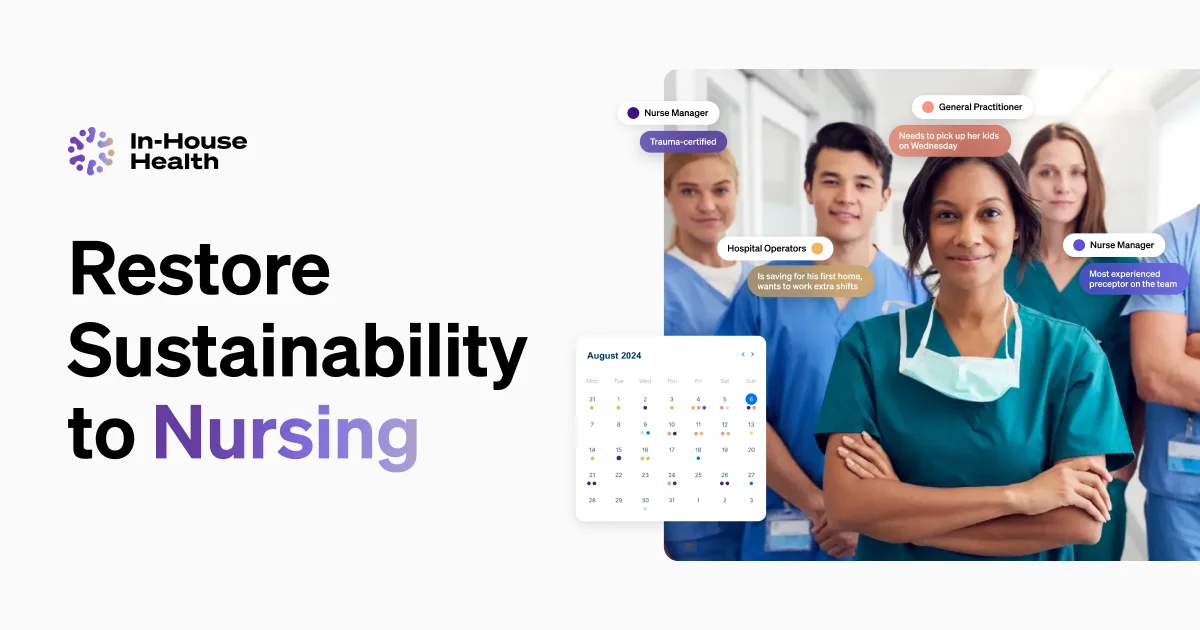
In-House Health is an enterprise-grade AI scheduling platform purpose-built for clinical nursing teams. It addresses the growing complexity of nurse workforce management by combining predictive automation with end-to-end scheduling tools that serve everyone from the CNO to bedside nurses. At its core, In-House uses shift-level census and acuity prediction to automatically adjust schedules based on patient workload, skill mix, and union or regulatory requirements. The platform can function as a standalone end-to-end scheduling solution or layer on top of an existing base scheduling system as an AI automation engine. Key capabilities include self-scheduling and shift assignment communications, payroll reconciliation, executive-level dashboarding, and integrated float pool assignment. An AI 'copilot' assists managers in redesigning schedules in real time, balancing staffing models that span PRN, float, travel, and per diem workers. In-House serves four main personas: CNOs who need facility-wide real-time visibility, unit managers who must enforce scheduling rules fairly, central scheduling coordinators managing multiple facilities, and direct care nurses who want transparency and flexibility over their own shifts. The platform is designed to be implemented in as little as four weeks, with immediate budget impact. It is particularly valuable for health systems navigating challenges like virtual nursing, new care roles, and the ongoing clinical workforce capacity crisis.
Key Features
- Predictive Shift Scheduling: AI automatically adjusts schedules based on shift-level census and acuity predictions, accounting for patient workload, skill mix, and union or regulatory requirements.
- AI Schedule Copilot: An intelligent assistant helps managers redesign schedules in real time, balancing complex staffing models including PRN, float, travel, and per diem workers.
- Self-Scheduling & Communications: Enables nurses to self-schedule shifts with automated assignment communications and end-of-period payroll reconciliation.
- Float Pool & Facility Management: Executive dashboards provide real-time visibility into staffing across all units, with integrated float pool assignment to fill gaps efficiently.
- Flexible Deployment: Can be deployed as a full end-to-end scheduling solution or layered on top of an existing scheduling system as an AI automation layer.
Use Cases
- A Chief Nursing Officer monitors real-time staffing performance across all facility units, enabling informed budget and scheduling discussions without waiting for monthly reports.
- A unit manager for a Med/Surg floor automatically enforces scheduling rules—such as requiring 2 nights and 1 weekend per cycle per nurse—across the entire team in minutes.
- A central scheduling coordinator manages self-scheduling timelines and payroll reconciliation for three facilities simultaneously from a single dashboard.
- A bedside ICU nurse flags her availability preferences and picks up extra shifts that match her schedule, gaining flexibility and transparency over her own work-life balance.
- A hospital system reduces reliance on expensive travel nurses by optimizing internal float pool assignments and proactively filling coverage gaps with predictive census data.
Pros
- Significant Cost Savings: Organizations report up to $270K in cost savings per unit per year and a 31% improvement in shifts completed at budget.
- Fast Time to Value: Implementation takes as little as four weeks with immediate budget impact, making it practical even for resource-constrained healthcare organizations.
- Serves All Stakeholders: Designed for every level—from CNOs needing enterprise dashboards to bedside nurses wanting shift transparency—ensuring organization-wide adoption.
Cons
- Enterprise-Only Pricing: As a paid enterprise platform, In-House Health may be cost-prohibitive for smaller independent clinics or outpatient facilities with limited budgets.
- Healthcare-Specific Focus: The platform is built exclusively for nursing and clinical teams, making it unsuitable for workforce scheduling needs outside of healthcare settings.
Frequently Asked Questions
What types of healthcare facilities does In-House Health support?
In-House Health serves hospitals and skilled nursing facilities. It supports nursing teams at all levels, including unit-based teams, central staffing coordinators, and executive nursing leadership.
Can In-House Health integrate with our existing scheduling system?
Yes. In-House can function as an AI automation layer on top of an existing base scheduling system, or it can serve as a complete end-to-end scheduling solution—whichever fits your organization's needs.
How long does it take to implement In-House Health?
Implementation typically takes around four weeks, and the platform is designed to deliver immediate budget impact from the start.
How does In-House Health handle complex staffing models?
The platform balances multiple staffing models simultaneously—including PRN, float, travel, and per diem workers—while factoring in certifications, union rules, overtime, and regulatory requirements.
What measurable results do users see with In-House Health?
Users report an average of $270K in cost savings per unit per year, 5.5 hours saved per manager per week, and a 31% improvement in shifts completed at budget.