
About
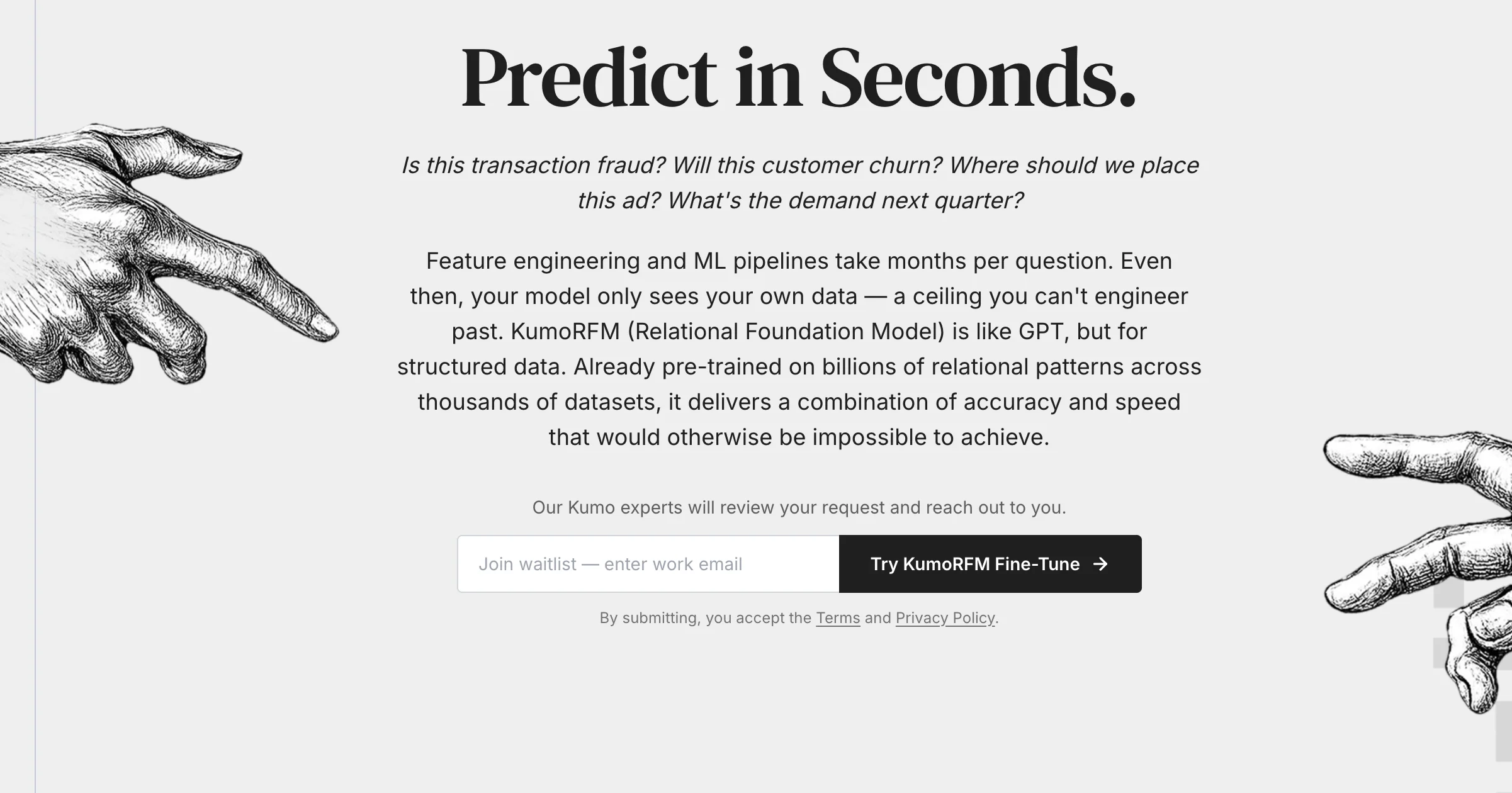
Kumo AI is the first foundation model platform designed specifically for relational enterprise data. It enables organizations to build and run predictive AI models directly on top of their data warehouse without setting up complex ML pipelines. Kumo offers two core products: the Relational Foundation Model (RFM), a free-to-start zero-shot engine that answers ad-hoc predictive questions in natural language, and an Enterprise tier that supports custom, fine-tuned models at unlimited scale with enterprise-grade governance and production readiness. With Kumo, users simply point the platform at their warehouse, ask predictive questions in plain English, and receive explainable, transparent answers backed by pretrained tabular foundation models. Predictions can then be pushed back to downstream tools and platforms via Reverse ETL to trigger real-time business actions. The platform supports fine-tuning for domain-specific accuracy, robust security controls, and deep explainability features. Kumo serves a wide range of industries including Retail & CPG (personalization, operational efficiency), Financial Services (risk and customer value), and Media (hyper-personalized engagement). Notable customers like Reddit have achieved record-breaking ad performance lifts using Kumo's graph embeddings. It is ideal for data teams, business analysts, and enterprises looking to democratize predictive AI without heavy ML investment.
Key Features
- Relational Foundation Model (RFM): A pretrained tabular foundation model that delivers zero-shot predictions from structured business data — no ML experience or data preparation needed.
- Natural Language Predictive Queries: Business users can ask predictive questions in plain English and receive reliable, explainable answers directly from their warehouse data.
- Direct Data Warehouse Integration: Connect Kumo directly to your existing data warehouse with no complex pipeline setup, enabling fast prototyping and production deployments.
- Reverse ETL & Real-Time Action: Push predictions back to downstream tools and platforms instantly to trigger automated, data-driven business actions.
- Enterprise-Grade Fine-Tuning & Governance: Fine-tune models for domain-specific accuracy while maintaining security, explainability, and enterprise governance controls at unlimited scale.
Use Cases
- Retail teams predicting customer churn, lifetime value, or product demand directly from their transactional warehouse data.
- Financial services firms building risk scoring and customer segmentation models without a dedicated ML engineering team.
- Media and ad platforms improving ad targeting accuracy using graph-based embeddings and predictive audience models.
- Business analysts asking natural language predictive questions against enterprise data for fast, ad-hoc decision support.
- Data teams fine-tuning foundation models on proprietary datasets to achieve domain-specific prediction accuracy at production scale.
Pros
- No ML Expertise Required: Business users can get predictive AI answers without data science skills, removing the traditional barrier to enterprise ML adoption.
- Fast Time to Value: Kumo claims custom predictive models can be built 20x faster than traditional methods, with a free-to-start RFM tier for immediate exploration.
- Explainable Predictions: Built-in explainability features provide transparent reasoning behind predictions, building trust with business stakeholders.
- Proven at Scale: Trusted by major companies like Reddit, delivering record-breaking performance lifts on real production workloads.
Cons
- Enterprise Pricing Opacity: Detailed pricing for the Enterprise tier is not publicly listed, requiring a sales conversation before committing.
- Focused on Relational/Tabular Data: The platform is purpose-built for structured relational data and may not support unstructured data types like documents or images.
- Warehouse Dependency: Requires an existing data warehouse setup; teams without cloud data infrastructure may need to build foundational data pipelines first.
Frequently Asked Questions
What data sources does Kumo connect to?
Kumo connects directly to your existing data warehouse. It is designed to work with relational, structured business data with no complex pipeline setup required.
Do I need machine learning experience to use Kumo?
No. Kumo's Relational Foundation Model allows business users to ask predictive questions in natural language and get answers without any ML expertise or data preparation.
Is Kumo secure for enterprise data?
Yes. Kumo offers enterprise-grade security and governance controls, making it suitable for production deployments with sensitive business data.
How is Kumo priced?
Kumo offers a free-to-start Relational Foundation Model (RFM) tier for ad-hoc questions and fast prototyping. The Enterprise tier, which includes custom model building and unlimited scale, requires contacting sales for pricing.
How does Kumo differ from building ML models in-house?
Kumo enables custom predictive models to be built 20x faster than traditional in-house methods by eliminating the need for ML pipelines, data engineering, and specialized data science teams.