

About
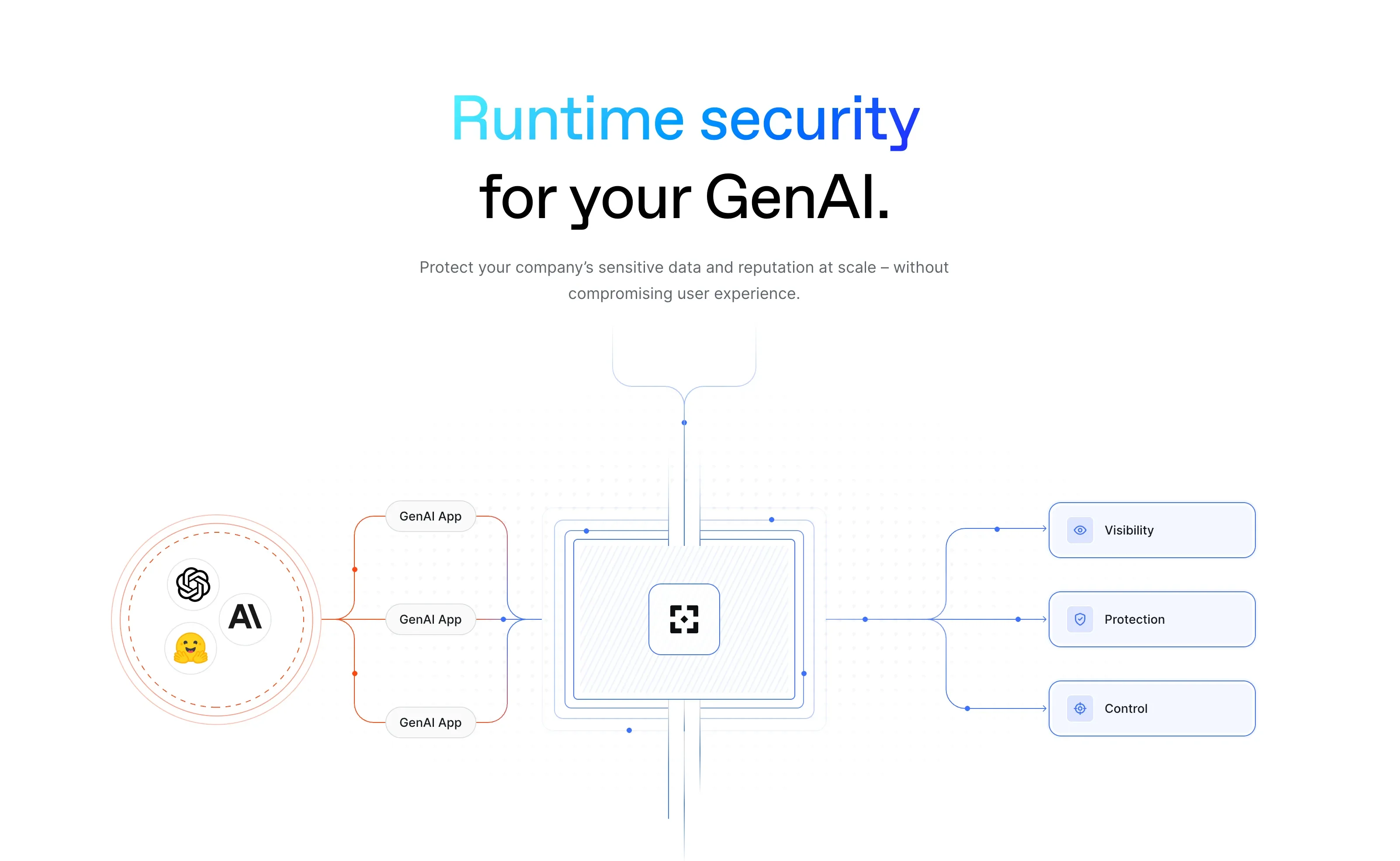
Lakera Guard is a runtime security solution purpose-built for generative AI applications, LLM pipelines, and agentic systems. As AI adoption accelerates across enterprises, Lakera Guard addresses the unique threats that traditional security tools miss — including prompt injection, indirect prompt injection, sensitive data exposure, toxic content generation, and multilingual or multimodal adversarial attacks. The platform connects to your GenAI stack via a single API, enabling real-time inspection and filtering of both inputs and outputs across all AI interactions. It provides continuous visibility into GenAI usage patterns and risks, allowing security teams to detect anomalies and enforce policies without adding latency or degrading the end-user experience. Lakera Guard supports a wide range of deployment patterns: conversational agents, document and RAG-based agents, enterprise GenAI gateways, and interconnected multi-agent systems. Its risk coverage spans prompt injection, data leakage, compliance and regulatory violations, and content safety. Beyond runtime protection, Lakera offers AI Red Teaming services for proactive risk assessment, and Gandalf — an interactive AI security training tool for organizations. A growing library of security guides, implementation docs, and a 1,000+ member Slack community (Momentum) makes it a comprehensive resource hub for AI security practitioners. Lakera Guard is ideal for security engineers, platform teams, and enterprises deploying LLMs in production who need robust, low-friction security tooling for their GenAI infrastructure.
Key Features
- Prompt Injection Defense: Detects and blocks both direct and indirect prompt injection attacks in real time, preventing adversarial inputs from hijacking LLM behavior.
- AI Data Leak Prevention: Monitors GenAI inputs and outputs to identify and suppress sensitive data exposure, protecting PII, credentials, and confidential business information.
- Runtime Visibility & Monitoring: Provides continuous observability into all GenAI usage across your organization, surfacing risk patterns and enabling proactive policy enforcement.
- Broad Risk Coverage: Handles toxic content generation, multilingual and multimodal attacks, and compliance & regulatory risks — all in a single integrated security layer.
- Single API Integration: Connects to any GenAI pipeline through one API call, making it straightforward to add enterprise-grade security to existing LLM applications without major refactoring.
Use Cases
- Securing production LLM chatbots and virtual assistants from prompt injection attacks that could manipulate responses or extract system prompts.
- Protecting RAG-based document agents from leaking confidential enterprise data stored in knowledge bases through crafted user queries.
- Enforcing AI content policies and compliance controls on enterprise GenAI gateway traffic to meet regulatory requirements.
- Monitoring employee-facing AI tools to detect and prevent misuse, data exfiltration, or policy violations in real time.
- Conducting AI red teaming and proactive risk assessments for LLM applications before and after production deployment.
Pros
- Frictionless Integration: A single API integration makes it easy to add security to existing LLM stacks without significant architectural changes or performance overhead.
- Comprehensive Threat Coverage: Addresses a wide spectrum of GenAI-specific risks — from prompt injection and data leaks to content safety and regulatory compliance — in one platform.
- Agent-Aware Security: Natively supports agentic architectures including RAG pipelines, conversational agents, and connected multi-agent systems, which many traditional tools don't cover.
- Free Tier Available: Offers a no-cost starting point, lowering the barrier for developers and smaller teams to evaluate and adopt AI security tooling.
Cons
- Limited Public Pricing Transparency: Advanced enterprise features and full pricing details require booking a demo or contacting sales, making cost estimation difficult upfront.
- Enterprise-Oriented Complexity: The platform's breadth and enterprise focus may be more than necessary for small projects or individual developers with simple GenAI deployments.
- Cloud-Dependent Runtime: As an API-based runtime security layer, organizations with strict data residency or air-gapped environments may face deployment constraints.
Frequently Asked Questions
What is Lakera Guard?
Lakera Guard is a real-time runtime security platform for generative AI applications and agents. It protects against threats like prompt injection, AI data leaks, toxic content, and compliance violations by sitting between your application and LLM via a single API.
How does prompt injection protection work?
Lakera Guard analyzes user inputs and model outputs in real time, identifying patterns consistent with prompt injection attempts — both direct (from end users) and indirect (from external data sources like documents or web content). Detected attacks are flagged or blocked before they can manipulate the LLM's behavior.
What types of AI risks does Lakera Guard address?
The platform covers prompt injection, indirect prompt injection, AI data leaks, toxic content generation, multilingual and multimodal adversarial attacks, and compliance & regulatory risks — providing a comprehensive security layer for production GenAI systems.
How do I integrate Lakera Guard into my application?
Integration is done via a single API. You route your LLM requests through Lakera Guard's endpoint, which inspects and filters inputs and outputs in real time. Implementation guides and documentation are available in the developer resources section.
Is there a free plan available?
Yes, Lakera Guard offers a free tier to get started. Larger-scale enterprise deployments with advanced features and SLA support are available through paid plans, which can be explored by booking a demo.