
About
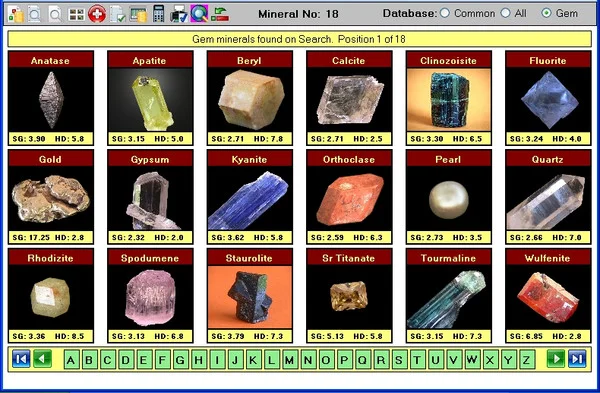
Mineral Search Software is a comprehensive Windows desktop tool designed for mineral identification, research, and collection management. Developed by Mineralab, it provides access to a rich database of 700 minerals — each documented with up to 20 properties including Specific Gravity, Hardness, Refractive Index, Birefringence, Dispersion, Color, Streak, Luster, Crystal System, Chemical Formula, Mineral Group, and Locale. The Property Search engine allows users to filter across any combination of these characteristics, making it far more powerful than a simple keyword lookup. Complementary tools include a photographic Browser that displays 18 minerals at a time in a slide-show format, a Name Search covering 600+ primary and 1,000+ related mineral names, and configurable subdatabases (all 700 minerals, 300 common minerals, or 110 gem minerals). For serious users, the software supports custom additions: collectors can add their own photographs for uncommon minerals, append personal notes or optical data, and even add entirely new minerals to the database. The built-in Catalog module lets users document their collections by species, specimen name, ID number, color, size, locality, acquisition date, cost, and value — complete with label printing and export. An interactive Periodic Table is included for reference. Mineral Search is ideal for mineralogists, gemologists, educators, rockhounds, and gem dealers who need a dependable offline tool for identification and collection management. It runs on Windows XP through 10 and requires Microsoft .NET 3.5 or later. Distributed as a digital download at a one-time price of $72.
Key Features
- Multi-Property Search Engine: Search across any combination of 20 mineral properties — including Specific Gravity, Hardness, Refractive Index, Color, Streak, Luster, Crystal System, and Chemical Formula — for precise mineral identification.
- Photographic Browser: Browse 18 minerals at a time in a slide-show-style photographic display, or navigate directly to any mineral with a single click using the quick-access Browser panel.
- Flexible Subdatabases: Choose to work with all 700 minerals, narrow down to the 300 most common, or focus exclusively on the 110 gem minerals — each sortable by Dana Number or alphabetically.
- Collection Cataloging Module: Document your mineral collection with fields for species, specimen name, ID number, color, size, habit, locality, cost, value, and acquisition details. Includes label printing and data export.
- User-Extensible Database: Add custom minerals, personal notes, additional optical data, and your own photographs to extend the database beyond its built-in 700 entries.
Use Cases
- A geology student uses the property search to identify an unknown mineral specimen by entering its measured hardness, specific gravity, and streak color.
- A gem dealer uses the 110 gem mineral subdatabase to look up refractive index and birefringence data when grading stones for customers.
- A mineral collector catalogs their entire collection using the built-in Catalog module, tracking locality, acquisition cost, and estimated value for insurance purposes.
- A science teacher uses the photographic browser and interactive Periodic Table as a visual reference tool during classroom lessons on mineralogy.
- A professional mineralogist extends the database by adding rare minerals from fieldwork, attaching personal photographs and optical measurements to each new entry.
Pros
- Comprehensive Mineral Coverage: With 700 minerals and 20 documented properties each, the database covers the vast majority of minerals encountered by collectors, students, and professionals.
- Powerful Targeted Search: The property-based search is highly customized for mineralogy rather than being a generic text search, making identification fast and accurate.
- All-in-One Tool: Combines mineral identification, reference browsing, collection cataloging, and an interactive Periodic Table in a single offline desktop application.
- Extensible & Customizable: Users can add minerals, notes, and photos — making the software adaptable for gemologists and advanced mineralogists with specialized data needs.
Cons
- Windows Only: The software runs exclusively on Windows XP through 10, with no support for macOS, Linux, or mobile platforms.
- Dated Interface & Technology: Designed for 800×600 screen resolution and dependent on Microsoft .NET 3.5, the application's design and technical requirements feel outdated on modern hardware.
- No Cloud or Collaboration Features: As a standalone desktop app, it lacks cloud sync, online sharing, or multi-user collaboration capabilities.
Frequently Asked Questions
How many minerals are included in Mineral Search Software?
The database contains 700 minerals in total. Users can also work with a subdatabase of the 300 most common minerals or the 110 gem minerals for more focused searches.
What properties can I use to search for a mineral?
You can search by any combination of Specific Gravity, Hardness, Conductivity, Refractive Index, Birefringence, Dispersion, Color, Streak, Luster, Crystal System, Chemical Formula, Mineral Group, Locale, and more — 20 properties in all.
Can I add my own minerals or photos to the database?
Yes. The software allows you to add new minerals, attach your own photographs to existing entries, and append personal notes or additional optical data to any mineral record.
What are the system requirements?
Mineral Search Software requires a Windows PC (XP, 7, 8, or 10), Microsoft .NET 3.5 Framework or later, an internet connection for the initial download, and at least 120 MB of free hard disk space. It is optimized for 800×600 screen resolution.
Does the software include a collection management tool?
Yes. The built-in Catalog module lets you document your mineral collection by photograph, species, specimen name, ID number, color, size, habit, locality, cost, value, and acquisition date. It also includes a search tool, collection valuation sum, and label export.