
About
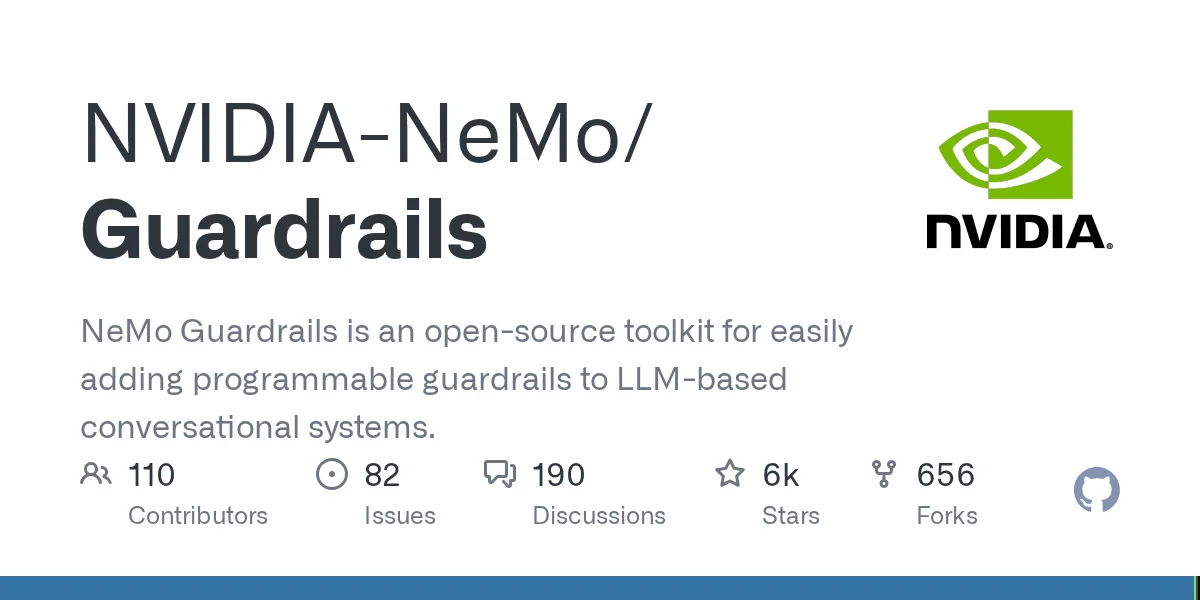
NeMo Guardrails is an open-source framework developed by NVIDIA designed to give developers fine-grained, programmable control over the behavior of LLM-based conversational applications. Rather than relying solely on prompt engineering, NeMo Guardrails introduces a structured approach to AI safety and alignment through a custom scripting language called Colang, which enables developers to define topical guardrails (keeping conversations on-topic), safety rails (preventing harmful or undesirable outputs), and dialog management flows. The toolkit integrates with a wide range of LLM backends including OpenAI, Hugging Face, and NVIDIA's own models, making it highly flexible for both research and production use cases. It supports multi-layered guardrail configurations including input rails (validating user inputs before they reach the model), output rails (filtering model responses), and retrieval rails (governing RAG pipelines). NeMo Guardrails is particularly suited for enterprises building AI assistants, customer support bots, or any application where controllability, compliance, and safety are critical requirements. With 6,000+ GitHub stars and an Apache 2.0 license, it is actively maintained with strong community support. It also includes a VSCode extension for authoring Colang files and a built-in chat UI for testing guardrail configurations.
Key Features
- Colang DSL for Guardrail Authoring: A purpose-built domain-specific language that lets developers declaratively define conversation flows, topical boundaries, and safety rules without modifying the underlying LLM.
- Multi-Layer Rail System: Supports input rails, output rails, and retrieval rails to intercept and govern LLM interactions at every stage of the conversational pipeline.
- Broad LLM Provider Compatibility: Integrates with OpenAI, Hugging Face, NVIDIA NIM, and other LLM backends, allowing guardrails to be applied regardless of the underlying model.
- RAG Pipeline Guardrails: Provides dedicated retrieval rails for securing and controlling Retrieval-Augmented Generation pipelines, preventing off-topic or unsafe retrieved content from influencing responses.
- VSCode Extension & Chat UI: Includes a VSCode extension for authoring Colang configuration files and a built-in chat interface for rapidly testing and iterating on guardrail setups.
Use Cases
- Restricting enterprise chatbots to approved topics and preventing off-brand or off-topic conversations.
- Adding safety and content moderation layers to customer-facing AI assistants in regulated industries like healthcare and finance.
- Securing RAG-based knowledge base bots to ensure only vetted, on-policy information is surfaced to users.
- Building compliance-ready AI applications that require auditable, configurable safety controls for enterprise governance.
- Rapid prototyping and testing of LLM conversation safety policies using the built-in chat UI and VSCode extension.
Pros
- Truly Open Source (Apache 2.0): Fully permissive license allows commercial use, modification, and distribution with no lock-in — backed by NVIDIA with active maintenance and a large community.
- Declarative, Readable Configuration: Colang makes guardrail logic easy to read, audit, and update compared to embedding safety logic directly in prompts or application code.
- Comprehensive Safety Coverage: Covers the full request-response lifecycle with input, output, and retrieval rails, providing defense-in-depth for production AI applications.
- Provider-Agnostic Design: Works with virtually any major LLM provider, reducing migration risk and enabling teams to swap models without rewriting safety logic.
Cons
- Steep Learning Curve for Colang: Teams must learn the Colang DSL to author guardrails effectively, which adds onboarding overhead especially for non-developer stakeholders.
- Added Latency: Guardrail evaluation introduces additional inference calls and processing steps that can meaningfully increase response latency in production deployments.
- Developer-Only Audience: There is no no-code or low-code interface; implementation requires Python development skills and familiarity with LLM application architecture.
Frequently Asked Questions
What is NeMo Guardrails?
NeMo Guardrails is an open-source Python toolkit by NVIDIA that lets developers add programmable guardrails — topical, safety, and dialog-flow controls — to LLM-based conversational applications using a DSL called Colang.
What LLMs does NeMo Guardrails support?
It supports a wide range of LLM backends including OpenAI (GPT-4, etc.), Hugging Face models, NVIDIA NIM endpoints, and other providers through a flexible adapter system.
Is NeMo Guardrails free to use?
Yes. It is released under the Apache 2.0 open-source license, making it free for both personal and commercial use.
What is Colang?
Colang is NVIDIA's purpose-built domain-specific language for defining conversational guardrails. It lets developers specify allowed topics, forbidden responses, dialog flows, and safety rules in a readable, declarative syntax.
Can NeMo Guardrails be used with RAG pipelines?
Yes. NeMo Guardrails includes retrieval rails specifically designed to govern Retrieval-Augmented Generation pipelines, filtering retrieved context and ensuring it aligns with defined safety and topical policies.