

About
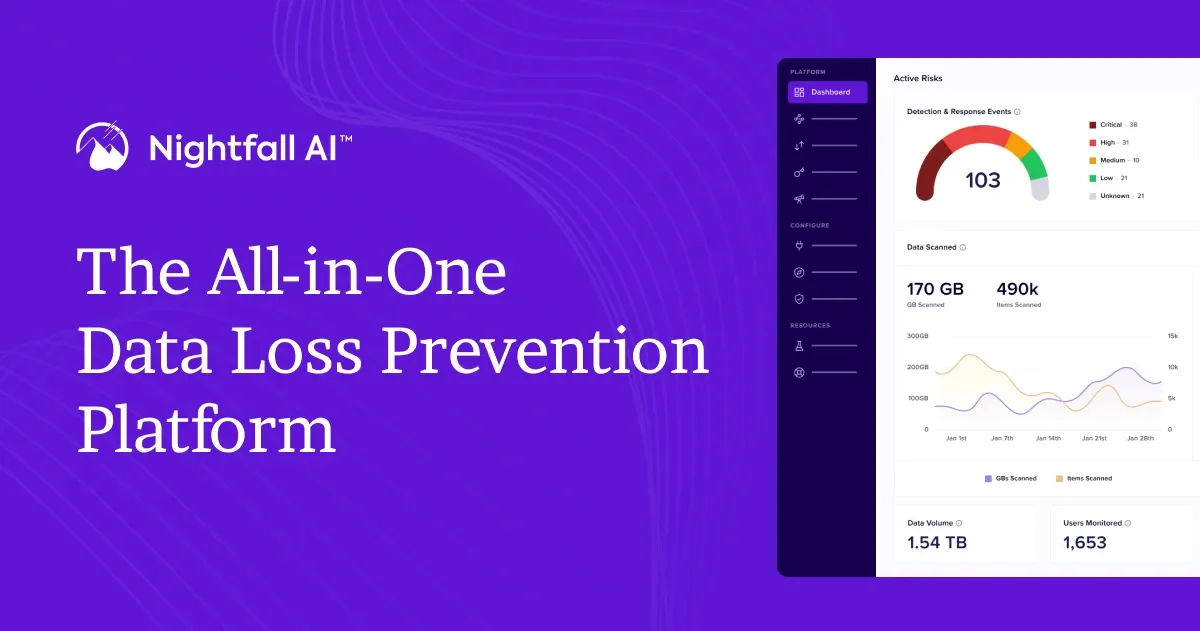
Nightfall AI DLP is a modern, AI-native data loss prevention platform built for the era of generative AI and cloud-first enterprises. Unlike legacy DLP solutions, Nightfall uses LLM and behavioral-powered models to deeply understand the sensitivity of content and trace data's full journey across your organization — from SaaS applications like Slack, Google Drive, and Microsoft 365 to AI tools, endpoints, and browsers. The platform offers four core capabilities: Data Exfiltration Prevention (DEX) to track and block sensitive data from leaving via managed or unmanaged devices; Data Detection & Response (DDR) to automatically stop real-time sharing of sensitive data across SaaS and generative AI apps; Data Discovery & Classification (DDC) to find and remediate historical sensitive data exposure at rest; and Nyx, an autonomous AI DLP analyst agent that investigates incidents, reasons with business context, and intervenes before data gets exposed. Nightfall also provides MCP and AI Agent Security controls, giving security teams visibility into what data AI agents access and expose. Deployment is frictionless with API-based integrations and lightweight browser plugins that go live in minutes. Intelligent, self-learning policies minimize false positives and avoid blocking legitimate business workflows. Nightfall serves organizations ranging from fast-growing startups to Fortune 500 enterprises across healthcare, financial services, legal, technology, and manufacturing industries.
Key Features
- Data Exfiltration Prevention (DEX): Traces and blocks sensitive data from leaving the organization across both managed and unmanaged devices, including via AI prompts, file uploads, email, and removable media.
- Data Detection & Response (DDR): Automatically detects and stops real-time sensitive data sharing — including NHIs, PHI, PCI, and PII — across SaaS and generative AI applications the moment it happens.
- Data Discovery & Classification (DDC): Scans and remediates years of sensitive data exposure at rest across SaaS and generative AI platforms, eliminating historical risk from over-permissioned sharing.
- Nyx — Autonomous DLP Analyst: An AI agent that acts as a 24/7 DLP analyst with investigative judgment, business context awareness, and the ability to intervene and shape employee behavior before data is exposed.
- MCP & AI Agent Security: Provides granular control over what data AI agents and MCP-connected tools can access and expose, securing the growing attack surface introduced by agentic AI workflows.
Use Cases
- Prevent employees and AI agents from leaking sensitive IP, credentials, or customer data via generative AI tools like ChatGPT, Gemini, or Claude through prompts, file uploads, or copy-paste.
- Automatically detect and remediate PII, PHI, and PCI data shared in collaboration tools like Slack, Microsoft Teams, or Google Drive in real time to maintain compliance with HIPAA, GDPR, and PCI-DSS.
- Discover and clean up years of over-permissioned or improperly shared sensitive files sitting at rest across SaaS platforms like Google Drive and OneDrive.
- Stop insider threats and accidental data exfiltration via endpoints, browsers, email clients, and removable media with full data lineage tracking.
- Secure AI agent workflows by controlling what data MCP-connected AI agents can access, process, and expose across enterprise environments.
Pros
- Holistic, unified coverage: Covers SaaS apps, generative AI apps, endpoints, and browsers in a single platform, eliminating the patchwork of point solutions and reducing blind spots.
- AI-native detection with deep context: LLM and behavioral-powered models understand the full context of sensitive content and its data lineage, delivering fewer false positives than rule-based legacy DLP tools.
- Fast, frictionless deployment: API-based integrations and lightweight browser plugins deploy in minutes, with self-learning policies that adapt over time without constant manual tuning.
- Autonomous incident response: The Nyx AI analyst reduces alert fatigue by autonomously investigating and remediating incidents, acting like a tireless expert analyst available around the clock.
Cons
- Enterprise-oriented pricing: Nightfall is positioned as an enterprise security platform, which may make it cost-prohibitive for very small businesses or individual users.
- Complexity for smaller security teams: The breadth of features and integrations, while comprehensive, may present a learning curve for organizations without a dedicated security operations team.
- Requires demo for pricing transparency: Pricing is not publicly listed and requires contacting sales, making it harder to quickly evaluate cost fit without engaging with the vendor.
Frequently Asked Questions
What is Nightfall AI DLP?
Nightfall AI DLP is an agentic, all-in-one data loss prevention and AI data security platform. It uses LLM-powered detection and autonomous AI agents to prevent data leaks, stop exfiltration, and protect sensitive data like PII, PHI, PCI, and NHIs across SaaS apps, generative AI tools, endpoints, and browsers.
Which applications and platforms does Nightfall integrate with?
Nightfall integrates with a wide range of platforms including Slack, Google Drive, Gmail, Microsoft Teams, OneDrive, SharePoint Online, Exchange Online, Salesforce, GitHub, Atlassian Jira, Confluence, Notion, Zendesk, and many more. It also covers endpoints and browsers via lightweight agents and browser plugins.
How is Nightfall different from traditional DLP solutions?
Traditional DLP tools rely on static rules and keyword matching, which struggle with modern AI-driven data flows. Nightfall uses LLM and behavioral models to understand content sensitivity in context, traces full data lineage, and includes autonomous AI agents for real-time remediation — capabilities legacy DLP platforms were never built to provide.
What is Nyx and how does it work?
Nyx is Nightfall's autonomous DLP analyst — an AI agent that continuously monitors data flows, investigates potential incidents with expert-level judgment, applies business context to prioritize risks, and intervenes automatically to prevent data exposure before it occurs. It functions as a 24/7 security analyst without human fatigue.
What types of sensitive data can Nightfall detect and protect?
Nightfall can detect and protect a broad range of sensitive data types including personally identifiable information (PII), protected health information (PHI), payment card industry data (PCI), non-human identities (NHIs) such as API keys and credentials, intellectual property, and other custom-defined sensitive content patterns.