

About
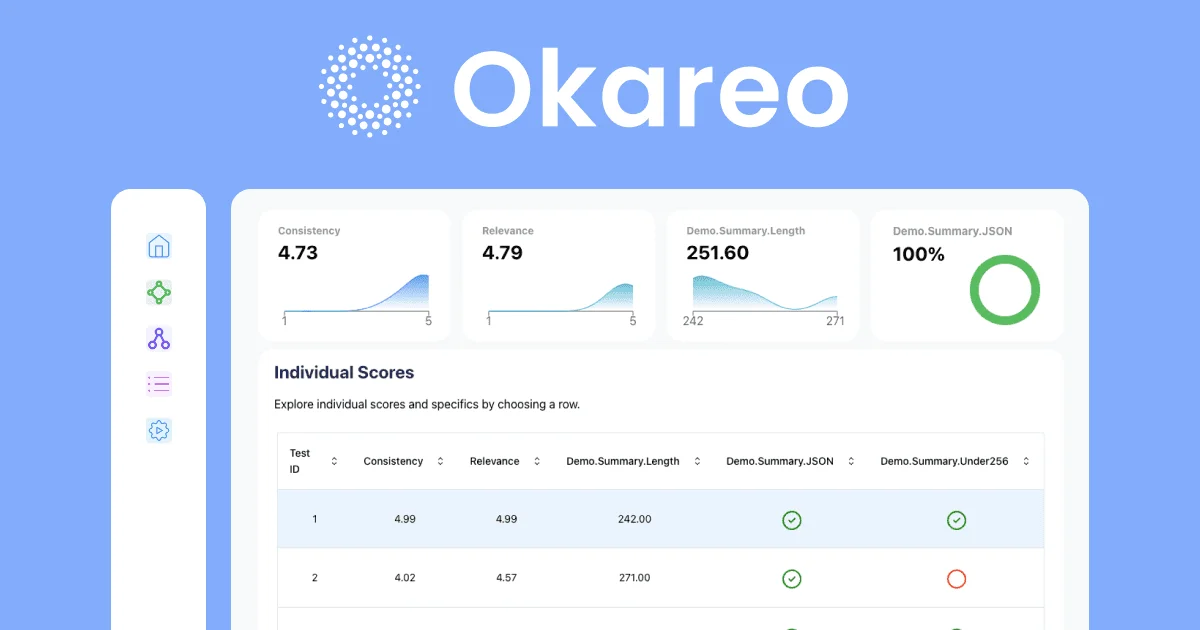
Okareo is a comprehensive AI product quality platform designed to help engineering and AI teams test, evaluate, observe, and fine-tune AI agents and LLM-powered features with confidence. At its core, Okareo enables teams to define synthetic users—called Drivers—that autonomously interact with multi-turn agents to surface unexpected behaviors, edge cases, and failure modes before real users ever encounter them. The platform builds a behavioral map of your agent across diverse scenarios, highlighting gaps, loops, and dead-ends so root causes can be fixed rather than symptoms chased. Okareo integrates directly into CI/CD workflows, allowing automated synthetic user simulations to run on every commit and replacing time-consuming manual QA with fast, repeatable test runs. Beyond pre-production testing, Okareo provides production guardrails and real-time monitoring to catch issues as they arise. When errors do occur in production, the platform pairs them with synthetic data generation to create new test cases and fine-tuning datasets, forming a closed loop that continuously strengthens guardrails and improves model accuracy. Okareo supports voice, text, and headless agent testing and works with existing AI stacks, making it suitable for teams building RAG systems, agentic AI applications, and MCP-based workflows. It is designed to scale from small teams to enterprise deployments, offering faster iteration cycles, full observability, and cost-efficient AI operations.
Key Features
- Synthetic User Simulation: Define goal-driven synthetic users (Drivers) that autonomously interact with multi-turn agents to expose unexpected behaviors and edge cases without manual QA.
- Agent Behavior Mapping: Automatically builds a visual map of your agent's behaviors across scenarios, surfacing gaps, loops, and dead-ends so teams can address root causes.
- CI/CD Evaluation Automation: Run synthetic user simulations on every commit to catch regressions early and ship AI agents with confidence through continuous automated evaluation.
- Production Guardrails & Monitoring: Real-time error tracking and observability in production, with automatic triggers to generate new test cases and fine-tuning data from live failures.
- Closed-Loop Fine-Tuning: Production issues automatically generate synthetic data and test cases to retrain or fine-tune models, creating a continuous improvement cycle.
Use Cases
- Testing multi-turn AI agents end-to-end with synthetic users before deploying to production, eliminating manual QA overhead.
- Integrating automated LLM evaluation into CI/CD pipelines to catch agent regressions and behavior changes on every commit.
- Monitoring production AI agents in real-time and automatically generating new test cases from live failures to close the improvement loop.
- Evaluating and improving RAG pipelines by simulating diverse user queries and measuring retrieval and response quality.
- Generating synthetic training data from production error patterns to fine-tune models and strengthen agent guardrails over time.
Pros
- Eliminates Manual QA Bottlenecks: Synthetic user simulation replaces hours of manual testing with fast, repeatable, automated runs that scale across every commit.
- Full-Stack AI Observability: Covers the entire lifecycle from pre-production testing to production monitoring and fine-tuning, giving teams end-to-end visibility.
- CI/CD Native: Seamless integration into existing deployment pipelines means evaluation is never an afterthought—it's built into every release.
- Supports Multiple Agent Types: Works with voice, text, and headless agents as well as RAG pipelines and MCP workflows, making it versatile for diverse AI stacks.
Cons
- Requires Setup Investment: Configuring synthetic users and integrating with existing CI/CD pipelines requires meaningful upfront effort, especially for complex agent architectures.
- Primarily Developer-Focused: The platform is built for technical teams; non-developers or product managers may face a steeper learning curve with its evaluation and fine-tuning features.
- Pricing Transparency: Full pricing details beyond the free tier are not readily visible, which may complicate budget planning for larger teams and enterprises.
Frequently Asked Questions
What are Drivers in Okareo?
Drivers are synthetic users you define with specific context, goals, and behaviors. They autonomously interact with your multi-turn AI agent during simulations to uncover unexpected behaviors and edge cases that manual testing might miss.
Can Okareo integrate with my existing CI/CD pipeline?
Yes. Okareo is designed to plug into CI/CD workflows, enabling automated synthetic user simulations to run on every code commit so regressions are caught before reaching production.
Does Okareo support RAG and agentic AI use cases?
Yes. Okareo explicitly supports RAG pipeline evaluation, agentic AI testing, and MCP-based workflows, making it suitable for a wide range of modern LLM application architectures.
How does Okareo help with fine-tuning?
When production issues are detected, Okareo pairs error tracking with synthetic data generation to automatically create new training examples and test cases that can be used to retrain or fine-tune your underlying models.
Is there a free tier available?
Yes. Okareo offers a free tier to get started. Teams can sign up and begin simulating users and evaluating agents without an upfront commitment, with paid plans available for larger-scale use.