

About
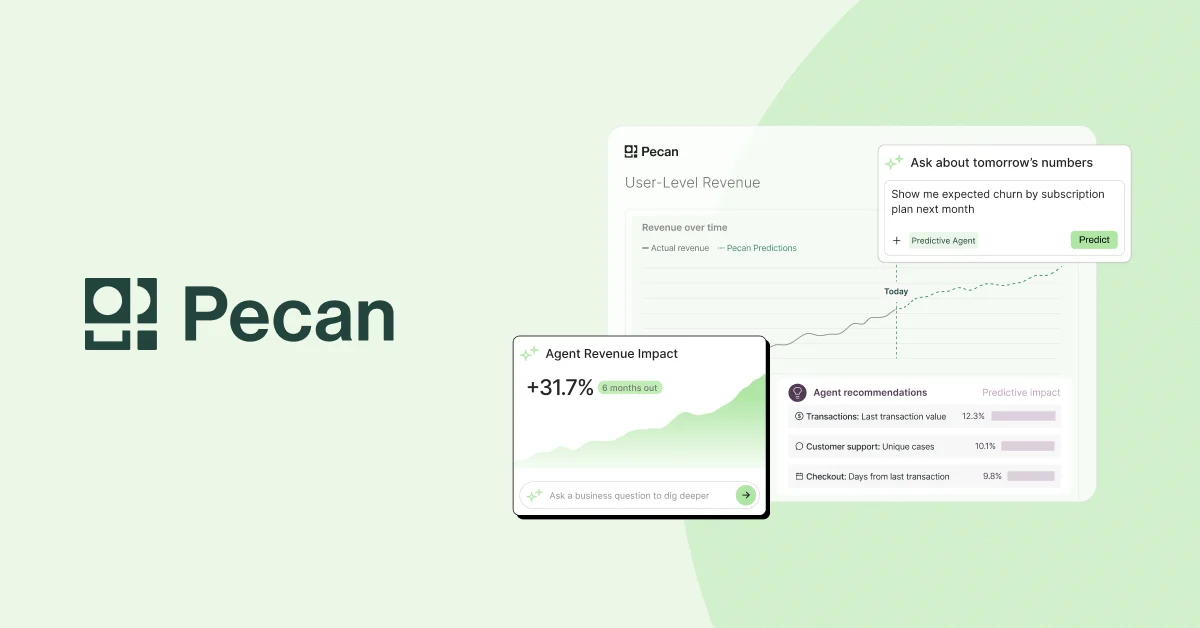
Pecan AI is a predictive analytics platform built for business teams that need reliable predictions without deep data science resources. Its core capability is a conversational predictive AI agent: users ask a business question in plain language, and Pecan automatically understands the data, defines the prediction target, prepares the data pipeline, builds and validates the model, and delivers results — all without manual workflows or SQL expertise. The platform covers a wide range of business-critical use cases out of the box, including customer churn prediction, lifetime value (LTV) modeling, lead scoring, demand forecasting, upsell and cross-sell opportunity identification, customer winback, fraud and chargeback prevention, and campaign ROAS prediction. Pecan integrates directly with existing data sources and warehouses, meaning teams don't need to move or restructure their data before getting started. According to Pecan's reported customer outcomes, teams using the platform have achieved a 12% average reduction in customer churn, 15% improvement in marketing ROAS, 25% reduction in inventory costs, and 90% of predictions delivered without data science support. The tool is trusted by brands in ecommerce, retail, fintech, and subscription businesses. Pecan is especially suited for data analysts, marketing operations teams, and business leaders who need to act on forward-looking insights without waiting on a data science team.
Key Features
- Conversational Predictive AI Agent: Ask a business question in plain language and Pecan's AI agent automatically defines the prediction target, prepares data, builds, and validates the model — no SQL or data science required.
- Pre-Built Prediction Use Cases: Covers eight core business prediction scenarios out of the box: churn, LTV, lead scoring, demand forecasting, upsell/cross-sell, customer winback, fraud prevention, and campaign ROAS.
- No-Code Model Building: Business analysts and marketing teams can build and deploy predictive models without writing code or relying on a data science team, cutting time-to-prediction from months to minutes.
- Native Data Integrations: Connects directly to existing data sources and cloud data warehouses so teams can start predicting from their current data stack without complex data migration.
- Business Outcome Metrics: Delivers predictions tied to measurable business results such as reduced churn rates, improved ROAS, and lower inventory costs, not just model accuracy scores.
Use Cases
- A subscription ecommerce brand uses Pecan to predict which customers are likely to churn in the next 30 days and proactively sends targeted retention offers.
- A marketing team forecasts campaign ROAS 24–48 hours after launch to reallocate budget from underperforming ads to likely winners before wasted spend accumulates.
- A retail operations team predicts future inventory demand using historical sales and seasonal trends to optimize stock levels and reduce inventory costs by 25%.
- A B2B SaaS company scores inbound leads by conversion likelihood so sales reps prioritize outreach toward the highest-value prospects first.
- A fintech company scores each transaction for fraud risk in real time, automatically flagging suspicious activity for review and reducing false positives.
Pros
- Truly No-Code for Business Users: The conversational interface means non-technical stakeholders can run predictive models independently, reducing bottlenecks on data science teams.
- Wide Range of Pre-Built Use Cases: Ready-to-use prediction templates for the most common business scenarios accelerate time-to-value and reduce setup effort.
- Proven Business Impact: Customer-reported outcomes including 12% churn reduction and 15% ROAS improvement demonstrate real ROI from adoption.
Cons
- Enterprise-Focused Pricing: Pecan is positioned as a premium enterprise solution with demo-based sales, making it potentially inaccessible for smaller teams or early-stage startups.
- Limited Customization for Data Scientists: Teams that want granular control over model architecture, hyperparameter tuning, or custom feature engineering may find the abstracted no-code approach restrictive.
Frequently Asked Questions
Do I need coding skills to use Pecan AI?
No. Pecan is designed for business and data teams without data science backgrounds. Its conversational AI agent handles data preparation, model building, and validation automatically.
What types of predictions can Pecan AI make?
Pecan supports customer churn prediction, lifetime value (LTV) modeling, lead scoring, demand forecasting, upsell and cross-sell identification, customer winback, fraud and chargeback prevention, and campaign ROAS prediction.
How does Pecan connect to my existing data?
Pecan integrates directly with your existing data sources and cloud data warehouses, so no data migration or restructuring is required before you begin building models.
How long does it take to get a prediction?
According to Pecan, teams can go from a business question to a reliable prediction in minutes, compared to the weeks or months traditional model development requires.
Who is Pecan AI best suited for?
Pecan is built for data analysts, marketing operations teams, ecommerce businesses, and business leaders who need predictive insights without depending on a dedicated data science function.