
About
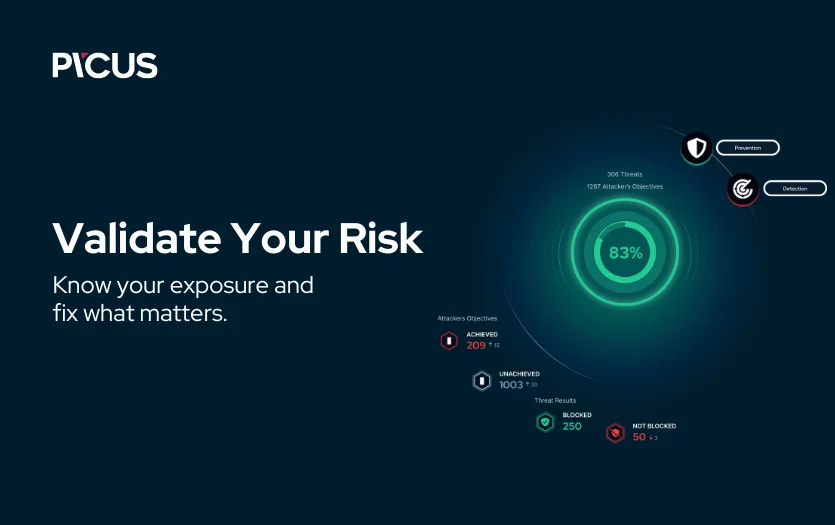
Picus Security is a comprehensive automated security validation platform designed for enterprise security teams seeking to continuously measure and improve their cyber defenses. At its core, the platform consolidates siloed security data through Picus Fabric & Knowledge Graph, correlating disparate signals into a unified risk view that drives smarter decision-making. The platform spans the full validation lifecycle: Exposure Assessment surfaces vulnerabilities and misconfigurations across external and internal attack surfaces (EASM and CAASM); Security Control Validation (SCV) and Detection Rule Validation (DRV) confirm that preventive and detective controls actually work; and Exposure Validation (EXV) confirms which findings are genuinely exploitable in a customer's specific environment. Attack Path Validation (APV) and Cloud Security Validation (CSV) extend coverage to lateral movement scenarios and cloud-native infrastructure. Numi AI, Picus's embedded intelligence engine, interprets contextual data to guide prioritization and remediation decisions—reducing high/critical severity backlogs by up to 86% according to analysis of over 100 million anonymized exposure records. One-click auto-remediation and third-party integrations accelerate mean time to remediate. Picus supports major compliance frameworks including MITRE ATT&CK, NIST CSF, HIPAA, and DORA, making it well-suited for regulated industries such as healthcare, financial services, and IT/OT environments. It is used by security operations, red and blue teams, and risk management professionals to operationalize continuous threat exposure management (CTEM).
Key Features
- Exposure Assessment & Validation: Discovers, evaluates, and prioritizes vulnerabilities and misconfigurations across EASM and CAASM, then confirms which exposures are genuinely exploitable in your environment.
- Security Control Validation: Tests preventive and detective security controls—including detection rules—to verify they block, detect, and respond to real-world attack techniques effectively.
- Attack Path & Cloud Security Validation: Maps and validates lateral movement attack paths and cloud-native security gaps so teams understand how adversaries could traverse their infrastructure.
- Numi AI Intelligence Engine: An embedded AI layer that interprets security data, connects contextual signals across the platform, and recommends smarter validation and remediation actions.
- One-Click Auto-Remediation: Provides actionable, one-click mitigation steps and integrates with third-party tools to accelerate remediation and shrink the window of exposure.
Use Cases
- Continuous Threat Exposure Management (CTEM): Security teams use Picus to maintain ongoing visibility into exploitable exposures and continuously validate controls rather than relying on point-in-time assessments.
- SOC Optimization: Security Operations Centers leverage Detection Rule Validation to confirm their SIEM and EDR rules actually fire on live attack techniques, reducing blind spots and improving mean time to detect.
- Automated Penetration Testing: Red teams and pentesters use Picus to automate routine attack simulations across the environment, freeing skilled analysts for complex, manual engagements.
- Cloud Security Posture Validation: Cloud and DevSecOps teams validate cloud-native security configurations and controls to ensure misconfigurations can't be weaponized by attackers.
- Regulatory Compliance Assurance: Compliance officers in healthcare and financial services use Picus to map security control effectiveness to HIPAA, DORA, and NIST CSF requirements, generating evidence for audits.
Pros
- Noise Reduction at Scale: Deprioritizes 98% of theoretical vulnerabilities and reduces high/critical severity backlogs by up to 86%, letting teams focus effort where it matters most.
- Unified Platform Coverage: Combines EASM, CAASM, breach and attack simulation, automated pentesting, and cloud validation into a single cohesive workflow, eliminating tool sprawl.
- Compliance Framework Support: Out-of-the-box alignment with MITRE ATT&CK, NIST CSF, HIPAA, and DORA simplifies audit readiness for regulated industries.
- AI-Driven Prioritization: Numi AI continuously interprets live data to surface the highest-risk, most-exploitable threats, reducing manual analyst triage time.
Cons
- Enterprise Pricing: The platform is tailored to enterprise-scale organizations, which likely places it out of reach for smaller teams or startups with limited security budgets.
- Integration Setup Complexity: Fully leveraging the Picus Fabric & Knowledge Graph across siloed tools and data sources requires upfront integration work and ongoing maintenance.
- Learning Curve: The breadth of modules—EXV, APV, SCV, DRV, CSV—means new users may need time and training (e.g., Purple Academy) to use the platform to its full potential.
Frequently Asked Questions
What is Picus Security?
Picus Security is an automated security validation platform that continuously tests an organization's security controls, validates which vulnerabilities are truly exploitable, and provides one-click remediation to close gaps before attackers can exploit them.
What is Breach and Attack Simulation (BAS)?
BAS is the practice of safely simulating real-world cyberattacks against your environment to measure how well your existing controls—firewalls, EDR, SIEM—detect and block threats. Picus pioneered BAS and integrates it into its broader validation platform.
How does Picus reduce vulnerability overload?
Picus uses its Exposure Validation module and Numi AI to confirm which discovered exposures are actually exploitable in your specific environment, allowing teams to deprioritize the ~98% of theoretical findings and focus only on the ~2% of genuine risks.
What compliance frameworks does Picus support?
Picus supports major frameworks including MITRE ATT&CK, NIST Cybersecurity Framework (CSF), HIPAA, and the Digital Operational Resiliency Act (DORA), making it suitable for healthcare, finance, and other regulated industries.
Is a free trial available?
Yes, Picus offers a free trial that allows organizations to explore the platform's capabilities before committing to a paid plan. A demo can also be requested directly from the website.