
About
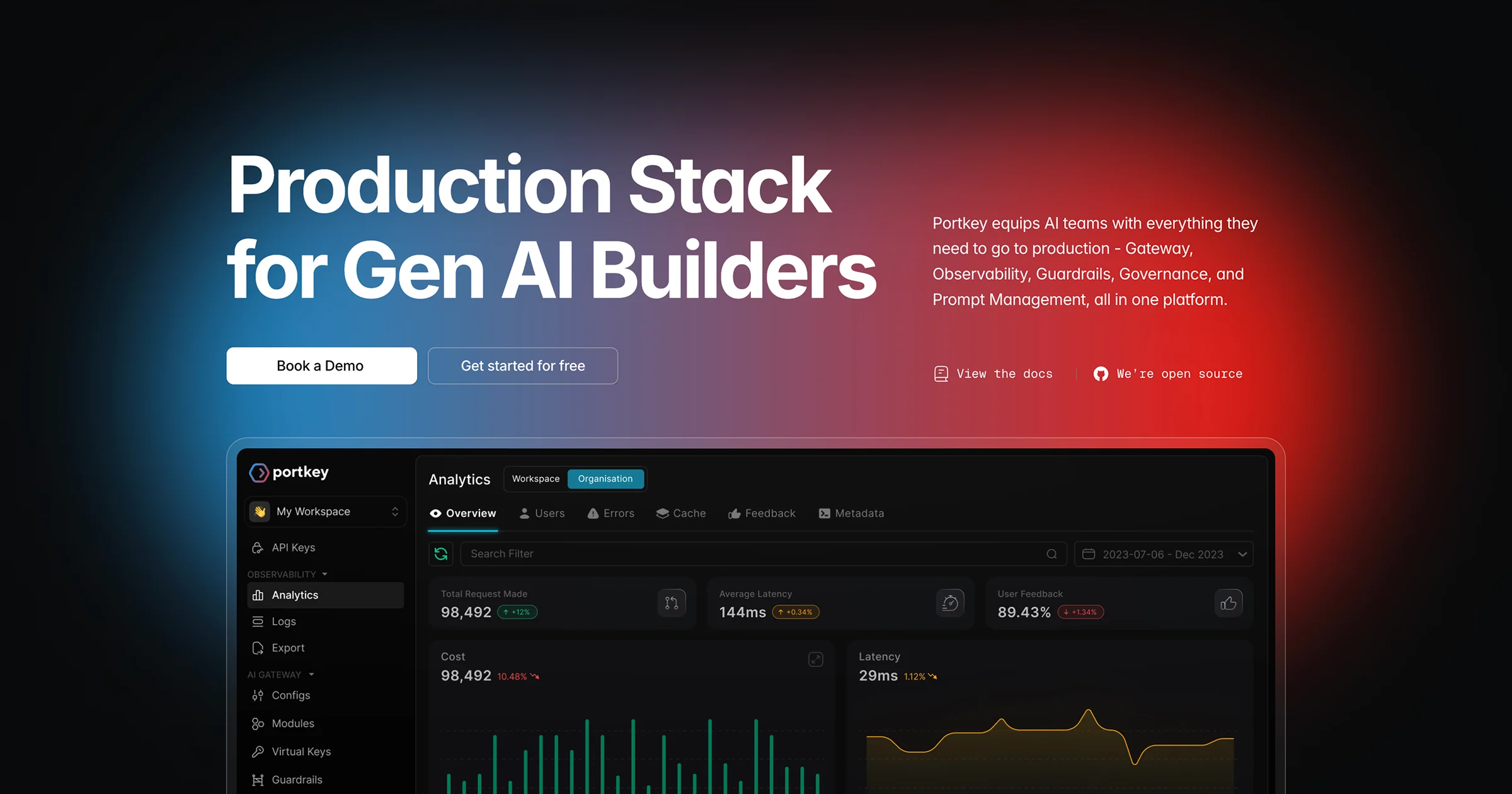
Portkey is a comprehensive production stack built for AI engineering teams who need to ship reliable, cost-effective LLM-powered applications at scale. At its core is the AI Gateway, which provides a single, unified API endpoint to access more than 1,600 large language models — eliminating the integration overhead of managing multiple provider SDKs. Beyond routing, Portkey layers in a full suite of production essentials: real-time observability dashboards to monitor LLM behavior and catch anomalies early; configurable guardrails to keep AI outputs safe and on-policy; governance controls to manage access, budgets, and usage across teams; and a visual prompt management module for versioning and testing prompts. Intelligent caching significantly reduces redundant API calls, delivering measurable cost savings — users report saving thousands of dollars on repeated LLM calls. Portkey is open source, offering transparency and extensibility for teams that want to self-host or contribute. It integrates seamlessly into existing workflows with drop-in compatibility for the OpenAI SDK, making adoption straightforward. Whether you are a startup experimenting with AI or an enterprise running billions of tokens daily, Portkey provides the reliability, visibility, and control needed to move confidently from prototype to production.
Key Features
- Unified AI Gateway: Access 1,600+ LLMs from a single API endpoint, removing the need to manage multiple provider integrations and SDKs.
- Real-Time Observability: Monitor LLM behavior, track token usage, catch anomalies early, and manage costs proactively through a live dashboard.
- Guardrails & Governance: Enforce output safety policies, manage team-level access controls, and set budget limits to keep AI deployments compliant and on-policy.
- Intelligent Caching: Cache repeated LLM responses to dramatically reduce API costs and latency, with users reporting thousands of dollars saved.
- Prompt Management: Version, test, and collaborate on prompts visually without code deployments, keeping prompt iteration fast and organized.
Use Cases
- Enterprise AI teams managing multiple LLM providers who need a unified gateway to simplify integrations, control costs, and enforce usage policies across departments.
- AI startups building LLM-powered products who need production-grade observability and guardrails to monitor and safeguard model outputs before launch.
- DevOps and ML engineering teams embedding LLM calls in CI/CD pipelines who want to use caching to avoid repeated API costs on unchanged test suites.
- Platform teams setting up internal AI governance, defining budget limits and access controls so different business units can use AI safely and within approved boundaries.
- Prompt engineers and product teams who need a visual prompt management system to version, A/B test, and iterate on prompts without requiring code deployments.
Pros
- Massive Model Coverage: Supports 1,600+ LLMs through one unified API, giving teams the flexibility to swap or combine models without re-engineering integrations.
- Open Source & Transparent: The core gateway is open source, allowing teams to audit, self-host, or extend the platform to fit their security and compliance requirements.
- Proven Cost Savings: Built-in caching and usage monitoring help teams cut LLM spending significantly, with a clear and demonstrable ROI from day one.
- Drop-In Compatibility: Works as a drop-in replacement for the OpenAI SDK, making adoption fast with minimal code changes for existing projects.
Cons
- Complexity for Simple Use Cases: Teams with a single LLM provider and basic needs may find Portkey's full feature set more than necessary for their scale.
- Self-Hosting Requires DevOps Effort: While open source, running a self-hosted instance at scale demands infrastructure expertise and ongoing maintenance.
- Pricing Scales With Usage: Higher token volumes and advanced enterprise features may push costs up, requiring careful planning for large-scale deployments.
Frequently Asked Questions
What is Portkey AI Gateway?
Portkey AI Gateway is an open-source AI infrastructure platform that provides a unified API to access 1,600+ LLMs, alongside observability, guardrails, prompt management, and governance tools for production AI applications.
Is Portkey open source?
Yes, Portkey is open source. The core AI gateway is available on GitHub, and teams can self-host it or use the managed cloud version.
How does Portkey save money on LLM API costs?
Portkey includes intelligent caching that stores and reuses identical or similar LLM responses, preventing redundant API calls and significantly reducing token spend — particularly valuable for testing and CI/CD workflows.
Which LLM providers does Portkey support?
Portkey supports 1,600+ models across all major providers including OpenAI, Anthropic, Google, Mistral, Cohere, and many more, accessible through a single unified API.
How easy is it to integrate Portkey into an existing project?
Very straightforward — Portkey is drop-in compatible with the OpenAI SDK. You typically just change your base URL and API key, and your existing code starts routing through Portkey with minimal modifications.