

About
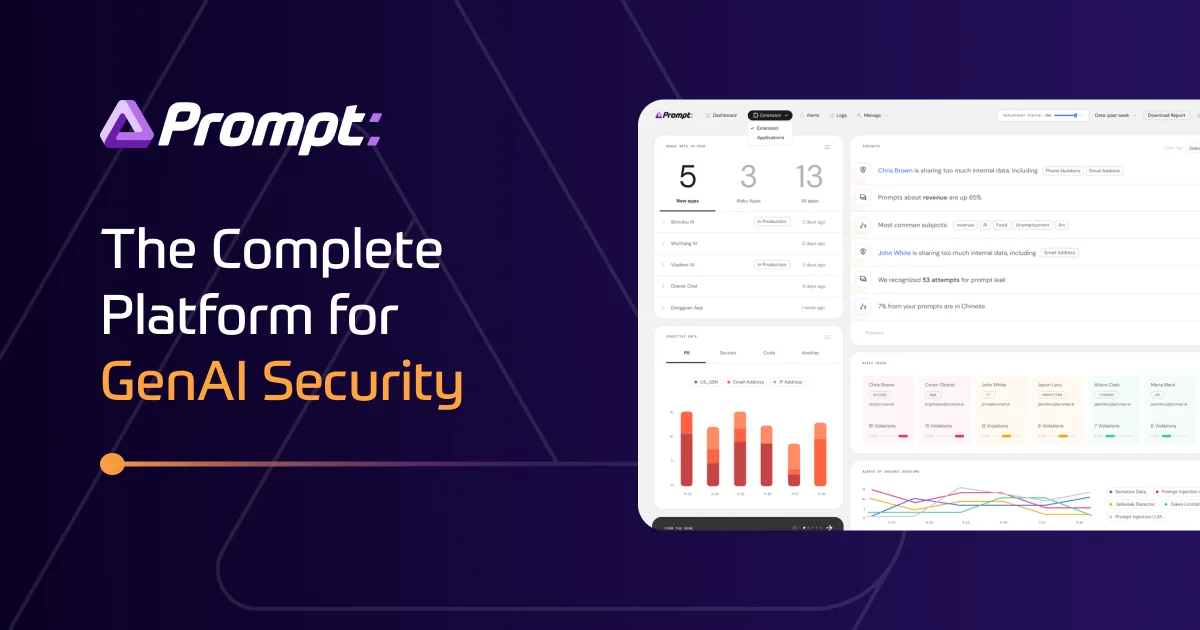
Prompt Security is a comprehensive AI security platform designed to help enterprises safely adopt and govern generative AI across every touchpoint. Built by core members of the OWASP AI security research team, the platform addresses a wide range of AI-specific threats including prompt injection, indirect prompt injection, data privacy leaks, jailbreaks, shadow AI, privilege escalation, and toxic or harmful LLM outputs. The platform offers four primary use-case pillars: securing employee AI tool usage (providing visibility, governance, and policy enforcement over tools like ChatGPT and Copilot); protecting homegrown LLM applications from prompt attacks and data exfiltration; ensuring safe adoption of AI code assistants like GitHub Copilot; and monitoring and governing agentic AI workflows. Prompt Security also provides AI Red Teaming capabilities to proactively identify vulnerabilities in custom AI applications before they are exploited. The company serves industries with high compliance demands including healthcare and finance & insurance, where data privacy and regulatory adherence are critical. In addition to its commercial platform, Prompt Security offers free community resources including the open-source Prompt Fuzzer tool for AI vulnerability assessment, an AI Risks Index, an AI Risk Assessment Tool for evaluating MCP servers and AI sites, and the PromptCast podcast. The platform is suited for security teams, developers building LLM-powered applications, and enterprises scaling AI adoption responsibly.
Key Features
- Prompt Injection & Data Leak Prevention: Detects and blocks prompt injection attacks, indirect prompt injections, and sensitive data exfiltration in real time across LLM-powered applications.
- Shadow AI & Employee Governance: Provides visibility and policy enforcement over employee use of AI tools, preventing unauthorized AI adoption and reducing regulatory and data privacy risks.
- Agentic AI Security: Monitors, governs, and secures autonomous AI agents to prevent privilege escalation, unintended actions, and policy violations in agentic workflows.
- AI Red Teaming: Proactively identifies vulnerabilities in homegrown AI applications through automated adversarial testing, including the open-source Prompt Fuzzer tool.
- AI Code Assistant Security: Enables secure adoption of AI code assistants like GitHub Copilot by enforcing guardrails that prevent code leaks and policy violations during development.
Use Cases
- Protecting a customer-facing LLM chatbot from prompt injection attacks that could leak sensitive business or user data.
- Enforcing enterprise-wide governance policies over employee use of AI tools like ChatGPT and Claude to prevent shadow AI and data privacy violations.
- Red teaming a homegrown generative AI application to discover and remediate vulnerabilities before production deployment.
- Securing agentic AI workflows and autonomous AI pipelines to prevent privilege escalation and unauthorized actions.
- Ensuring safe and compliant adoption of AI code assistants like GitHub Copilot within a regulated industry such as healthcare or financial services.
Pros
- Comprehensive AI Risk Coverage: Addresses the full OWASP AI risk taxonomy—from prompt injection and jailbreaks to toxic content and shadow AI—across all AI touchpoints in the enterprise.
- OWASP-Backed Expertise: Built by core OWASP AI security researchers, giving the platform deep, authoritative threat intelligence and credibility in the security community.
- Free Community Tools Included: Offers open-source resources like Prompt Fuzzer and the AI Risk Assessment Tool, lowering the barrier to entry for teams exploring AI security.
- End-to-End Enterprise Coverage: Secures AI at every layer—employees, custom apps, code assistants, and agents—from a single unified platform.
Cons
- Enterprise-Focused Pricing: The platform appears to require a sales demo to access, making it less accessible for small teams or individual developers without enterprise budgets.
- No Self-Serve Onboarding Visible: There is no publicly listed free trial or self-serve signup, which may slow evaluation for teams looking to test the product quickly.
- Primarily Reactive Governance: While strong on detection and blocking, teams requiring deep developer-side secure-by-design integrations may need to supplement with additional tooling.
Frequently Asked Questions
What types of AI threats does Prompt Security protect against?
Prompt Security protects against a wide range of AI-specific threats including prompt injection, indirect prompt injection, data privacy leaks, jailbreaks, shadow AI, privilege escalation, denial of wallet/service attacks, insecure plugin design, and toxic or harmful LLM-generated content.
Can Prompt Security protect AI agents and agentic workflows?
Yes. Prompt Security has a dedicated Agentic AI Security solution that monitors, governs, and secures autonomous AI agents to prevent unintended actions, privilege escalation, and policy violations.
Does Prompt Security offer any free tools?
Yes. The company provides the open-source Prompt Fuzzer for AI vulnerability assessment, a free AI Risk Assessment Tool for evaluating AI sites and MCP servers, and an AI Risks Index. These are available to the community at no cost.
Which industries does Prompt Security serve?
Prompt Security serves enterprises across industries, with particular focus on healthcare (securing AI adoption while protecting patient data) and finance & insurance (meeting compliance requirements and protecting customer data).
How does Prompt Security handle employee AI tool usage?
The platform provides visibility, security policies, and governance controls over employee use of AI tools like ChatGPT, preventing shadow AI adoption, blocking sensitive data from being shared with external AI services, and ensuring regulatory compliance.