

About
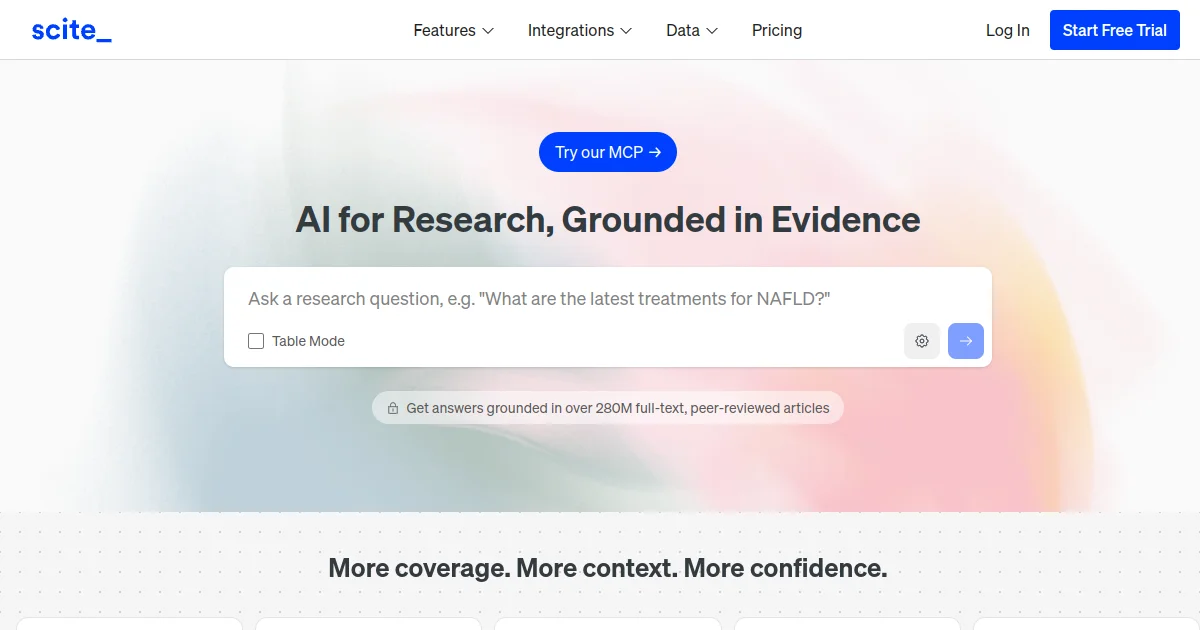
Scite AI is a powerful research intelligence platform built for researchers, academics, and institutions who need reliable, evidence-backed answers from the scientific literature. Unlike general-purpose AI tools that may hallucinate, Scite grounds every response in over 280 million full-text peer-reviewed articles, preprints, books, patents, and datasets sourced through direct publisher agreements with Wiley, SAGE, and 30+ others. At the core of Scite is its Smart Citations technology — a deep learning system that reads citation contexts and classifies them as supporting, contrasting, or mentioning, allowing researchers to instantly see whether a finding has been replicated or challenged by later work. This gives users an unprecedented ability to gauge the reliability and consensus around any scientific claim. Scite also offers full-text search that goes far beyond abstracts, surfacing relevant passages from inside papers. Its AI assistant generates answers directly from verifiable sources, making it ideal for literature reviews, hypothesis evaluation, and academic writing. The platform is trusted by over 2 million researchers and industry experts at leading universities and organizations worldwide, and also offers an MCP integration for developer and workflow use cases. Key use cases include literature review, citation verification, grant writing support, systematic reviews, and scientific fact-checking. Scite is available as a web platform with API access.
Key Features
- Smart Citations: Deep learning model classifies each citation context as supporting, contrasting, or mentioning, showing whether a finding has been confirmed or challenged by later research.
- 280M+ Full-Text Article Search: Search across over 280 million full-text peer-reviewed articles, preprints, books, patents, and datasets — going far beyond abstracts.
- Verifiable AI Answers: AI-generated responses are grounded in real, identified papers — never hallucinated — with traceable citations for every claim.
- Citation Context Explorer: View the exact passage where a paper was cited, the section it appeared in, and related articles for deeper understanding of scientific debates.
- MCP Integration: Developer-friendly MCP (Model Context Protocol) integration allows Scite's research capabilities to be embedded into AI workflows and tools.
Use Cases
- Conducting systematic literature reviews to identify supporting and contradicting evidence for a research hypothesis.
- Verifying the reliability of citations before submitting academic papers or grant proposals.
- Discovering the latest research on a topic by searching full-text content across 280M+ scientific sources.
- Assessing scientific consensus or ongoing debates around a specific finding or methodology.
- Accelerating academic writing by generating AI-assisted summaries and answers grounded in verified peer-reviewed literature.
Pros
- Evidence-grounded AI: Every answer is backed by real, traceable scientific papers, making it far more reliable for academic and professional research than general AI tools.
- Unmatched coverage: Access to 280M+ sources through direct publisher agreements, covering both open access and paywalled content unavailable to most other tools.
- Smart citation reliability scoring: The ability to see whether a study has been supported or contradicted saves hours of manual literature review and prevents citing unreliable findings.
- Trusted by millions of researchers: Used at top universities and institutions globally, lending credibility and reliability to the platform's data quality.
Cons
- Freemium limitations: Free tier access may be restricted in terms of search volume, full-text access, or advanced features, requiring a paid plan for heavy usage.
- Primarily academic scope: Best suited for scientific and academic research; less useful for general web research, business intelligence, or non-academic content discovery.
- Learning curve for Smart Citations: New users may need time to understand how citation classification confidence scores work and how to interpret supporting vs. contrasting evidence.
Frequently Asked Questions
What are Smart Citations in Scite AI?
Smart Citations are a proprietary feature that uses deep learning to analyze the context in which a paper is cited and classify it as supporting, contrasting, or simply mentioning the cited work. This helps researchers quickly assess whether a finding has been replicated or challenged by the broader literature.
How many articles does Scite cover?
Scite indexes over 280 million full-text peer-reviewed articles, preprints, books, patents, and datasets. It has direct agreements with publishers including Wiley, SAGE, and 30+ others, covering both open access and paywalled content.
Is Scite AI free to use?
Scite offers a free trial so new users can explore the platform. Full access to all features, including unlimited searches and full-text citation analysis, typically requires a paid subscription.
How is Scite different from Google Scholar or PubMed?
Unlike Google Scholar or PubMed, Scite provides full-text citation context analysis, classifying each citation as supporting or contrasting. It also offers an AI assistant that generates verifiable, source-grounded answers rather than just returning a list of papers.
Can developers integrate Scite into their own tools?
Yes. Scite provides an MCP (Model Context Protocol) integration and API access, allowing developers to embed Scite's research search and citation analysis capabilities into their own AI workflows and applications.