

About
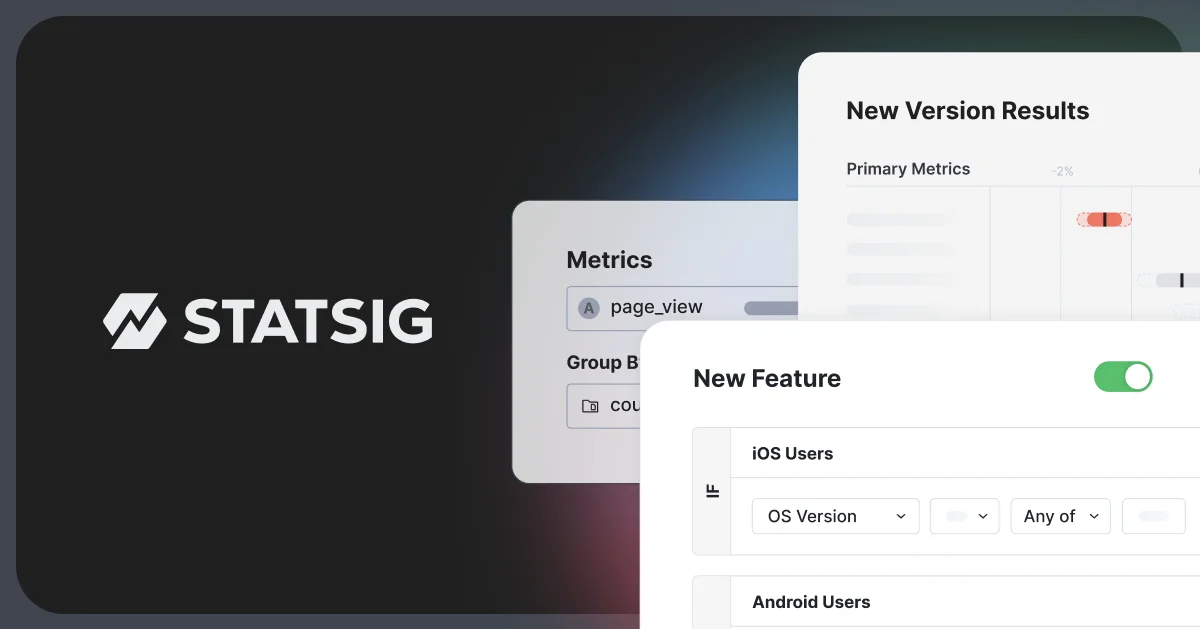
Statsig is a comprehensive product development platform trusted by thousands of companies—from OpenAI to Series A startups—to ship better products faster. At its core, Statsig offers a world-class experimentation engine that supports sophisticated A/B and multivariate tests with advanced statistical treatments such as CUPED, sequential testing, and Bayesian analysis. Feature Flags allow teams to control exactly who sees what, enabling safe gradual rollouts, kill switches, and targeted releases linked directly to product metrics. Product Analytics provides a trusted set of metrics with tools like Metrics Explorer, User Segments, Funnels, and Logs Explorer so data teams can turn behavioral signals into actionable insights. Session Replays connect user interactions to every flag and experiment, making it easy to diagnose friction and surface emerging trends. Statsig also supports a Warehouse Native architecture, letting companies run all computations inside their own data warehouse for full data control and cost efficiency. With infrastructure processing over 1 trillion events per day, 2.5 billion monthly experiment subjects, and sub-millisecond evaluation latency, Statsig is built for reliability at enterprise scale. It's especially well-suited for AI product teams that need to rigorously measure how model-driven features land with real users.
Key Features
- Advanced Experimentation Engine: Run sophisticated A/B and multivariate tests with statistical treatments like CUPED, sequential testing, and holdouts. Supports warehouse-native computation for full data control.
- Feature Flags & Releases: Control every release with smart feature flags tied directly to product metrics. Supports gradual rollouts, targeting rules, kill switches, and no-code overrides.
- Product Analytics: Build a trusted set of product metrics with Metrics Explorer, Funnels, User Segments, and Logs Explorer—purpose-built for data and product teams.
- Session Replays: Watch how users interact with your product and connect replays directly to feature flags and experiments to understand the impact of every change.
- Warehouse Native Infrastructure: Run Statsig's full analytics and experimentation stack inside your own data warehouse (Snowflake, BigQuery, Databricks) for maximum data governance and cost efficiency.
Use Cases
- Running rigorous A/B tests on new product features to measure their impact on retention, engagement, and revenue before a full rollout.
- Testing AI-powered experiences such as LLM prompt variations, recommendation algorithms, or generative content to determine which performs best with real users.
- Managing gradual feature rollouts with feature flags, enabling teams to release to 1%, 10%, then 100% of users while monitoring for regressions.
- Consolidating product analytics, experimentation, and session replay into a single platform to eliminate data silos and reduce the overhead of managing multiple tools.
- Enabling data science and product teams to run warehouse-native experiments that keep sensitive data inside the company's own cloud data warehouse.
Pros
- All-in-One Platform: Replaces multiple point solutions by unifying experimentation, feature management, analytics, and session replay in a single integrated toolkit, reducing tool sprawl and data silos.
- Enterprise-Grade Scale & Reliability: Handles over 1 trillion events per day with 99.99% uptime and sub-millisecond evaluation latency, making it suitable for the most demanding production environments.
- AI-Native Experimentation: Specifically designed to help teams measure and iterate on AI-powered product experiences, with integrations and workflows built for modern AI product development.
- Generous Free Tier: Statsig Lite offers a meaningful free tier that allows startups and small teams to run real experiments and analytics without upfront cost.
Cons
- Complexity for Small Teams: The breadth of features and configuration options can feel overwhelming for teams without dedicated data scientists or engineers to manage the platform.
- Advanced Features Gated Behind Paid Plans: Warehouse Native, advanced statistical treatments, and higher event volumes require paid plans, which can become expensive at large scale.
- Learning Curve for Statistical Methods: Getting the most out of Statsig's advanced experimentation engine (CUPED, sequential testing, power analysis) requires statistical literacy that not all product teams possess.
Frequently Asked Questions
What is Statsig AI Experiment?
Statsig AI Experiment refers to Statsig's experimentation platform with specific capabilities for testing AI-powered product features. It allows teams to run controlled experiments on AI model outputs, prompt changes, and AI-driven UX to measure their impact on real user behavior and business metrics.
Is there a free version of Statsig?
Yes. Statsig offers a free account and a product called Statsig Lite, which provides access to core experimentation and feature flag features for teams getting started with product experimentation.
What is Warehouse Native and why does it matter?
Warehouse Native means Statsig can run its experimentation and analytics computations directly inside your own data warehouse (e.g., Snowflake, BigQuery, or Databricks). This gives your team full data control, avoids sending sensitive data to third-party servers, and can reduce costs significantly.
How does Statsig handle statistical significance in experiments?
Statsig uses a world-class stats engine that supports multiple methods including CUPED (variance reduction), sequential testing, Bayesian inference, and power analysis—helping teams reach statistically valid conclusions faster and with less data.
Which companies use Statsig?
Statsig is trusted by thousands of companies including OpenAI, Notion, Brex, and Ancestry. Brex reported a 50% reduction in data scientist time and 20% cost savings after consolidating on Statsig, while Ancestry grew from 70 to 600+ annual experiments—a 9x increase in experimentation velocity.