

About
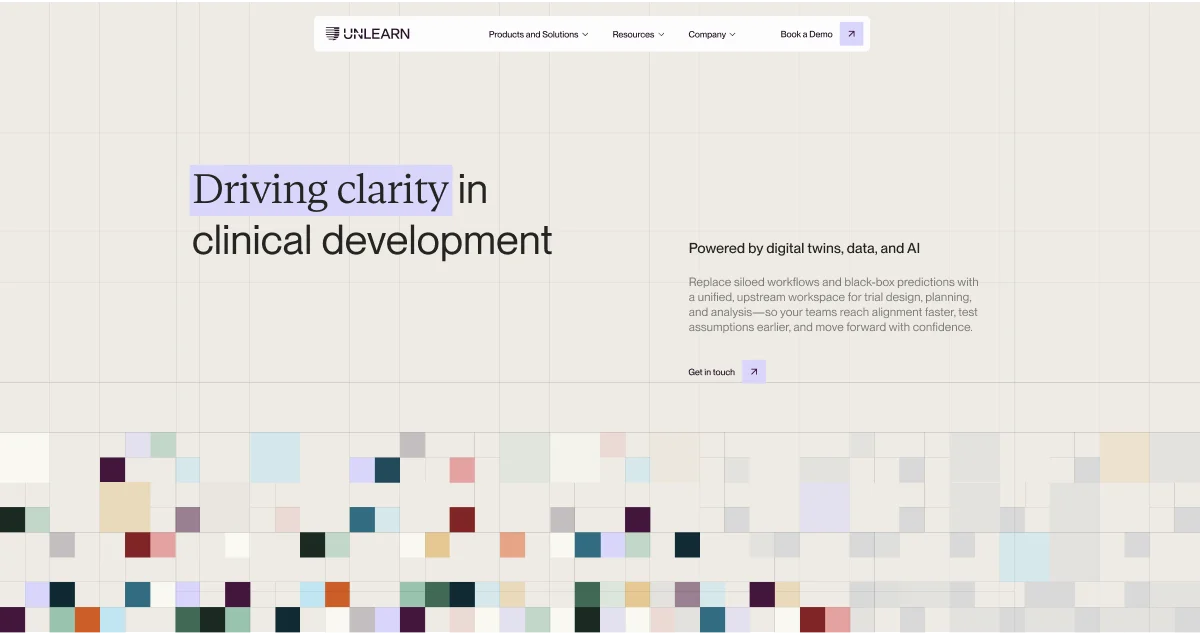
Unlearn AI is a clinical development intelligence platform that harnesses artificial intelligence and digital twin technology to transform how pharmaceutical and biotech companies design and execute clinical trials. At its core, Unlearn generates AI-powered digital twins—predictive forecasts of individual participants' expected control outcomes—which serve as external comparators in early-stage, open-label, and randomized studies. This approach reduces control arm sizes, lowers variability, and improves statistical power to detect treatment effects. The methodology is qualified by the European Medicines Agency (EMA) and aligned with current FDA guidance, giving sponsors regulatory confidence. The flagship TrialPioneer workspace brings together three integrated tools: Scout, which continuously searches and summarizes relevant literature and regulatory precedent from PubMed, ClinicalTrials.gov, and drugs@FDA; Hindsight, which lets teams explore harmonized clinical and real-world datasets to validate statistical and clinical assumptions; and SimLab, which enables teams to build and compare trial-design scenarios with explainable, reproducible outputs linked to underlying evidence. Unlearn operates across therapeutic areas including neuroscience, immunology, and metabolic disease, and has documented results of approximately 33% control arm size reductions and over 4 months of enrollment time saved. Trusted by sponsors working on conditions such as ALS and Alzheimer's disease, Unlearn is purpose-built for clinical research teams seeking to make faster, more confident go/no-go decisions.
Key Features
- AI Digital Twin Generation: Creates AI-generated forecasts of individual clinical trial participants' expected control outcomes, usable as external comparators to reduce control arm sizes and improve statistical power.
- Scout – Literature & Regulatory Search: Continuously searches, structures, and summarizes relevant literature and regulatory precedent from PubMed, ClinicalTrials.gov, and drugs@FDA to accelerate evidence alignment.
- Hindsight – Historical Data Exploration: Allows teams to explore harmonized clinical trial and real-world datasets to validate assumptions around population characteristics, endpoint behavior, and benchmarks.
- SimLab – Trial Design Scenario Modeling: Enables building and comparing trial-design scenarios for endpoints, inclusion/exclusion criteria, and sample size, with explainable, reproducible outputs tied to evidence.
- EMA-Qualified Methodology: Unlearn's digital twin approach is qualified by the European Medicines Agency and aligned with FDA guidance, providing regulatory confidence for sponsors.
Use Cases
- Reducing control arm sizes in Phase 2 and Phase 3 clinical trials to lower patient burden and trial cost
- Accelerating go/no-go decisions in early-stage drug development by using digital twins to improve detection of treatment effects
- Searching and synthesizing regulatory precedent and published literature during trial protocol development
- Validating statistical and clinical assumptions using harmonized historical trial and real-world datasets
- Designing and comparing trial scenarios for endpoints, inclusion/exclusion criteria, and sample sizes prior to protocol finalization
Pros
- Regulatory Acceptance: The digital twin methodology is EMA-qualified and FDA-aligned, giving clinical teams confidence in submitting studies using Unlearn's outputs.
- Measurable Efficiency Gains: Documented results show approximately 33% control arm size reductions and more than 4 months of enrollment time saved per trial.
- Unified Upstream Workspace: TrialPioneer consolidates literature search, data exploration, and scenario simulation into one platform, replacing fragmented workflows and siloed tools.
- Cross-Therapeutic Versatility: Supports multiple disease areas including neuroscience, immunology, and metabolic disease, making it broadly applicable across a sponsor's pipeline.
Cons
- Enterprise-Only Pricing: Unlearn appears to be an enterprise solution with demo-based access, making it inaccessible to smaller research organizations or academic teams with limited budgets.
- Requires Clinical Expertise: Effectively leveraging digital twins, SimLab scenarios, and regulatory alignment requires deep clinical and statistical domain knowledge, limiting self-service usability.
- Focused on Specific Trial Phases: The platform is primarily designed for upstream design and early-to-late stage trials; it may not address all downstream operational or site-management needs.
Frequently Asked Questions
What is a digital twin in the context of clinical trials?
A digital twin is an AI-generated forecast of a clinical trial participant's expected outcome if they had received the control treatment. These forecasts can serve as external comparators, reducing the number of patients needed in the control arm and improving statistical power.
Is Unlearn's methodology accepted by regulators?
Yes. Unlearn's digital twin methodology is qualified by the European Medicines Agency (EMA) and is aligned with current FDA guidance, making it suitable for use in regulatory submissions.
What therapeutic areas does Unlearn support?
Unlearn works across multiple therapeutic areas including neuroscience (e.g., Alzheimer's disease, ALS), immunology, and metabolic disease, with an expanding set of indications.
What is TrialPioneer?
TrialPioneer is Unlearn's unified upstream workspace for trial design. It integrates three tools—Scout for literature search, Hindsight for historical data analysis, and SimLab for scenario modeling—into a single collaborative environment.
How much can Unlearn reduce trial size and timeline?
Unlearn has documented approximately 33% reductions in control arm size and over 4 months of enrollment time saved, though results vary by indication and trial design.