

About
Weco AI is an autonomous research and optimization platform designed for machine learning engineers, data scientists, and AI researchers who want to systematically improve their ML pipelines without endless manual iteration. At its core is the AIDE ML algorithm — the same algorithm independently validated by researchers at OpenAI, Meta, and Sakana AI — which autonomously generates candidate solutions, evaluates them against your local eval pipeline, retains improvements, and discards failures in a continuous loop. The platform excels at a wide range of optimization tasks: improving prompt and vision-language model accuracy, reducing GPU inference latency through CUDA kernel optimization, pushing Kaggle leaderboard scores, optimizing algorithmic pricing and bidding strategies, solving vehicle routing and logistics planning problems, and advancing scientific ML models for molecular research. Key differentiators include strong privacy guarantees — your eval code and data never leave your machine; only metrics and diffs are transmitted — and support for any language that can print a metric to stdout (Python, C++, Rust, JavaScript, and more). Each optimization run produces a searchable tree of all tested candidates, letting you compare any two nodes side-by-side. You can also steer experiments using natural language constraints like 'avoid unsafe memory access' or 'prioritize readability.' Weco offers 20 free credits (~100 steps) to get started, with a paid tier for longer runs. The underlying AIDE ML algorithm is also available as open-source for academic and industrial researchers.
Key Features
- AIDE ML Algorithm: Powered by the AIDE algorithm that achieved ~4× the medal rate of competing autonomous agents across 75 Kaggle competitions on OpenAI's MLE-Bench.
- Autonomous Code Optimization: Continuously generates, tests, and refines candidate solutions against your eval pipeline without human intervention — able to run for weeks unattended.
- Local Data Privacy: Eval code runs entirely on your machine; only metrics and code diffs are sent to Weco, ensuring sensitive data never leaves your environment.
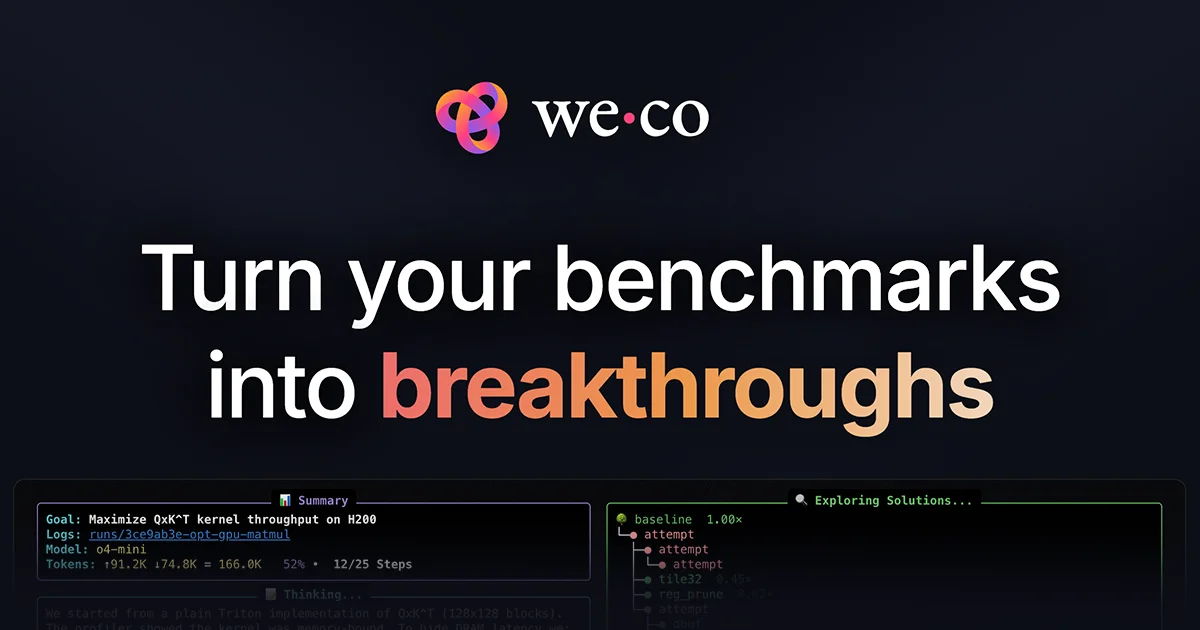
- Visual Experiment Tree: Every run produces a searchable, interactive tree of all candidate solutions, allowing side-by-side comparison of any two nodes to understand what worked and why.
- Natural Language Steering: Guide the optimization process with plain-language constraints (e.g., 'avoid unsafe memory access', 'prioritize readability') to align results with your engineering standards.
Use Cases
- Improving accuracy in vision-language model pipelines by iteratively refining prompts, model calls, and post-processing logic against a held-out validation set.
- Reducing GPU inference latency by autonomously proposing and testing CUDA kernel-level changes while maintaining output correctness.
- Pushing Kaggle and ML benchmark leaderboard scores through systematic iteration over modeling strategies, feature engineering, and pipeline code.
- Optimizing algorithmic pricing and sequential bidding strategies in competitive markets by evolving decision logic to maximize profit and win rate.
- Accelerating scientific ML research by optimizing models for molecular behavior, stability, or efficacy against real experimental datasets.
Pros
- Best-in-class benchmark performance: Independently validated to achieve ~4× the medal rate of the next best autonomous agent on OpenAI's MLE-Bench across 75 Kaggle competitions.
- Strong privacy guarantees: Data and eval logic remain on your local machine; the open-source CLI can be inspected to verify exactly what is transmitted.
- Cost-efficient experimentation: Each candidate solution costs fractions of a cent to evaluate, making large-scale systematic search economically practical.
- Language-agnostic optimization: Works with Python, C++, Rust, JavaScript, and any other language that can print a metric to stdout, fitting into diverse tech stacks.
Cons
- Requires a well-scoped eval pipeline: Weco performs best when you already have a clear, efficient evaluation harness; poorly defined metrics can lead to suboptimal or misleading optimizations.
- Limited free tier: The free plan provides only 20 credits (~100 optimization steps), which may not be sufficient for complex or long-running optimization tasks.
- Technical setup required: Integrating a local eval pipeline and configuring the CLI requires engineering effort that may be a barrier for non-technical users.
Frequently Asked Questions
What is the Weco Platform?
Weco is an autonomous code optimization platform that iteratively generates and tests candidate improvements to your ML pipeline, using the AIDE ML algorithm to find non-obvious wins that manual iteration would miss.
How is Weco related to AIDE ML?
Weco is built by the team that created AIDE ML, the open-source algorithm behind the platform. AIDE ML is available on GitHub for researchers to build on, while the Weco Platform adds a managed cloud dashboard, observability, and natural language steering on top of it.
Where does my code and data run?
Your evaluation code runs locally on your own machine. Weco only receives the performance metrics and code diffs from each experiment — your raw data never leaves your environment. You can review the open-source CLI to verify this.
What kinds of problems can Weco tackle?
Weco handles any optimization problem where you can define a quantitative metric. Common use cases include prompt/VLM optimization, CUDA kernel performance tuning, Kaggle competition improvement, algorithmic pricing and bidding, vehicle routing, and scientific ML model refinement.
How long does an optimization run take?
Run duration depends on the complexity of your problem and the cost of each evaluation step. Weco is designed to run autonomously for extended periods — potentially days or weeks — without human intervention, making it suitable for overnight or weekend optimization campaigns.