
About
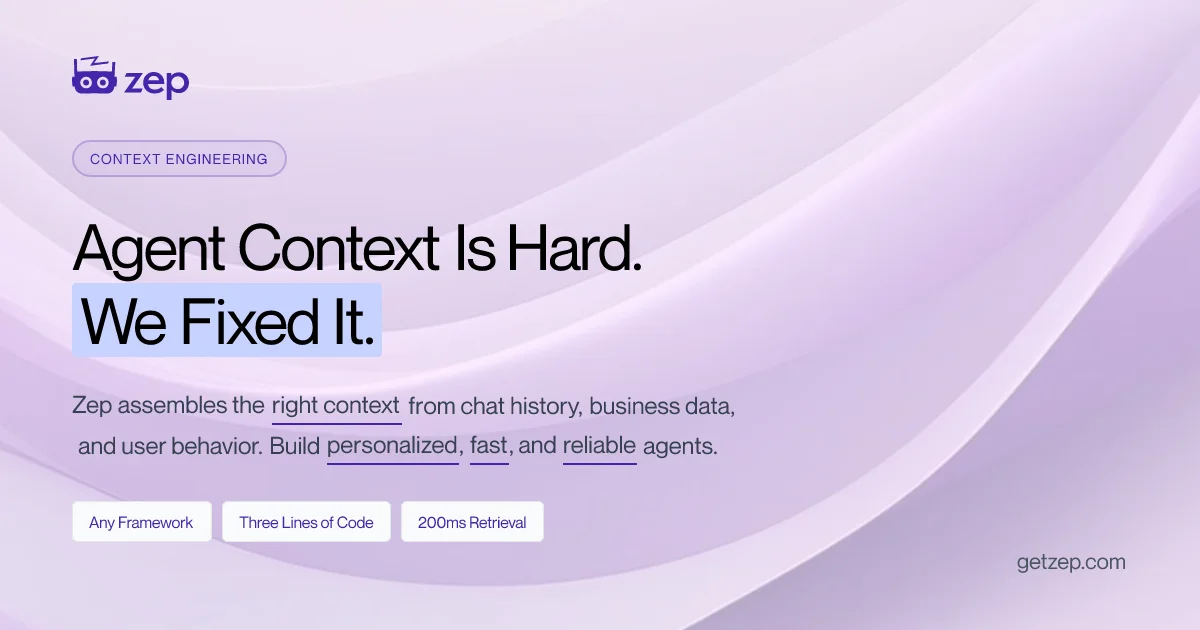
Zep solves one of the hardest problems in production AI: getting agents the right context at the right time. Unlike basic chat memory or static RAG pipelines, Zep builds a dynamic, temporal context graph that continuously ingests data from chat histories, CRM systems, JSON business data, documents, and app events. As facts change over time, old ones are automatically invalidated and new ones are recorded — keeping your agent's world model accurate and up to date. At query time, Zep's Graph RAG engine retrieves the most relevant facts, user traits, and recent interactions, then assembles them into a compact, LLM-ready context block with P95 retrieval latency under 200ms. This makes it suitable for real-time applications such as voice agents, live customer support, and interactive assistants. Zep works with any agent framework — LangChain, LlamaIndex, CrewAI, AutoGen, or custom pipelines — and requires just three lines of code to integrate. It is trusted by developers building personalized, reliable, and context-aware AI products at scale. Key use cases include personalized AI assistants, enterprise customer support bots, AI sales development representatives, and any agent that must reason over evolving user profiles and business data. Zep offers a hosted cloud platform with a free tier, paid plans for growing teams, and enterprise offerings for large-scale deployments.
Key Features
- Temporal Knowledge Graph: Automatically builds and maintains a context graph from chat, documents, CRM, and app events. When facts change, outdated ones are invalidated and new ones are recorded — keeping agent context accurate over time.
- Graph RAG Context Assembly: Retrieves the most relevant facts, user traits, and recent interactions at query time and assembles them into a compact, token-efficient context block ready for your LLM prompt.
- Sub-200ms Retrieval Latency: Delivers assembled context with P95 latency under 200ms, making Zep suitable for real-time use cases like voice agents, video agents, and live customer support.
- Universal Framework Compatibility: Integrates with LangChain, LlamaIndex, CrewAI, AutoGen, or any custom agent framework using just three lines of Python or TypeScript code.
- Multi-Source Data Ingestion: Ingests from chat histories, JSON business data, documents, CRM records, and application events to build a holistic, unified picture of each user and their interactions.
Use Cases
- Building personalized AI assistants that remember user preferences, past purchases, and behavioral history across sessions.
- Powering enterprise customer support bots that need real-time access to CRM data, account status, and prior interaction history.
- Enabling AI sales development representatives (SDRs) to maintain up-to-date context about leads, deal stages, and communication history.
- Creating real-time voice and video agents that require sub-200ms context retrieval without sacrificing personalization or accuracy.
- Developing long-running autonomous agents that must track evolving facts over time and reason correctly as the world changes.
Pros
- Minimal Integration Effort: Getting started requires only three lines of code and works with virtually any existing agent framework, significantly lowering the barrier to production-grade memory.
- Dynamic, Evolving Context: Unlike static RAG or plain chat history, Zep's temporal graph reflects how facts change over time, so agents always reason from current, accurate information.
- Real-Time Performance: Sub-200ms P95 retrieval ensures context is available fast enough for latency-sensitive applications like voice and live support agents.
- Holistic User Modeling: Combines multiple data sources into a single unified context, giving agents a complete picture of a user's history, preferences, and current situation.
Cons
- Hosted Dependency: The primary offering is a managed cloud platform; teams with strict data residency or air-gapped requirements may need to evaluate the enterprise self-hosted option carefully.
- Newer Ecosystem: As a relatively new platform, the community, third-party tutorials, and ecosystem integrations are still growing compared to more established memory or RAG solutions.
- Complexity for Simple Use Cases: For agents that only need basic short-term conversation history, Zep's full context graph pipeline may introduce more infrastructure than necessary.
Frequently Asked Questions
What makes Zep different from standard RAG or chat history?
Standard RAG retrieves static documents and chat history only stores recent messages. Zep builds a temporal knowledge graph that unifies chat, business data, and app events, automatically invalidates stale facts, and assembles the most relevant context for each agent call — giving a much richer and more accurate picture of the user.
How fast is Zep's context retrieval?
Zep delivers assembled context with a P95 latency of under 200ms, making it suitable for real-time agent applications including voice agents and live customer support bots.
Which agent frameworks does Zep support?
Zep is framework-agnostic and works with LangChain, LlamaIndex, CrewAI, AutoGen, and any custom Python or TypeScript agent pipeline. Integration requires just three lines of code.
What data sources can Zep ingest?
Zep can ingest chat messages, JSON business data, documents, CRM records, and application events. It extracts entities and relationships from all sources and merges them into a single unified context graph per user.
Is Zep available as open source?
Zep offers an open-source component alongside its managed cloud platform. There is also an enterprise tier for teams with larger scale or specific compliance and deployment requirements.