

About
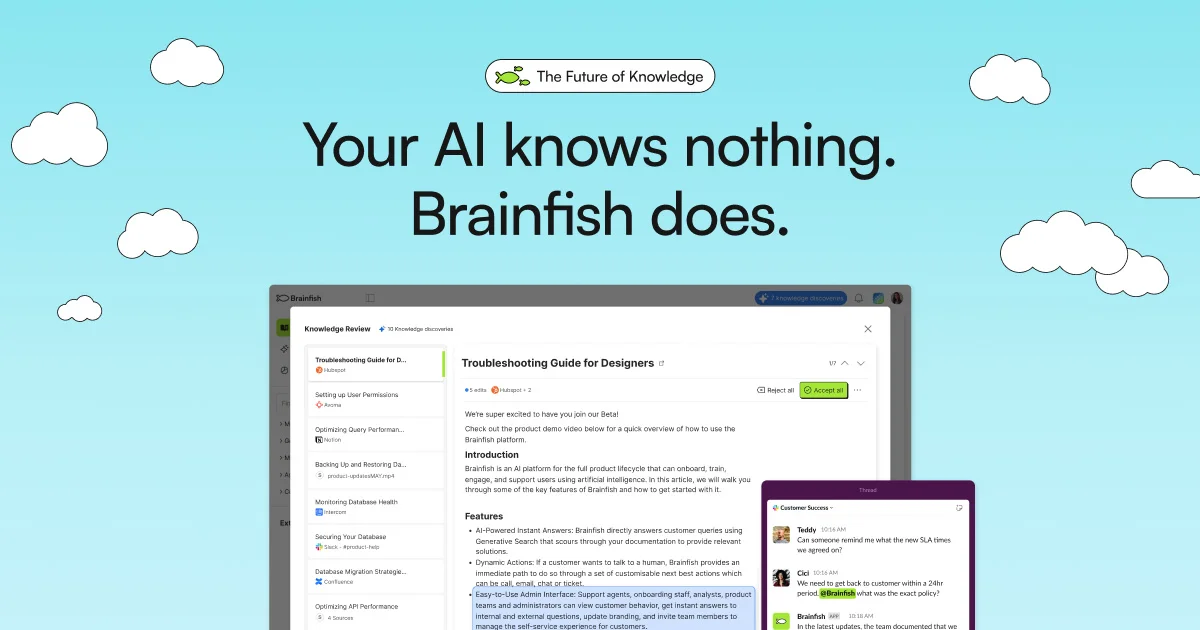
Brainfish is an AI knowledge infrastructure platform designed to eliminate knowledge sprawl and supercharge customer support operations. Unlike static documentation tools, Brainfish builds a living product knowledge layer by continuously ingesting videos, call recordings, Slack threads, third-party docs, and system updates—ensuring your AI agents and internal teams always work from accurate, up-to-date information. The platform offers three core pillars: AI Agents that resolve issues and execute end-to-end workflows (from updating permissions to processing refunds) across chat, Slack, WhatsApp, email, and in-app channels; an AI Knowledge Layer that auto-generates and auto-updates structured content whenever product changes ship; and Internal AI Copilots that surface domain-specific guidance in-tab for support, sales, and success teams. Brainfish also provides contextual personalization—segmenting knowledge by account, role, plan, or use case—so every user receives exactly what they need rather than generic responses. Proactive Nudges surface friction points before users even reach out, while Customer Analytics deliver actionable data to improve adoption and reduce inbound volume. Native integrations with Zendesk, Intercom, and HubSpot streamline existing workflows. Brainfish is best suited for SaaS companies, customer success teams, and enterprise support operations looking to scale self-service resolution, reduce ticket volumes, and boost team productivity without rebuilding their knowledge base from scratch.
Key Features
- Self-Updating Knowledge Layer: Automatically ingests product changes, call recordings, Slack threads, and docs to keep your AI's knowledge accurate and current without manual maintenance.
- Omnichannel AI Agents: Deploy AI agents across chat, Slack, WhatsApp, email, in-app, and API channels that don't just answer questions—they execute real Level 2 workflows like refunds and permission changes.
- Contextual Personalization: Segment and deliver knowledge based on each user's account, plan, and role so every customer receives tailored, relevant answers rather than one-size-fits-all responses.
- Internal AI Copilots: Convert Slack threads and internal calls into searchable knowledge and serve verified, context-aware guidance to any team member in-tab—eliminating tribal knowledge silos.
- Customer Analytics & Proactive Nudges: Identify friction points in real time and receive actionable insights to fix adoption issues before users ever need to submit a support ticket.
Use Cases
- A SaaS company deploys Brainfish AI agents to handle routine customer support queries (password resets, plan changes, billing questions) automatically, freeing human agents to focus on complex escalations.
- A customer success team uses Brainfish to convert high-value Slack threads and internal call recordings into a searchable, always-accurate knowledge base accessible to every new hire in real time.
- A product team connects Brainfish to their release pipeline so that every new feature deployment automatically triggers a review of related documentation, ensuring help center articles are never stale.
- An enterprise support organization uses Brainfish's personalization engine to serve different knowledge content to free-tier users vs. enterprise customers, improving self-service resolution rates across segments.
- A growth team leverages Brainfish's Customer Analytics and Proactive Nudges to identify where users experience friction in onboarding flows and address issues before they result in churn or support volume spikes.
Pros
- Zero-maintenance knowledge base: Brainfish automatically detects product changes and flags or updates outdated content, dramatically reducing the manual effort needed to keep documentation accurate.
- Deep workflow automation: Unlike simple FAQ bots, Brainfish agents can execute complex backend actions (refunds, plan changes, permissions) via API integrations, truly resolving issues end-to-end.
- Fast time-to-value: Users report minimal onboarding time compared to alternatives, with one COO citing hours saved per week and over 275% bottom-line ROI shortly after deployment.
- Broad integration ecosystem: Native integrations with Zendesk, Intercom, HubSpot, and Slack mean Brainfish fits into existing support stacks without requiring major workflow changes.
Cons
- Enterprise pricing model: Brainfish targets mid-market and enterprise customers, making it potentially cost-prohibitive for smaller teams or early-stage startups with limited budgets.
- Demo-gated onboarding: Getting started requires booking a demo rather than a self-serve sign-up, which adds friction for teams wanting to evaluate the platform quickly on their own.
- Requires rich content sources: The quality of the AI knowledge layer depends on having sufficient existing content (calls, docs, videos) to ingest—new or lean organizations may see limited initial value.
Frequently Asked Questions
What types of content can Brainfish ingest to build its knowledge layer?
Brainfish can ingest virtually any source containing product knowledge, including recorded videos, call recordings, Slack threads, written documentation, third-party sources, and system data. If it contains knowledge, Brainfish mines it.
How does Brainfish keep knowledge up to date when products change?
Brainfish continuously monitors your connected sources and automatically flags outdated content for review the moment a product change is detected. It can also auto-generate updated articles from new calls, videos, or docs.
What channels can Brainfish AI agents be deployed on?
Brainfish AI agents can be deployed across chat widgets, Slack, WhatsApp, email, in-app experiences, and via API—making them accessible wherever your customers and team members already work.
Can Brainfish do more than answer questions—can it take real actions?
Yes. Brainfish agents support Level 2 workflow execution, meaning they can trigger real API actions such as updating user permissions, processing refunds, and changing subscription plans without requiring human intervention.
Which third-party tools does Brainfish integrate with?
Brainfish integrates natively with customer support and CRM platforms including Zendesk, Intercom, and HubSpot, as well as Slack for internal knowledge workflows.