
About
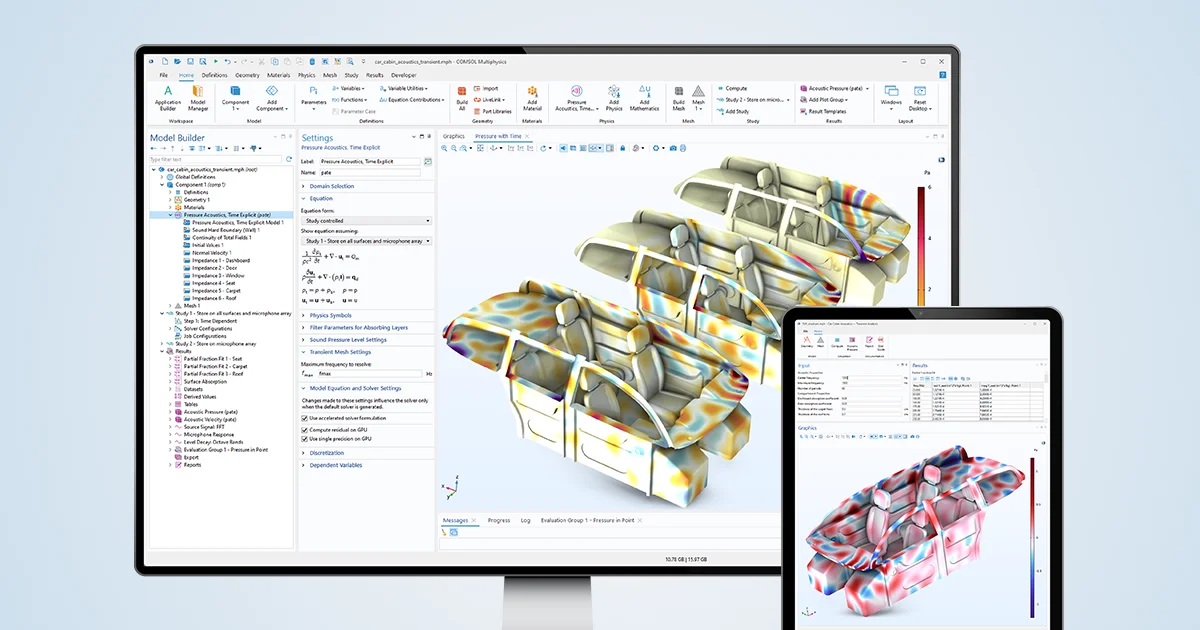
COMSOL Multiphysics is an industry-leading multiphysics simulation software developed since 1986, trusted by engineers, researchers, and educators worldwide. It provides a unified modeling environment where users can build geometry, define physics, set up meshes, run solvers, and analyze results — all within a single, consistent interface regardless of the engineering application. The platform supports a broad range of physics disciplines through specialized add-on modules, including electromagnetics, structural mechanics, acoustics, fluid flow, heat transfer, and chemical engineering. GPU-accelerated and HPC-ready solvers ensure fast, scalable simulations for demanding computational workloads. Beyond core simulation, COMSOL offers the Application Builder for creating custom simulation apps, COMSOL Compiler™ for packaging apps as standalone executables, and COMSOL Server™ for browser-based deployment across an organization. These tools make it easy for simulation experts to share digital twins and apps with non-expert stakeholders. COMSOL is used across industries including automotive, aerospace, electronics, biomedical, energy, and academic research. Version 6.4 introduced GPU-accelerated simulations, time-explicit structural dynamics, and a new product for granular flow. With 500+ employees and 16 global offices, COMSOL is a cornerstone tool for high-tech product development, academic research, and advanced engineering education.
Key Features
- Unified Multiphysics Modeling: Combine multiple physics disciplines — electromagnetics, fluid flow, heat transfer, structural mechanics, and more — in a single, consistent modeling environment.
- GPU-Accelerated & HPC-Ready Solvers: Leverage NVIDIA GPU support and high-performance computing clusters for dramatically faster, scalable simulation runs.
- Custom Simulation App Builder: Use the Application Builder to create tailored simulation apps and digital twins that can be shared with colleagues or deployed organization-wide.
- COMSOL Server & Compiler Deployment: Distribute simulation apps as standalone executables or web-accessible tools via COMSOL Compiler™ and COMSOL Server™, enabling non-experts to run simulations.
- Extensive Add-On Module Ecosystem: Extend core functionality with specialized modules for acoustics, chemical engineering, CFD, structural dynamics, and more, plus LiveLink™ integrations with third-party CAD tools.
Use Cases
- Simulating electromagnetic field behavior in antenna and RF component design for consumer electronics and wireless devices.
- Modeling heat transfer and fluid flow in industrial heat exchangers and cooling systems for energy-efficient engineering.
- Performing structural mechanics analysis of aerospace components to predict fatigue, stress, and deformation under operational loads.
- Building and deploying custom simulation apps and digital twins that allow non-expert stakeholders to run validated models via a web browser.
- Conducting acoustics simulations for speaker, microphone, and noise-control design in consumer and industrial products.
Pros
- All-in-One Simulation Workflow: Handles the full modeling pipeline — geometry, meshing, physics setup, solving, and post-processing — in one unified interface, reducing tool-switching overhead.
- Broad Physics Coverage: Supports an exceptionally wide range of engineering disciplines through modular add-ons, making it suitable for highly interdisciplinary simulation work.
- Enterprise App Deployment: COMSOL Server and Compiler enable organizations to democratize simulation by allowing non-experts to run validated apps via a web browser.
- Active Community & Learning Resources: Backed by extensive training courses, webinars, an annual conference, and a rich online learning center to help users at all skill levels.
Cons
- High Cost: COMSOL is a premium enterprise product with licensing fees that can be prohibitive for individual users, small teams, or early-stage startups.
- Steep Learning Curve: The breadth of physics modules and advanced solver settings requires significant time investment to master, especially for multi-physics coupling scenarios.
- Hardware Intensive: Complex simulations demand substantial CPU, RAM, and GPU resources, often requiring dedicated workstations or HPC infrastructure for large-scale models.
Frequently Asked Questions
What is COMSOL Multiphysics used for?
COMSOL Multiphysics is used to simulate and model physical phenomena across disciplines such as electromagnetics, fluid dynamics, structural mechanics, heat transfer, acoustics, and chemical engineering — helping engineers and researchers optimize product designs and understand real-world behavior before physical prototyping.
Does COMSOL support GPU acceleration?
Yes. Starting with recent versions including 6.4, COMSOL supports NVIDIA GPU-accelerated simulations, significantly speeding up compute-intensive models. It is also HPC-ready for cluster-based parallel computing.
What is the difference between COMSOL Compiler and COMSOL Server?
COMSOL Compiler packages simulation apps into standalone executables that anyone can run without a COMSOL license. COMSOL Server hosts and manages apps within an organization, allowing users to run them through a web browser or thin client.
What industries use COMSOL?
COMSOL is used across a wide range of industries including automotive, aerospace, biomedical devices, consumer electronics, energy, semiconductors, and academic research institutions.
Is COMSOL available as a free trial?
COMSOL typically offers a free trial through their website for qualified engineers and researchers. Pricing is quote-based, with academic and commercial licensing options available.