

About
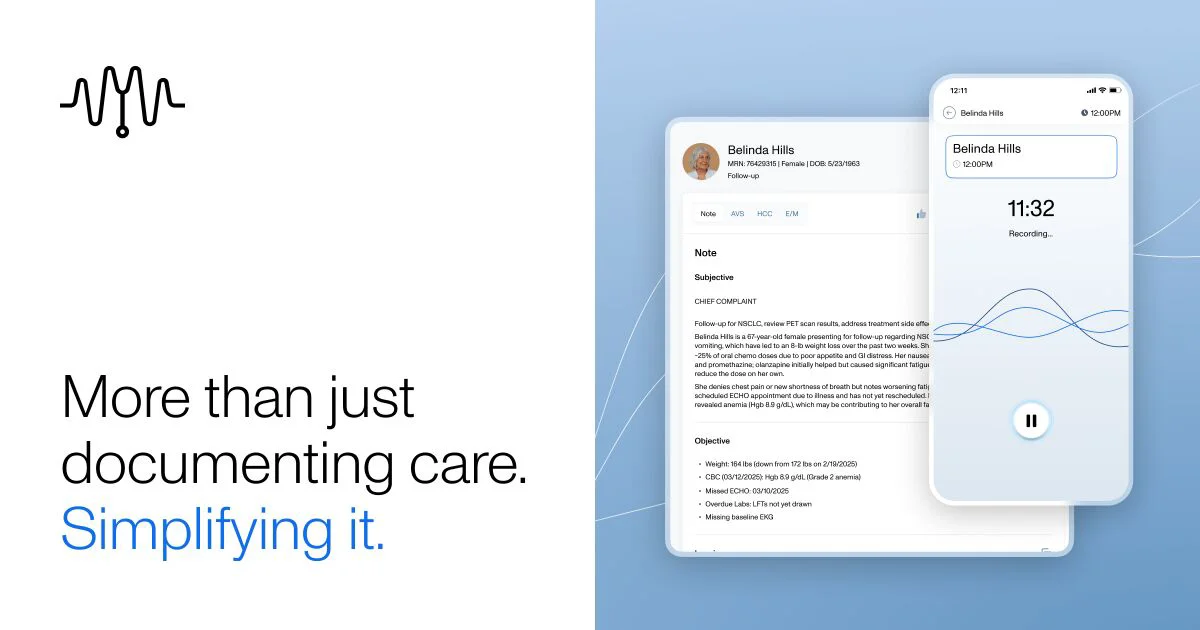
DeepScribe is an advanced ambient AI operating system purpose-built for specialty healthcare. By passively listening to clinical conversations, it generates highly accurate, specialty-specific documentation without disrupting the natural clinician-patient interaction. Rated 98.8 out of 100 by KLAS, DeepScribe is trusted by leading health systems and used across more than 4 million oncology visits annually. The platform goes beyond simple transcription. Its AI Medical Scribe captures complex clinical dialogue with state-of-the-art speech recognition. AI Pre-charting prepares clinicians with full patient context — past notes, labs, imaging, medications, and diagnoses — before each visit. AI Coding automates complete, compliant specialty coding in real time, ensuring accurate reimbursement and reducing revenue leakage. The Customization Studio lets each provider fine-tune note style and format, while DeepScribe Assist surfaces actionable quality and value-based care insights at the point of care. DeepScribe integrates seamlessly with the most widely used EHRs and supports specialties including oncology, cardiology, gastroenterology, neurology, orthopedics, and urology. It is HIPAA-compliant and built for enterprise-scale deployment. Clinicians report significant reductions in daily documentation time, improved focus on patients, and better clinical and financial outcomes — making DeepScribe the ambient AI of choice for specialty and value-based care organizations.
Key Features
- AI Medical Scribe: Passively listens to clinical conversations and generates accurate, specialty-specific documentation using advanced speech recognition — no manual input required.
- AI Pre-charting: Automatically aggregates and surfaces each patient's full care history — labs, imaging, medications, and prior notes — so clinicians walk into every visit fully prepared.
- AI Coding: Automates E/M, HCC, and ICD-10 coding in real time with audit-ready documentation, reducing administrative burden and ensuring proper reimbursement.
- Customization Studio: Learns each provider's individual style and voice over time, offering near-limitless options to fine-tune clinical note format and content for maximum adoption.
- EHR Integrations: Connects seamlessly with the most widely used electronic health record systems, enabling automated ordering, diagnosis delivery, and data flow directly into existing workflows.
Use Cases
- Oncologists using ambient AI to automatically document longitudinal cancer care visits, including interval history and treatment responses, without manual charting.
- Cardiology practices automating specialty-specific clinical notes and HCC/ICD-10 coding to reduce administrative time and improve billing accuracy.
- Health systems deploying ambient scribing across multiple specialties to reduce physician burnout and documentation hours system-wide.
- Value-based care organizations leveraging DeepScribe Assist to surface real-time quality insights and close care gaps during patient encounters.
- Clinicians using AI Pre-charting to review a patient's complete care history before appointments, enabling more focused and informed consultations.
Pros
- Specialty-optimized AI: Unlike generic scribes, DeepScribe is purpose-built for complex specialties like oncology and cardiology, producing context-aware, clinically accurate notes.
- Significant time savings: Clinicians report saving significant hours daily on documentation, allowing more time for patient care and reducing physician burnout.
- High KLAS rating: Scored 98.8 out of 100 by KLAS, reflecting strong real-world performance and clinician satisfaction across health systems.
- End-to-end workflow coverage: Covers pre-visit preparation, in-visit documentation, post-visit coding, and quality insights — functioning as a full ambient OS rather than a single-point solution.
Cons
- Enterprise-focused pricing: DeepScribe is designed for health systems and group practices; pricing is not publicly listed and may be cost-prohibitive for solo practitioners or small clinics.
- Specialty-centric, not general practice: The platform is optimized for specialty medicine, which may make it less suited for primary care or general practice settings without customization.
- Requires EHR integration setup: Realizing the full value of pre-charting and automated coding depends on proper EHR integration, which may require IT resources and onboarding time.
Frequently Asked Questions
What specialties does DeepScribe support?
DeepScribe supports a wide range of specialties including oncology, cardiology, gastroenterology, neurology, orthopedics, and urology, with AI models optimized for each specialty's unique documentation needs.
How does DeepScribe capture clinical conversations?
DeepScribe uses ambient listening technology — typically via a mobile device or dedicated microphone — to passively record and transcribe the natural conversation between a clinician and patient during a visit, without requiring any manual dictation or input.
Which EHR systems does DeepScribe integrate with?
DeepScribe integrates with the most widely used EHR platforms. Specific integrations can be confirmed on their website's integrations page, and the team works with health systems to support their existing EHR environment.
Is DeepScribe HIPAA compliant?
Yes. DeepScribe is built to meet healthcare security and compliance requirements, including HIPAA, making it suitable for enterprise health system deployment.
How does AI Pre-charting work?
Before each visit, DeepScribe automatically pulls relevant patient data — including past notes, labs, imaging, medications, and diagnoses — and surfaces it in a structured, context-aware format so clinicians can walk in fully prepared.