
About
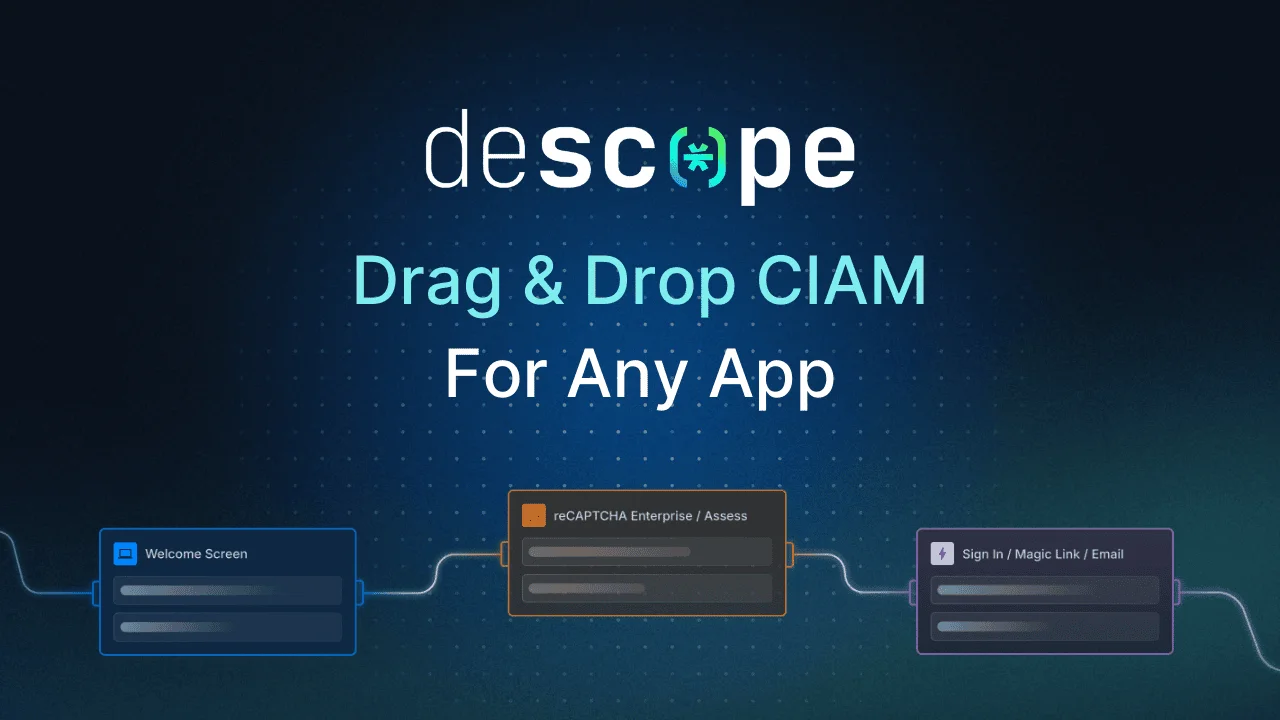
Descope is a comprehensive Customer and Agentic Identity Platform (External IAM) that empowers organizations to build secure, frictionless identity experiences for end users, business customers, partners, AI agents, and MCP servers — all from a single platform. At its core, Descope offers a drag-and-drop, no-code workflow builder where teams can add signup, login, MFA, SSO, step-up authentication, and more without modifying their codebase. Alongside visual flows, it provides frontend/backend SDKs and APIs for full programmatic control. The platform addresses the full spectrum of identity needs: B2C CIAM with passwordless auth and A/B testing, B2B CIAM with multi-tenancy and self-service enterprise SSO/SCIM, account takeover (ATO) prevention via adaptive MFA and risk signals, identity orchestration across 50+ third-party tools, identity federation for a unified 360° customer view, and Agentic IAM — a purpose-built layer for securing AI agents and remote MCP servers with scope-based access control, consent management, and token handling. Descope also includes fine-grained authorization (RBAC, ReBAC, ABAC), complete user management with identity merging and verification, and customizable self-service portals. Trusted by over 1,000 organizations in production, it enables teams to set up and migrate authentication in days rather than months.
Key Features
- No-Code Visual Workflow Builder: Drag-and-drop interface to design complete authentication flows — signup, login, MFA, SSO, step-up auth — with no codebase changes required.
- Agentic IAM for AI Agents & MCP Servers: Dedicated identity infrastructure for AI agents and remote MCP servers, covering authorization, scope-based access control, consent management, DCR security, and token lifecycle.
- Adaptive Multi-Factor Authentication: Enforce MFA only when risk signals flag suspicious activity, reducing friction for legitimate users while actively blocking account takeover attempts.
- Fine-Grained Authorization: Add RBAC, ReBAC, and ABAC access control to any app, with support for multi-tenancy, delegated admin, and enterprise permission models out of the box.
- Identity Federation & Orchestration: Unify identities across multiple apps and identity providers in real time, and orchestrate flows across 50+ third-party integrations with just-in-time provisioning.
Use Cases
- A SaaS startup adding passwordless signup and social login to their app using no-code visual workflows with zero engineering overhead
- An enterprise SaaS vendor enabling self-service SSO and SCIM provisioning for their business customers without custom development
- A developer team securing AI agents and remote MCP servers with scope-based access control, consent flows, and token management
- A security team deploying adaptive MFA to prevent account takeover without degrading the experience for trusted, low-risk users
- A platform aggregating multiple apps that needs to federate identities across several identity providers into a single, unified customer view
Pros
- Fast Time-to-Production: Visual workflows and pre-built SDKs let teams implement and migrate authentication in days or weeks — not months — significantly reducing engineering overhead.
- All-in-One Identity Platform: Covers B2C, B2B, ATO prevention, and next-generation agentic/MCP identity needs from a single unified platform, eliminating the need for multiple vendors.
- Security Without Added Friction: Adaptive MFA and native risk signals surface security checks only when genuinely needed, keeping the user experience smooth for trusted sessions.
- No-Code Iteration: Auth flows can be updated and A/B tested without touching application code, giving product and security teams direct control over identity experiences.
Cons
- Pricing Opacity: Enterprise-grade features like fine-grained authorization, agentic IAM, and advanced federation may require higher-tier plans whose costs aren't transparently listed upfront.
- Complex Configurations Still Require Planning: While basic flows are no-code, intricate multi-tenant, federated, or agentic identity setups can still demand significant architectural planning and expertise.
- Potential Vendor Lock-in: Deep reliance on Descope's visual workflows and proprietary SDKs can make future migrations to alternative identity providers more challenging.
Frequently Asked Questions
What is Descope and who is it for?
Descope is an External IAM (Identity and Access Management) platform for developers and product teams who need to build secure authentication and identity experiences for end users, business customers, partners, AI agents, and MCP servers — without heavy engineering investment.
Does Descope support AI agent and MCP server authentication?
Yes. Descope offers dedicated Agentic IAM capabilities including secure authentication, scope-based access control, consent management, token lifecycle management, and DCR security specifically designed for AI agents and remote MCP servers.
Can I use Descope without writing code?
Yes. Descope's drag-and-drop visual workflow builder lets you design, modify, and A/B test authentication flows — including MFA, SSO, and step-up auth — without changing your application's codebase.
What authentication methods does Descope support?
Descope supports passwordless authentication, adaptive MFA, enterprise SSO (with SCIM provisioning), social login, magic links, OTPs, step-up authentication, and risk-based auth using both native and third-party risk signals.
Is Descope suitable for B2B SaaS products?
Absolutely. Descope includes full B2B CIAM features — multi-tenancy, self-service SSO and SCIM setup, delegated admin, fine-grained authorization (RBAC, ReBAC, ABAC), and audit logging — making it enterprise-ready out of the box.