

About
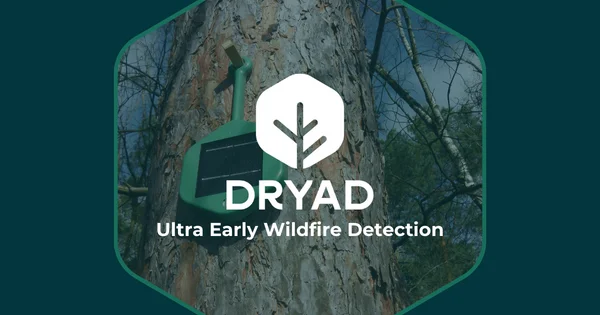
Dryad Networks delivers an AI-powered environmental monitoring solution centered on ultra-early wildfire detection and forest health analytics. At the core of their offering is the Silvanet Suite — a distributed mesh network of solar-powered IoT sensors built on LoRaWAN, the industry-leading open standard for long-range radio IoT. Sensors collect temperature, humidity, and gas data from deep within forests, enabling detection of wildfires during the smoldering phase, often minutes after ignition — far earlier than satellite or camera-based systems. The architecture is designed for massive scale, supporting millions of low-cost sensor nodes suitable for nationwide or continent-wide deployments in areas with no existing network coverage. The open-standards approach allows integration of third-party sensors and applications, eliminating single-vendor lock-in. Cloud-based big data analytics power the platform's monitoring and alerting capabilities, turning raw sensor data into actionable insights for forest owners, firefighting agencies, utilities, and government bodies. Use cases span wildfire early warning, disaster response coordination, power grid and rail infrastructure protection, and long-term forest vitality and growth monitoring. Dryad targets governments, municipalities, utilities, and private forest managers seeking a cost-effective, scalable, and durable solution to protect forests — one of the planet's most critical carbon sinks. Reseller partnerships further extend Silvanet's global reach.
Key Features
- Ultra-Early Fire Detection: Detects wildfires during the smoldering phase — minutes after ignition — using gas, temperature, and humidity sensors distributed throughout the forest.
- Silvanet LoRaWAN Mesh Network: Solar-powered, distributed sensor mesh built on the open LoRaWAN standard, enabling large-scale deployments in remote forests without existing connectivity.
- Cloud-Based Analytics & Alerting: Big data platform processes sensor readings in real time, generating actionable alerts and forest health insights for operators and response teams.
- Open Standards & Third-Party Integration: No vendor lock-in — the platform supports integration of third-party sensors and applications, extending data coverage and analytical capabilities.
- Massive Scalability: Distributed architecture supports millions of sensor nodes, making it viable for regional, national, or continent-wide forest monitoring programs.
Use Cases
- Government forestry agencies deploying continent-wide early wildfire warning systems to protect national parks and reserves.
- Electric utility companies monitoring power line corridors through forested areas to detect and prevent infrastructure-caused wildfires.
- Municipal fire departments integrating real-time smoldering alerts into dispatch workflows to reduce response times.
- Rail operators protecting track infrastructure running through high-risk wildfire zones with automated sensor-based alerts.
- Private timber and conservation landowners monitoring forest health metrics like temperature, humidity, and growth patterns over time.
Pros
- Minutes-Fast Detection: Catches fires in the smoldering phase, giving response teams a critical head start before flames spread — a major advantage over satellite imagery or visual cameras.
- Open & Interoperable: Built on LoRaWAN open standards with support for third-party sensor integration, preventing lock-in and enabling flexible, multi-source deployments.
- Designed for Remote Environments: Solar-powered sensors and a self-forming mesh network work in areas with no existing telecommunications infrastructure, covering forests at scale.
Cons
- Enterprise-Only Pricing: Aimed at large-scale deployments for governments and utilities; likely cost-prohibitive for small private landowners or individual forest managers.
- Hardware Deployment Required: Physical sensor installation across forest terrain involves logistical complexity, ongoing maintenance, and potentially significant upfront investment.
- Limited Public Pricing Transparency: No self-service or published pricing — prospective customers must request a demo and go through a sales process to understand costs.
Frequently Asked Questions
How does Dryad Networks detect wildfires so early?
Dryad's Silvanet sensors measure gas concentrations (including smoke-related compounds), temperature, and humidity directly in the forest. These readings identify the smoldering phase of a fire — before open flames appear — enabling detection within minutes of ignition.
What wireless technology does Silvanet use?
Silvanet is built on LoRaWAN (Long Range Wide Area Network), an open standard for low-power, long-range IoT communications. This allows sensors to transmit data over several kilometers without cellular or Wi-Fi coverage.
Can the system work in forests with no internet or cellular coverage?
Yes. Silvanet uses a distributed mesh network with solar-powered sensors that relay data hop-by-hop to a Border Gateway, which then connects to the cloud. This makes it suitable for the most remote forest environments.
Who are the primary customers of Dryad Networks?
Primary customers include government agencies, municipalities, firefighting and disaster response organizations, utility and rail infrastructure operators, and private forest owners — anyone responsible for protecting large forested areas.
Does Dryad Networks support third-party sensor integration?
Yes. The open LoRaWAN standard means the Silvanet platform can integrate third-party environmental sensors, allowing operators to enrich forest data without being locked into a single vendor's hardware ecosystem.