

About
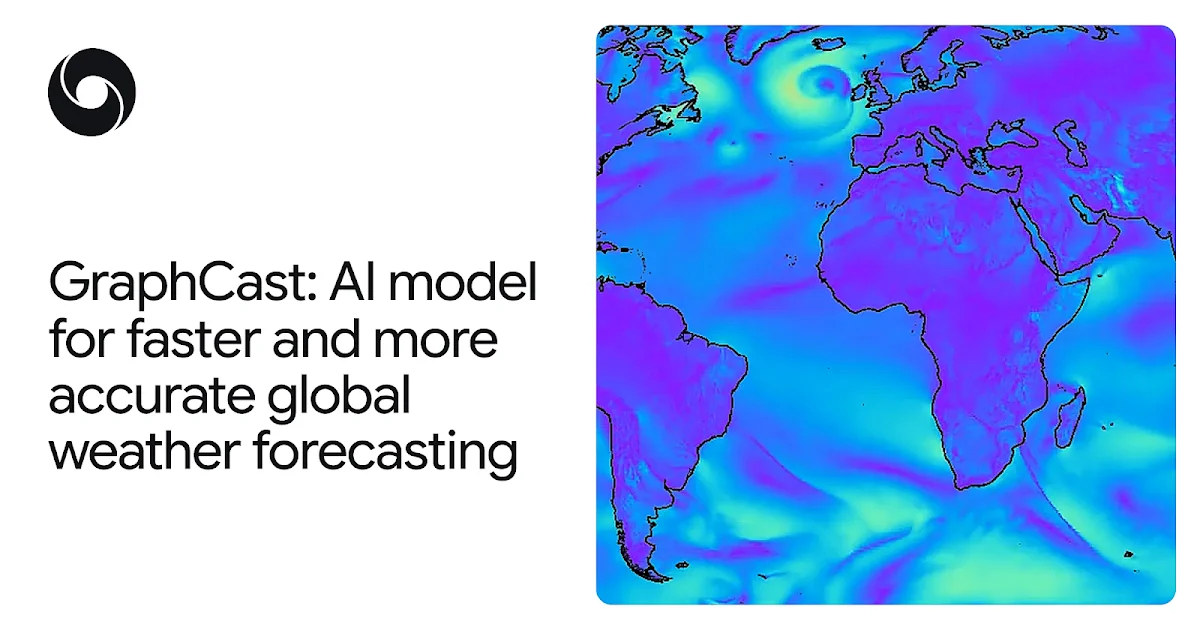
GraphCast is an advanced AI weather forecasting model developed by Google DeepMind that fundamentally transforms how meteorological predictions are generated. Using a graph neural network (GNN) architecture trained on four decades of ERA5 historical reanalysis data from ECMWF, GraphCast can produce accurate 10-day global weather forecasts in less than one minute on a single Google TPU — a task that previously required powerful supercomputers running for hours. The model predicts hundreds of weather variables including temperature, wind speed, atmospheric pressure, humidity, and precipitation across multiple altitude levels on a high-resolution global grid. In benchmarking tests, GraphCast outperformed ECMWF's industry-leading High Resolution Forecast (HRES) system in over 90% of evaluation targets, setting a new standard for forecast accuracy. GraphCast demonstrates particular strength in predicting extreme weather events such as tropical cyclones, atmospheric rivers, and heat waves, enabling earlier and more reliable warnings. The model is open source and available on GitHub, making it accessible to academic researchers, meteorological agencies, and developers. Its applications span disaster preparedness, renewable energy planning, agricultural decision-making, and climate research. GraphCast represents a paradigm shift toward machine learning-driven forecasting, complementing and eventually potentially replacing traditional physics-based numerical weather prediction in many scenarios.
Key Features
- 10-Day Global Weather Forecasts: Generates accurate, high-resolution weather forecasts for the entire globe up to 10 days ahead, covering hundreds of atmospheric variables at multiple pressure levels.
- Sub-Minute Inference Speed: Produces a full 10-day global forecast in under one minute on a single TPU, compared to hours of supercomputer time required by traditional numerical weather prediction systems.
- Graph Neural Network Architecture: Built on a GNN trained on 40 years of ERA5 reanalysis data, enabling the model to learn complex atmospheric dynamics far more efficiently than physics-based solvers.
- Superior Extreme Weather Detection: Demonstrates exceptional accuracy in tracking and predicting extreme weather events such as tropical cyclones, heat waves, and atmospheric rivers, enabling earlier warnings.
- Open-Source Availability: Fully open-sourced on GitHub, allowing meteorological agencies, academic researchers, and developers to replicate, fine-tune, and build applications on top of the model.
Use Cases
- Meteorological agencies generating rapid, cost-effective global weather forecasts as a complement or alternative to traditional numerical weather prediction systems.
- Disaster preparedness and emergency management organizations requiring early, accurate warnings for tropical cyclones, heat waves, and other extreme weather events.
- Renewable energy companies optimizing wind and solar power generation schedules based on accurate short- and medium-range weather forecasts.
- Agricultural businesses and governments making irrigation, planting, and harvesting decisions informed by high-resolution precipitation and temperature forecasts.
- Climate researchers and AI scientists studying atmospheric dynamics, model interpretability, and the application of deep learning to Earth system science.
Pros
- Unprecedented Forecasting Speed: Generates 10-day global forecasts in under 60 seconds, dramatically reducing the compute time and cost associated with traditional weather prediction methods.
- Best-in-Class Accuracy: Outperforms ECMWF's HRES — the gold standard in operational weather forecasting — in over 90% of evaluated metrics, setting a new benchmark for AI-driven meteorology.
- Freely Available and Open Source: Released publicly on GitHub, enabling the global research community to use, audit, and build upon the model at no cost.
- Strong Extreme Event Performance: Particularly excels at predicting high-impact weather events, giving emergency managers and policymakers more lead time for disaster preparedness.
Cons
- High Technical Barrier to Entry: Requires deep expertise in machine learning and meteorology to deploy effectively; there is no turnkey consumer-facing interface for non-technical users.
- Specialized Hardware Recommended: Optimal inference speed is achieved on Google TPUs or high-end GPUs, which may not be readily accessible to all researchers or organizations.
- Dependent on ERA5 Input Data Quality: Model performance is tied to the quality and timeliness of input reanalysis data; real-time operational deployment requires additional data pipeline infrastructure.
Frequently Asked Questions
What is Google GraphCast?
GraphCast is an AI-powered weather forecasting model developed by Google DeepMind. It uses a graph neural network trained on ERA5 historical reanalysis data to produce 10-day global weather forecasts at high accuracy in under one minute.
How accurate is GraphCast compared to traditional weather models?
GraphCast outperforms ECMWF's High Resolution Forecast (HRES) system — the leading operational weather forecasting model — in over 90% of evaluated forecast metrics, including surface variables and upper-atmosphere conditions.
Is GraphCast open source?
Yes, Google DeepMind has open-sourced GraphCast, making the model weights, architecture, and code publicly available on GitHub for research and development use.
What hardware is required to run GraphCast?
GraphCast runs optimally on a Google TPU and can produce a full 10-day global forecast in under one minute. It can also run on high-end GPUs, though inference times may vary.
What types of weather variables does GraphCast predict?
GraphCast predicts hundreds of atmospheric variables including surface temperature, wind speed and direction, atmospheric pressure, humidity, and precipitation across multiple altitude levels on a global grid.