

About
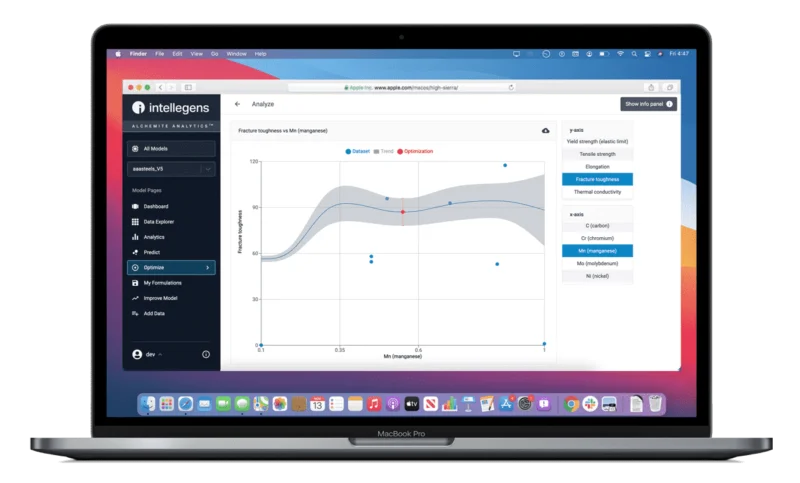
Intellegens Alchemite is a purpose-built machine learning suite that empowers scientists, engineers, and data teams to unlock hidden value in R&D datasets — even when data is sparse, incomplete, or noisy. Unlike generic ML tools, Alchemite was engineered specifically for the physical sciences and industrial R&D workflows. The Alchemite™ Suite includes specialized modules: Alchemite™ for DOE (Design of Experiments) cuts experimental workloads by 50–80% while surfacing solutions that traditional methods miss; Alchemite™ for Formulations accelerates the development of winning product formulations in chemicals, foods, and materials; Alchemite™ for R&D Insights applies deep learning to uncover patterns and drivers hidden in complex datasets; and Alchemite™ for Oligonucleotides supports biotech and life sciences research. Customers across industries — including NASA, Boeing, Genentech, Johnson Matthey, ArcelorMittal, and FUCHS — have reported outcomes such as 40% cost savings in manufacturing, 50% performance improvements, five-times-fewer required experiments, and formulation timescale reductions of months. The platform enables virtual experiments, predictive modeling, and intelligent experiment design, all through an accessible interface that requires no deep ML expertise. It is suitable for R&D teams in chemicals, materials science, FMCG, life sciences, additive manufacturing, and academic research.
Key Features
- Alchemite™ for DOE: Reduces experimental workloads by 50–80% by intelligently designing experiments and predicting outcomes, including solutions traditional DOE methods would miss.
- Alchemite™ for Formulations: Accelerates the discovery of optimal product formulations for chemicals, foods, materials, and lubricants by learning from existing formulation data.
- Alchemite™ for R&D Insights: Applies deep learning to uncover hidden patterns, identify key input drivers, and enable data-driven decision-making across complex R&D datasets.
- Sparse & Noisy Data Handling: Engineered to extract value from incomplete, sparse, or noisy real-world experimental data — no need for large, clean datasets to get started.
- Virtual Experimentation: Generates in-silico predictions for new input combinations, letting teams test hypotheses without running physical experiments.
Use Cases
- Optimizing dairy or food product formulations by identifying the most impactful ingredients and reducing development cycles.
- Designing improved catalyst formulations for chemical processes using fewer laboratory experiments.
- Accelerating alloy and advanced material development in additive manufacturing by predicting property outcomes from process parameters.
- Informing drug discovery and oligonucleotide R&D decisions by learning from existing biotech datasets.
- Reducing manufacturing testing costs by using ML models to identify optimal process parameters without exhaustive physical trials.
Pros
- Dramatic reduction in experimental cycles: Customers consistently report needing five times fewer experiments and months shorter development timelines compared to traditional approaches.
- Industry-validated across major enterprises: Adopted by global leaders including NASA, Boeing, Genentech, Johnson Matthey, and ArcelorMittal, demonstrating reliability at scale.
- Works with real-world imperfect data: Unlike most ML platforms, Alchemite is specifically designed to handle the sparse and noisy data common in scientific R&D environments.
- No deep ML expertise required: The platform is accessible to domain scientists and R&D professionals without requiring a dedicated data science background.
Cons
- Enterprise pricing model: Alchemite targets enterprise and mid-to-large R&D organizations; pricing is not publicly listed and may be prohibitive for smaller teams or startups.
- Domain-specific focus: Tailored for physical sciences and industrial R&D — not suitable for general-purpose ML tasks outside these domains.
- Limited self-serve transparency: Detailed product documentation, pricing, and onboarding information require direct contact with the sales team, limiting quick evaluation.
Frequently Asked Questions
What types of data does Alchemite work with?
Alchemite is designed to work with experimental R&D data that describes inputs (e.g., ingredients, process parameters, material compositions) and outputs (e.g., performance properties, yields, costs). It excels with sparse and noisy datasets common in scientific workflows.
Which industries does Alchemite serve?
Alchemite serves chemicals, advanced materials, FMCG and foods, life sciences (including biotech and drug discovery), manufacturing, additive manufacturing, and academic research.
How does Alchemite reduce experimental workloads?
By building predictive models from existing data, Alchemite enables virtual experiments and suggests the most informative next experiments. This allows teams to achieve the same R&D outcomes with 50–80% fewer physical experiments.
Is there a free trial available?
Yes, Intellegens offers a free trial of the Alchemite platform so R&D teams can evaluate its capabilities on their own data before committing to a full license.
Do I need machine learning expertise to use Alchemite?
No. Alchemite is designed to be accessible to domain scientists and engineers. The platform abstracts the complexity of deep learning, enabling R&D professionals to apply ML without needing a data science background.