

About
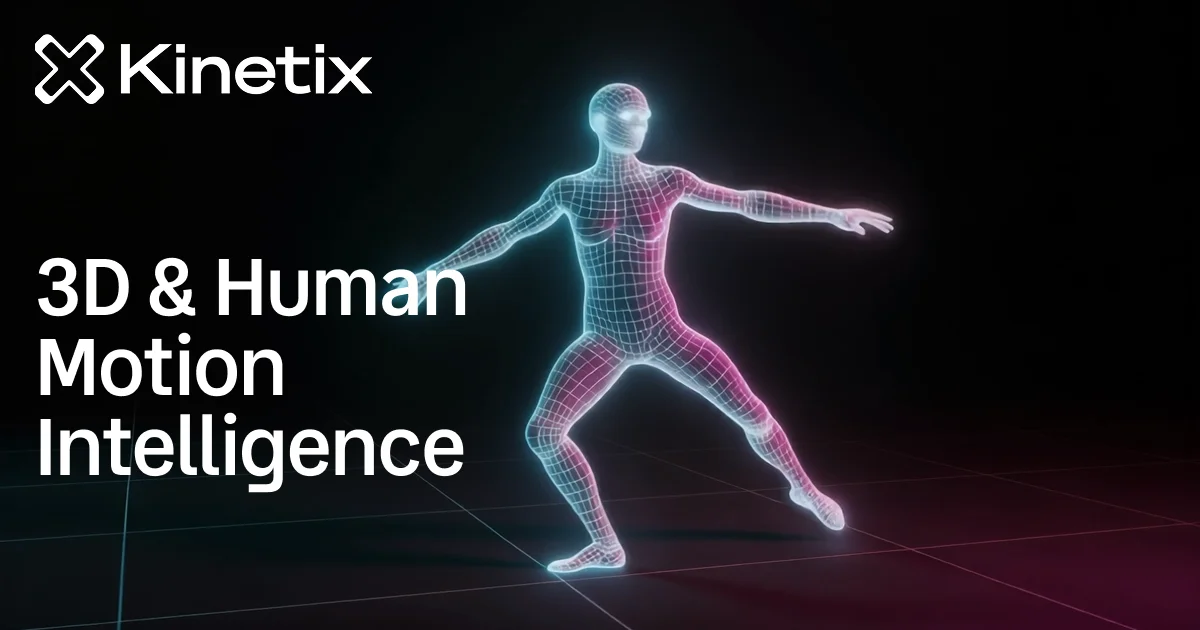
Kinetix is a frontier AI research lab specializing in 3D human motion intelligence, combining deep expertise in machine learning and 3D computer graphics to build state-of-the-art generative models for character animation. At the core of their work is human pose estimation, computer vision, and foundational 3D character workflow technologies. Their flagship product, Kamo-1, is a 3D-conditioned video generation model that introduces physical grounding and precise control into AI video. Kamo-1 supports multimodal conditioning including 3D camera trajectories, character animations reconstructed from RGB acting videos, reference images, and natural language prompts. By jointly conditioning on camera and character motion, it enables coordinated, spatially consistent video generation using depth and pose estimates as control signals via a flow-matching generation process. Kinetix's video-to-animation technology has been widely adopted across the industry: it is natively integrated into Unity's Muse AI services for game developers, licensed and integrated into Adobe Mixamo to enable AI-powered character animation for creators, and deployed as an in-game Emote Creator in KRAFTON's OVERDARE platform, allowing players to generate custom animations. The lab also built and deployed a moderation system for user-generated animation content. Kinetix is best suited for game developers, 3D artists, VFX studios, and platform builders seeking advanced AI-driven animation and video generation capabilities.
Key Features
- Kamo-1 Video Generation Model: A 3D-conditioned video generation model that brings physical grounding to AI video by jointly conditioning on camera trajectories and character animations via flow-matching.
- Video-to-3D Animation Conversion: Reconstructs 3D character animations from RGB acting videos, enabling creators and developers to generate animations from real-world footage.
- Multimodal Conditioning: Supports conditioning on 3D camera trajectories, character meshes, reference images, and natural language prompts for precise, coordinated scene control.
- Human Pose Estimation & Computer Vision: Core research in human pose estimation and computer vision enables accurate extraction of motion data from video inputs.
- Platform Integrations: Native integrations with Unity Muse, Adobe Mixamo, and KRAFTON's OVERDARE, enabling AI animation capabilities in industry-leading tools and games.
Use Cases
- Game developers generating custom 3D character animations directly within Unity using AI-powered video-to-animation tools.
- 3D artists and content creators animating characters in Adobe Mixamo using Kinetix's AI models instead of manual rigging.
- Game platforms enabling players to create personalized in-game emotes and animations from recorded video clips.
- VFX and film studios using Kamo-1 to generate physically grounded video scenes with precise camera and character motion control.
- Enterprise software companies licensing Kinetix's motion intelligence models to add AI animation capabilities to their own platforms.
Pros
- Physically Grounded Video Generation: Kamo-1 uses depth and pose estimates as control signals, producing spatially consistent video that respects the underlying 3D scene layout.
- Proven Industry Adoption: Technology is already integrated into major platforms including Unity, Adobe Mixamo, and a AAA game publisher, demonstrating production-grade reliability.
- Multimodal & Flexible Input: Accepts a wide range of input types—video, images, text, and 3D data—making it versatile for diverse animation and video production workflows.
Cons
- Research Lab Focus: As primarily a research lab and technology licensor, direct self-serve access for individual developers or small studios may be limited compared to consumer-facing tools.
- Limited Public Pricing Transparency: Pricing and access details are not publicly disclosed, requiring direct contact with the company to evaluate costs and availability.
- High Technical Barrier: The platform is optimized for enterprise integrations and technical teams; individual creators may find the onboarding process more complex than simpler animation tools.
Frequently Asked Questions
What is Kamo-1?
Kamo-1 is Kinetix's 3D-conditioned video generation model that enables physically grounded AI video creation. It conditions on 3D camera trajectories, character animations, reference images, and text prompts to produce spatially consistent video with coordinated character and camera motion.
How does Kinetix's video-to-animation technology work?
Kinetix uses computer vision and human pose estimation to reconstruct 3D character animations from standard RGB acting videos. The model extracts pose and depth data from the footage and converts it into usable 3D animation data.
Where is Kinetix's technology currently used?
Kinetix's animation AI is integrated into Unity Muse for game developers, licensed into Adobe Mixamo for character animation, and deployed as an in-game Emote Creator in KRAFTON's OVERDARE platform.
Who is Kinetix built for?
Kinetix primarily targets game developers, 3D artists, VFX studios, platform builders, and enterprise software companies seeking to integrate advanced AI animation and video generation capabilities into their products.
Is Kinetix a product or a research lab?
Kinetix operates as both a research lab and a technology provider. They publish research on human motion intelligence while also licensing and integrating their models into commercial platforms and products.