
About
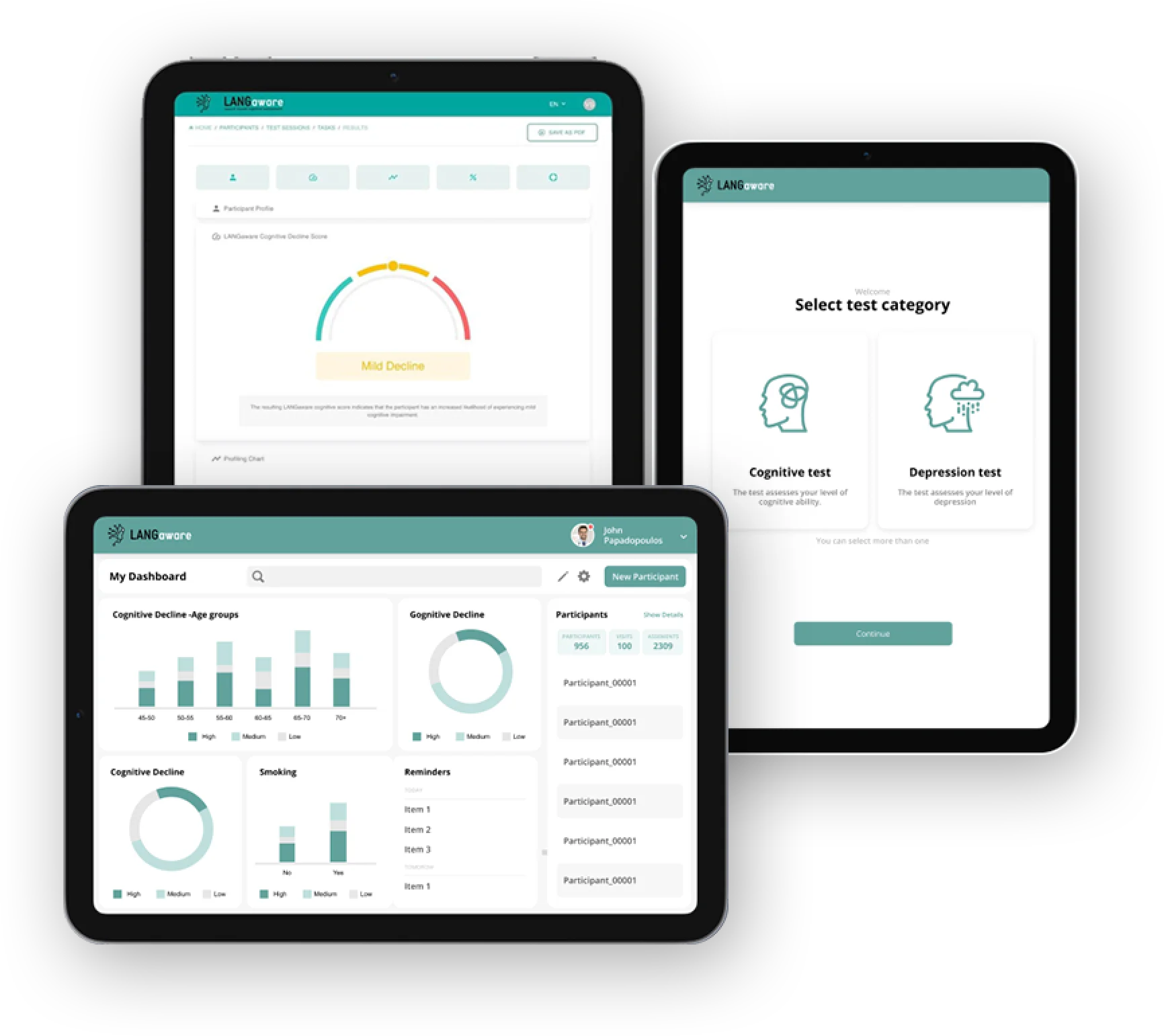
LANGaware is an advanced AI health-tech platform that harnesses proprietary voice and speech biomarker technology to enable early, objective detection of cognitive and mental health conditions including Mild Cognitive Impairment (MCI), Alzheimer's disease, and Depression. The platform works by collecting a brief audio sample—typically a 1-minute speaking task such as describing an image or a daily activity—which is then uploaded and analyzed by LANGaware's AI engine for linguistic, acoustic, and speech pattern signals. Results are generated within 3 minutes and delivered as a comprehensive report featuring 7 clinical data points, helping primary care providers and specialists make informed decisions around cognitive and mental health. The system achieves 90% sensitivity and 85% specificity for dementia detection, and 83% sensitivity and 80% specificity for depression, with ground truth labels validated by medical experts. LANGaware is designed for multiple stakeholders in the healthcare ecosystem: providers benefit from faster time-to-diagnosis and better specialist referrals; payors gain tools for risk adjustment and cost savings; life sciences companies can streamline clinical trial recruitment; and corporate wellness teams can support employee mental health initiatives. The platform is education-independent, stress-free, and can be administered in-person, remotely, or self-administered, making it highly accessible and scalable. It serves as a decision support tool and is not a substitute for medical diagnosis.
Key Features
- Proprietary Voice & Speech Biomarkers: Analyzes language, acoustic, and speech pattern signals from short audio samples using proprietary digital biomarkers developed and validated with medical experts.
- Rapid 3-Minute Results: Patients complete a 1-minute speaking task and receive a comprehensive clinical report within 2 additional minutes, enabling high-throughput screening.
- Multi-Condition Detection: Screens for Mild Cognitive Impairment (MCI), Alzheimer's disease (90% sensitivity, 85% specificity), and Depression (83% sensitivity, 80% specificity) from a single test.
- 7-Point Comprehensive Report: Generates a structured decision-support report with 7 clinical data points to help PCPs and specialists make informed cognitive and mental health assessments.
- Flexible, Accessible Administration: Education-independent and bias-free testing that works seamlessly in any setting—in-person, remote, or self-administered—without specialized equipment.
Use Cases
- Primary care providers screening elderly patients for early signs of Alzheimer's or MCI during routine checkups without lengthy neuropsychological evaluations.
- Health insurance payors identifying high-risk members for proactive specialist referrals, reducing costly late-stage treatment and hospitalizations.
- Life sciences companies accelerating clinical trial recruitment by quickly evaluating cognitive profiles of potential participants.
- Corporate wellness programs monitoring employee mental health at scale, reducing absenteeism and improving workforce engagement through early Depression detection.
- Telehealth and digital health platforms integrating cognitive and mental health screening directly into remote patient monitoring workflows.
Pros
- Fast and Clinically Accurate: Delivers results in under 3 minutes with high sensitivity and specificity validated by medical experts, reducing time-to-diagnosis significantly.
- Highly Accessible and Scalable: Education-independent and stress-free testing works in any environment and can be self-administered, making it easy to deploy at scale across diverse patient populations.
- Multi-Stakeholder Value: Serves providers, payors, life sciences companies, and corporate wellness programs with a single unified platform, driving ROI across the healthcare ecosystem.
Cons
- Decision Support Only: Results are not a substitute for formal medical diagnosis or clinical decisions; the tool must be used in conjunction with professional medical evaluation.
- Enterprise-Focused Access: Designed primarily for institutional clients; individual consumers or small clinics must go through a demo request process with no self-serve sign-up available.
- Limited Public Pricing Transparency: No publicly listed pricing or free tier; costs are available only after contacting the sales team, which may delay evaluation for smaller organizations.
Frequently Asked Questions
How does LANGaware detect cognitive and mental health conditions?
LANGaware records a short audio sample of the patient performing a speaking task—such as describing an image—and then applies AI algorithms to analyze proprietary voice and speech biomarkers. These biomarkers capture linguistic, acoustic, and speech pattern signals associated with conditions like MCI, Alzheimer's, and Depression.
What conditions can LANGaware screen for?
The platform currently supports early detection of Mild Cognitive Impairment (MCI), Alzheimer's disease (AD), and Depression. The company continues to expand its biomarker library for additional conditions.
How accurate is the LANGaware platform?
LANGaware achieves 90% sensitivity and 85% specificity for dementia detection, and 83% sensitivity and 80% specificity for depression. Ground truth labels are provided by medical experts to ensure clinical-grade accuracy.
Who is LANGaware designed for?
LANGaware serves healthcare providers (PCPs, specialists), health insurance payors, life sciences and clinical trial teams, and corporate wellness programs looking to proactively screen employees for cognitive and mental health risks.
Is LANGaware a replacement for a medical diagnosis?
No. LANGaware is a decision support tool that helps clinicians identify high-risk patients and make timely referrals. It is not a substitute for formal medical diagnosis or clinical evaluation by a licensed healthcare professional.