
About
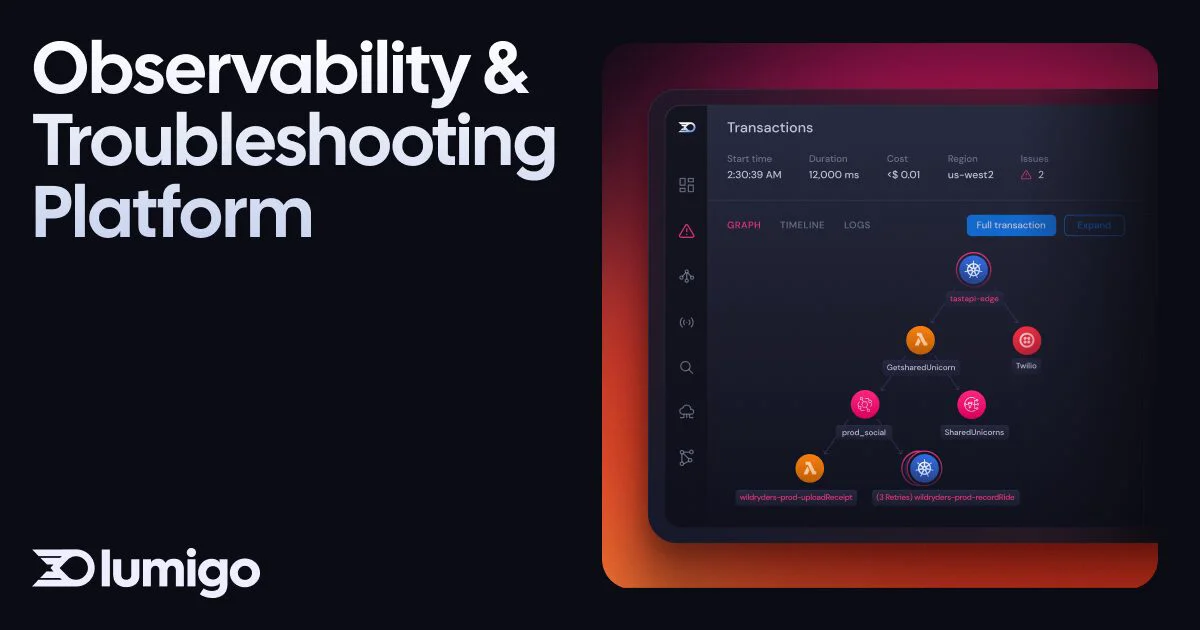
Lumigo is an AI-powered monitoring and troubleshooting platform designed for teams building and operating microservice and cloud-native applications. It provides comprehensive observability across your entire cloud infrastructure, from serverless functions to containerized services, enabling developers and DevOps engineers to identify and resolve issues in seconds rather than hours. At the heart of Lumigo is its AI-driven troubleshooting engine, which captures payload requests to deliver precise root cause analysis across complex, distributed systems. Its distributed tracing feature deploys end-to-end request tracking in minutes without code changes, supporting AWS, Kubernetes, and OpenTelemetry environments. Lumigo's log management solution uses a custom data ingestion pipeline to slash logging costs by up to 70%, while enriching log entries with trace and payload context for faster resolution. Real-time metrics dashboards provide visibility into application architecture and performance at every layer. A standout capability is Lumigo's AI Agent Observability module, which surfaces full visibility into LLM-based agent workflows — including every prompt, response, decision, token usage count, and latency metric across models and endpoints. This is invaluable for organizations deploying AI-driven applications at scale. With integrations for Kubernetes, AWS Lambda, ECS, EKS, EventBridge, MongoDB, Slack, Twilio, and hundreds more, Lumigo fits seamlessly into modern development toolchains. It is especially well-suited for startups and enterprises that need production-grade observability with minimal setup overhead. Lumigo is currently joining Dash0, continuing its trajectory of innovation in the developer observability space.
Key Features
- AI-Powered Root Cause Analysis: Automatically identifies and analyzes issues across distributed services using AI, drastically reducing time spent on manual log analysis and debugging.
- Instant Distributed Tracing: Deploy end-to-end request tracing in minutes across AWS, Kubernetes, and OpenTelemetry environments — no code changes required.
- Cost-Effective Log Management: Centralize logs from all services into one platform with a custom ingestion pipeline that reduces logging costs by up to 70% without sacrificing critical insights.
- Real-Time Metrics & Monitoring: Visualize application architecture and performance with custom metrics dashboards, AI-triggered alerts, and full-stack monitoring across microservices and serverless functions.
- AI Agent Observability: Track every prompt, LLM response, tool call, token usage, and latency metric across AI agent workflows to optimize cost and performance of AI-driven applications.
Use Cases
- Debugging distributed microservice failures by tracing requests across services to pinpoint the root cause without manual log sifting.
- Monitoring Kubernetes clusters and AWS Lambda functions in real time to detect performance degradations and availability issues before they impact users.
- Reducing cloud logging costs by up to 70% using Lumigo's custom ingestion pipeline while maintaining full log context and searchability.
- Gaining full observability into AI agent and LLM workflows to track token usage, latency, and decision logic for cost optimization and reliability.
- Centralizing observability across a multi-cloud or hybrid AWS environment with unified dashboards, AI alerts, and integrations for Slack, MongoDB, and other tools.
Pros
- Zero-Code Deployment: End-to-end tracing and observability can be deployed in minutes without any code changes, lowering the barrier to adoption significantly.
- Significant Cost Reduction: The custom log ingestion pipeline can cut logging expenses by up to 70%, making it cost-effective even at scale.
- Broad Integration Ecosystem: Supports hundreds of tools and services including Kubernetes, AWS Lambda, ECS, EKS, Slack, MongoDB, and more, fitting naturally into modern stacks.
- AI Agent Visibility: Unique LLM and AI agent observability features provide insight that generic monitoring tools lack, making it a strong choice for AI-native teams.
Cons
- Primarily AWS and Cloud-Focused: Lumigo's deepest integrations are centered on AWS services and cloud-native environments, which may limit value for teams with on-premise or non-AWS infrastructure.
- Pricing Can Escalate at Scale: While a free tier is available, costs can grow quickly for high-volume environments with many services, traces, or log ingestion requirements.
- Steeper Learning Curve for Advanced Features: Features like custom metrics, AI agent observability, and full distributed tracing configuration may require time to configure and fully leverage.
Frequently Asked Questions
What is Lumigo used for?
Lumigo is used for monitoring, troubleshooting, and gaining full observability into microservice and cloud-native applications. It provides distributed tracing, log management, real-time metrics, AI-powered root cause analysis, and AI agent observability.
Does Lumigo require code changes to get started?
No. Lumigo is designed for instant deployment and can set up end-to-end tracing across AWS, Kubernetes, and OpenTelemetry environments in minutes without any code changes.
Does Lumigo support Kubernetes monitoring?
Yes. Lumigo offers dedicated Kubernetes observability features, including support for EKS clusters and containerized workloads, providing visibility into container performance and microservices health.
What is Lumigo Copilot?
Lumigo Copilot is the platform's AI-powered observability feature that uses intelligent analysis to help developers diagnose and resolve complex microservice issues faster, leveraging payload data for more precise troubleshooting.
Is Lumigo free to use?
Lumigo offers a free tier to get started. Paid plans with expanded usage limits, advanced features, and enterprise support are available for larger teams and production environments.