
About
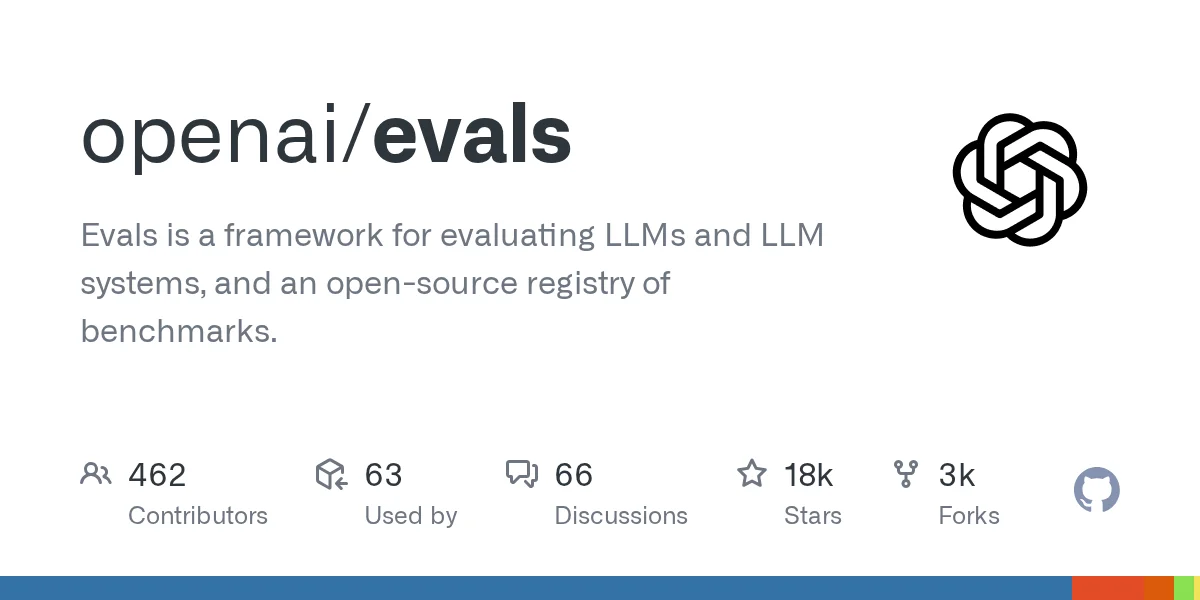
OpenAI Evals is a powerful, open-source evaluation framework designed to measure the quality and reliability of large language models (LLMs) and the systems built around them. Maintained by OpenAI and backed by an active open-source community with over 18,000 GitHub stars, it serves as both a flexible evaluation harness and a publicly accessible registry of benchmarks. With Evals, developers can run standardized tests against OpenAI models—or any LLM—across dimensions like accuracy, reasoning, instruction-following, and factual correctness. It also supports writing fully custom evaluations tailored to specific workflows, domains, or datasets. Importantly, private evals can be created using sensitive or proprietary data without exposing it publicly, making the tool suitable for enterprise compliance and quality assurance pipelines. The framework integrates directly with the OpenAI Dashboard for a no-code experience, allowing teams to configure and run evals without deep Python expertise. For power users, the Python-based CLI and library offer granular control over evaluation logic, metrics, and result reporting. OpenAI Evals is ideal for AI engineers validating model upgrades, researchers benchmarking emerging models, and product teams ensuring LLM-powered features meet quality standards before shipping. Its open registry also enables community-contributed benchmarks, fostering transparency and reproducibility in AI evaluation.
Key Features
- Open-Source Benchmark Registry: Access a community-maintained registry of benchmarks covering diverse LLM capabilities including reasoning, accuracy, and instruction-following.
- Custom Eval Authoring: Write your own evaluations tailored to your specific use case, domain, or dataset using the Python framework and templating system.
- Private Data Evals: Build private evaluations using proprietary or sensitive data without exposing it publicly, enabling enterprise-grade quality assurance.
- OpenAI Dashboard Integration: Configure and run evaluations directly from the OpenAI Dashboard without requiring code, making evals accessible to non-engineers.
- Model-Agnostic Architecture: Test any LLM or LLM-powered system, not just OpenAI models, making it suitable for comparative benchmarking across providers.
Use Cases
- Validating that a new model version maintains or improves performance before deploying it to production.
- Benchmarking multiple LLMs side-by-side to choose the best fit for a specific application or domain.
- Building a CI/CD quality gate for LLM-powered products that automatically flags regressions in model output quality.
- Creating private evaluations with enterprise data to measure model suitability for regulated or sensitive workflows.
- Contributing to and consuming community benchmarks for reproducible, transparent AI research and model comparisons.
Pros
- Fully Open Source: Free to use, fork, and contribute to under an open license with a large, active GitHub community and 18,000+ stars.
- Flexible Evaluation Modes: Supports both no-code Dashboard-based evals and deep programmatic customization via Python for advanced users.
- Private & Public Eval Support: Allows teams to keep sensitive evaluation data private while still leveraging the full framework — critical for enterprise and regulated industries.
Cons
- Steep Learning Curve for Custom Evals: Writing custom evaluations requires Python familiarity and understanding of the framework's architecture, which may be a barrier for non-developers.
- Primarily Optimized for OpenAI Models: While model-agnostic in principle, the framework and many built-in evals are most tightly integrated with OpenAI's own model ecosystem.
- Limited Built-in Visualization: Result analysis and visualization capabilities are basic out of the box; teams may need to build additional tooling to interpret results at scale.
Frequently Asked Questions
What is OpenAI Evals?
OpenAI Evals is an open-source Python framework for evaluating the performance of large language models (LLMs) and applications built on them. It includes a registry of community benchmarks and tools for writing custom evaluations.
Can I use OpenAI Evals with non-OpenAI models?
Yes. While the framework is maintained by OpenAI and integrates tightly with OpenAI's APIs, it is architecturally model-agnostic and can be adapted to evaluate other LLMs.
Is my data safe when running private evals?
Yes. OpenAI Evals supports private evaluations that use your own data without publishing it to the public registry, making it suitable for proprietary or sensitive use cases.
Do I need coding skills to use OpenAI Evals?
Not necessarily. Basic evals can be run via the OpenAI Dashboard with no code. However, creating custom evaluations requires Python knowledge and familiarity with the framework.
How do I contribute a benchmark to the registry?
You can contribute benchmarks by submitting a pull request to the openai/evals GitHub repository. The project has contribution guidelines and an active community of reviewers.