
About
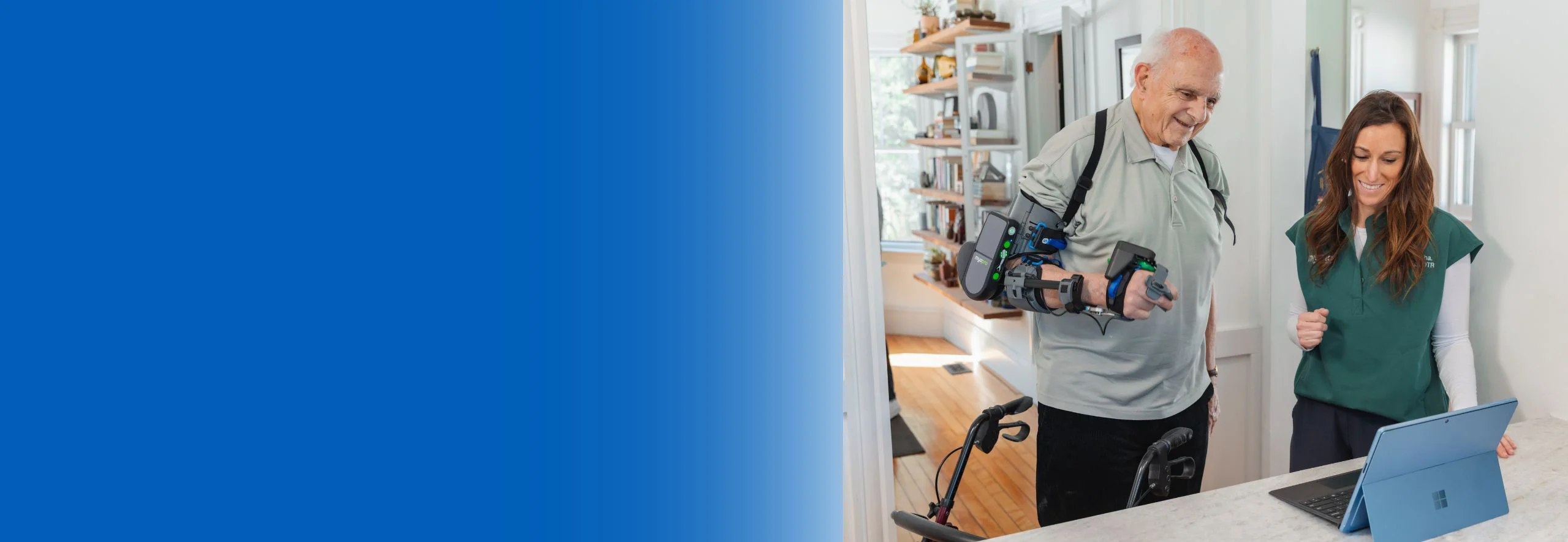
Myomo is a medical robotics company specializing in myoelectric-controlled arm orthoses for people with upper-limb paralysis or weakness. Their flagship product, the MyoPro®, is an electronically powered brace that reads the user's own residual electromyographic (EMG) muscle signals through non-invasive surface sensors and uses that input to power movement in the elbow, wrist, and hand. This enables users to perform activities of daily living (ADLs) independently — reaching, gripping, lifting, and carrying — that would otherwise be impossible. The device serves patients recovering from stroke, those living with brachial plexus injuries (BPI), cerebral palsy, ALS, spinal cord injuries, and other neuromuscular disorders. MyoPro is custom-fabricated for each patient and can be used both during clinical therapy sessions and at home for continued rehabilitation and independence. Myomo supports clinicians with software tools such as MyConfig for device programming, detailed research and clinical evidence resources, and MIRF (Myomo Insurance Reimbursement Forms) to simplify the billing process. The company has secured CMS Medicare DMEPOS fee schedule codes (L8701/L8702), enabling lump-sum reimbursement for qualifying Medicare Part B beneficiaries. Myomo also maintains dedicated programs for U.S. veterans. The MyoPro line includes models such as the MyoPro 2, 2+, and 2x to address varying clinical needs.
Key Features
- Myoelectric EMG Control: Detects the user's own residual muscle signals via surface sensors to power arm and hand movement without invasive surgery.
- Custom Fabrication: Each MyoPro device is custom-built to fit the individual patient's anatomy, ensuring comfort and optimal function.
- Home & Clinical Use: Patients can use the device during formal therapy sessions and take it home to continue performing ADLs independently.
- Medicare & Insurance Coverage: CMS has established DMEPOS fee schedule codes (L8701/L8702), enabling lump-sum Medicare Part B reimbursement for qualifying patients.
- MyConfig Software for Clinicians: Clinicians use MyConfig software to program and fine-tune each device to match the patient's specific muscle signal patterns and functional goals.
Use Cases
- Stroke survivors regaining the ability to reach, grip, and lift objects during daily life and therapy
- Patients with brachial plexus injuries using the device to perform self-care tasks such as dressing and eating independently
- Veterans with service-related upper-limb injuries restoring functional arm use through the MyoPro program
- Cerebral palsy patients leveraging myoelectric control to improve voluntary arm movement and reduce reliance on caregivers
- Physical and occupational therapists using the MyoPro in clinical rehabilitation sessions to accelerate functional recovery and document patient progress
Pros
- Restores Meaningful Independence: Empowers users to perform everyday tasks — eating, dressing, carrying — that paralysis had previously made impossible, significantly improving quality of life.
- Non-Invasive Technology: Uses surface EMG sensors rather than implants or surgery, making it accessible and low-risk for a broad patient population.
- Insurance & Medicare Reimbursable: Established CMS DMEPOS codes reduce financial barriers, allowing Medicare Part B beneficiaries to receive coverage for the device.
- Strong Clinical Support Ecosystem: Provides clinicians with evidence-based resources, programming software, and insurance reimbursement tools to streamline prescribing and fitting.
Cons
- Requires Residual Muscle Signal: The device depends on detectable EMG signals from the user's muscles; patients with no residual muscle activity may not be candidates.
- High Device Cost: As a custom-fabricated powered orthosis, the MyoPro carries a significant price tag, and insurance approval processes can be lengthy.
- Limited Availability: Access to qualified fitting clinicians and MyoPro providers may be limited depending on the user's geographic location.
Frequently Asked Questions
Who is eligible for the MyoPro?
Individuals with arm or hand paralysis or weakness caused by stroke, brachial plexus injury (BPI), cerebral palsy, ALS, spinal cord injury, or other neuromuscular conditions may be eligible. A key requirement is the presence of some residual EMG muscle signal in the affected limb.
Is the MyoPro covered by Medicare or insurance?
Yes. CMS has established Medicare DMEPOS fee schedule codes L8701 and L8702 for the MyoPro, enabling lump-sum reimbursement for qualifying Medicare Part B beneficiaries. Many private insurers also cover the device. Myomo provides MIRF (Myomo Insurance Reimbursement Forms) to assist clinicians with the process.
Can the MyoPro be used at home, or only in a clinical setting?
The MyoPro is designed for both clinical therapy and independent home use. After fitting and training, patients take the custom-fabricated device home to perform activities of daily living on their own.
What conditions can the MyoPro help treat?
The MyoPro is indicated for stroke survivors, people with brachial plexus injuries, cerebral palsy, multiple sclerosis, ALS, incomplete spinal cord injuries, and other upper-motor or lower-motor neuron conditions affecting arm and hand function.
How do clinicians prescribe and configure the MyoPro?
Clinicians evaluate patient eligibility, complete a referral, and work with Myomo's clinical team for fitting. The MyConfig software is then used to program the device's EMG sensitivity and motion parameters to match the individual patient's needs.