M
About
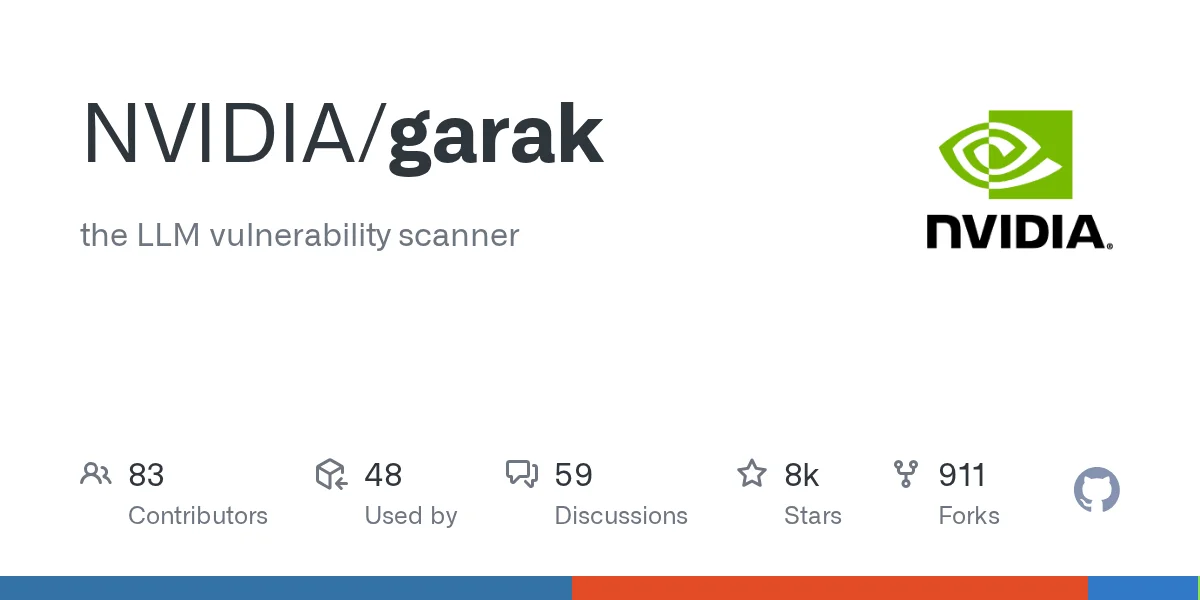
NVIDIA Garak (Generative AI Red-teaming & Assessment Kit) is a powerful open-source security tool built specifically for evaluating the robustness and safety of large language models (LLMs). Functioning similarly to penetration testing tools like nmap or Metasploit Framework—but purpose-built for AI—Garak systematically probes LLMs to discover exploitable weaknesses before they reach production environments. Garak covers a comprehensive range of vulnerability categories including hallucination, data leakage, prompt injection, misinformation, toxicity generation, and jailbreak susceptibility. Its modular architecture allows security researchers, AI engineers, and red teams to run targeted or broad assessments against any LLM endpoint. With over 7,600 GitHub stars and active community contributions, Garak has become the standard open-source toolkit for AI red-teaming. It is especially relevant for organizations deploying LLMs in regulated industries or high-stakes environments where safety, compliance, and robustness are critical. Garak is designed for developers, AI safety researchers, enterprise security teams, and anyone responsible for validating that an LLM behaves safely under adversarial conditions. It supports automated scanning workflows and can be integrated into CI/CD pipelines or used standalone via the command line.
Key Features
- Comprehensive Vulnerability Probing: Tests LLMs across a wide range of failure modes including hallucination, data leakage, prompt injection, misinformation, toxicity, and jailbreaks.
- Red-Teaming Automation: Automates adversarial probing of LLMs in a systematic, repeatable way—similar to how penetration testing tools work for traditional software.
- Modular and Extensible Architecture: Garak's plugin-based design allows users to add custom probes, detectors, and generators to target specific LLM behaviors or application contexts.
- Multi-Model Support: Works with a wide variety of LLM backends and APIs, enabling security assessments across different providers and model families.
- Detailed Reporting: Generates structured reports of vulnerabilities found, helping teams prioritize remediation and track safety improvements over time.
Use Cases
- Security teams red-teaming LLMs before deploying them in customer-facing applications to catch prompt injection and jailbreak vulnerabilities.
- AI researchers studying and cataloging failure modes across different language model architectures and providers.
- Enterprises in regulated industries (finance, healthcare, government) running compliance-oriented safety assessments on their LLM deployments.
- MLOps and DevSecOps teams integrating automated LLM vulnerability scanning into CI/CD pipelines to catch regressions after model updates.
- Academic researchers evaluating the robustness and safety properties of open-source and proprietary language models.
Pros
- Completely Open Source: Licensed under Apache-2.0, Garak is free to use, inspect, and extend—making enterprise-grade LLM security testing accessible to everyone.
- Broad Coverage of AI Vulnerabilities: Covers a comprehensive taxonomy of LLM risks including jailbreaks, prompt injection, toxicity, and hallucination in a single tool.
- NVIDIA-Backed with Active Community: Maintained by NVIDIA with 7,600+ GitHub stars and active community contributions, ensuring the tool stays current with emerging threats.
- Familiar Penetration Testing Paradigm: Security professionals familiar with tools like nmap or Metasploit will find Garak's conceptual model intuitive and immediately applicable.
Cons
- Requires Technical Setup: As a Python CLI tool, Garak requires programming knowledge and environment configuration, making it less accessible to non-technical users.
- No Native GUI: Garak operates entirely via the command line and lacks a graphical interface, which may slow adoption among teams without CLI experience.
- Evolving Threat Coverage: The AI security landscape evolves rapidly; some emerging attack vectors may not yet have corresponding probes in the current release.
Frequently Asked Questions
What is NVIDIA Garak?
Garak (Generative AI Red-teaming & Assessment Kit) is an open-source LLM vulnerability scanner developed by NVIDIA. It systematically probes language models for weaknesses like hallucination, prompt injection, jailbreaks, and toxicity generation.
How is Garak similar to nmap or Metasploit?
Like nmap scans network hosts for open ports and vulnerabilities, Garak scans LLMs for exploitable failure modes. It automates adversarial probing in a structured way, making it the AI equivalent of traditional penetration testing tools.
What types of vulnerabilities does Garak detect?
Garak probes for hallucination, data leakage, prompt injection, misinformation, toxicity generation, jailbreaks, and many other LLM-specific weaknesses.
Is Garak free to use?
Yes. Garak is fully open-source under the Apache-2.0 license and free to use for both research and commercial purposes.
Who should use Garak?
Garak is ideal for AI security researchers, ML engineers, enterprise security teams, and any organization that deploys LLMs in production and needs to validate their safety and robustness before or after deployment.