

About
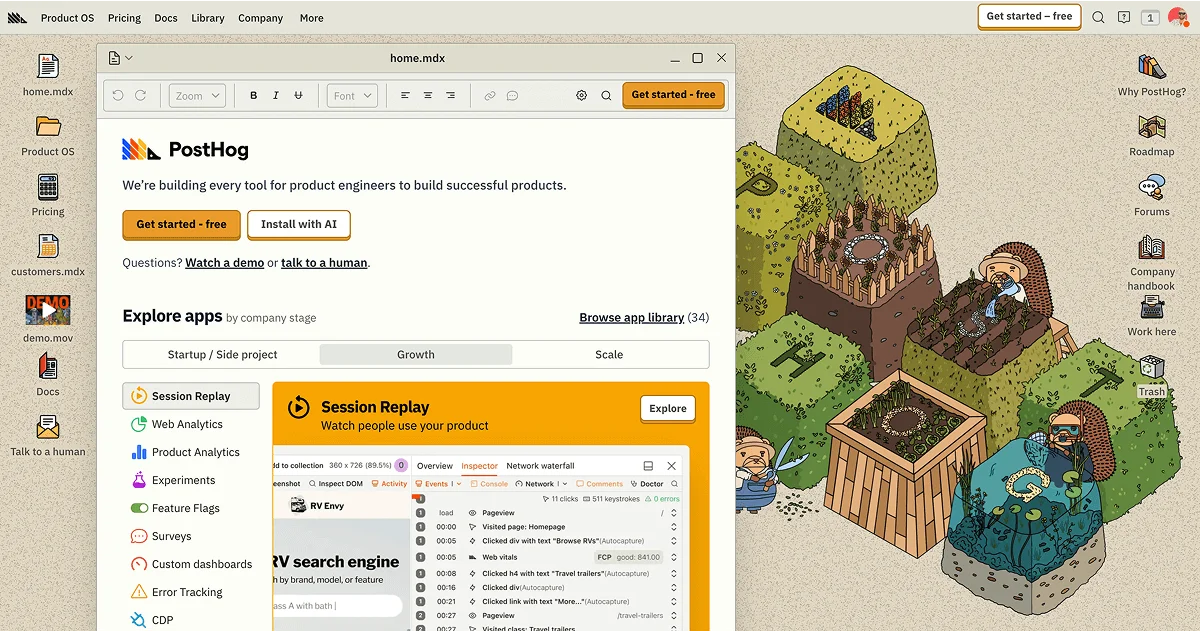
PostHog is a comprehensive, open-source product operating system designed for product engineers who want to move fast without juggling dozens of disconnected tools. At its core, PostHog provides product analytics, web analytics, revenue analytics, session replay, heatmaps, funnel analysis, user paths, and lifecycle tracking — all in a single platform with a unified data model. Beyond analytics, PostHog includes feature flags and A/B testing so teams can safely roll out changes to targeted user segments. Its built-in managed data warehouse supports 120+ sources and destinations, a SQL editor, BI dashboards, and a CDP-lite user activity feed, giving data teams a single source of truth that includes payment data from Stripe, support tickets, error tracking events, and more. For AI-native products, PostHog ships LLM observability tooling — evals, traces, and generation monitoring — so teams can measure the performance of their AI features the same way they measure everything else. PostHog AI assistant works across the platform to auto-generate insights, summarize trends, and answer natural-language questions about your data. PostHog is self-hostable (open source) or available as a fully managed cloud service with transparent, usage-based pricing. Free tiers cover 1M analytics events, 5,000 session recordings, and 1M feature flag requests per month. It's ideal for startups, scale-ups, and engineering-led teams that want product visibility without the overhead of a traditional enterprise analytics stack.
Key Features
- Product & Web Analytics: Track events, funnels, user paths, lifecycle stages, and conversion metrics across your entire product with powerful filtering by person, company, or AI feature.
- Session Replay & Heatmaps: Record and replay real user sessions to diagnose bugs and UX friction points. Heatmaps reveal exactly where users click, scroll, and drop off.
- Feature Flags & A/B Testing: Safely roll out features to targeted audiences and run experiments with built-in statistical analysis — no third-party tool required.
- Built-in Data Warehouse: Connect 120+ data sources (Stripe, support tools, error trackers) and query everything with a SQL editor alongside PostHog's native product data.
- LLM Observability: Monitor AI features with evals, traces, and generation tracking so teams can measure LLM quality and cost alongside all other product metrics.
Use Cases
- A SaaS startup uses PostHog to track onboarding funnel drop-off, replay problem sessions, and roll out a new pricing page to 10% of users via feature flags — all without leaving one platform.
- An engineering team at a scale-up queries Stripe payment data alongside in-app event data in PostHog's SQL editor to understand which features correlate with revenue expansion.
- A product manager monitors daily active usage trends and sets up heatmaps on a newly launched dashboard to identify which UI elements are being ignored.
- An AI startup instruments their LLM-powered chat feature with PostHog's tracing and evals tooling to track latency, cost-per-query, and user satisfaction scores over time.
- A growth engineer runs an A/B test on a checkout flow, analyzes session replays of the losing variant to understand why it underperformed, and ships the winning version to 100% of users.
Pros
- Genuinely generous free tier: 1M analytics events, 5K session recordings, and 1M feature flag requests per month free — 98% of customers never pay a cent.
- Everything in one platform: Replaces a fragmented stack of Mixpanel, FullStory, LaunchDarkly, and a data warehouse with a single, unified product OS.
- Open source & self-hostable: The full platform is open source and can be self-hosted, giving teams full data control and no vendor lock-in.
- Built for engineers: Developer-first DX with an MCP server, AI-assisted setup wizard, SDKs, and a transparent, no-sales-call pricing model.
Cons
- Can be overwhelming for small teams: The breadth of features means there's a learning curve; smaller teams may not need — or have the bandwidth to leverage — the full platform.
- Self-hosting requires DevOps effort: Running PostHog on your own infrastructure demands ongoing maintenance, scaling, and operational expertise.
- Costs can scale quickly at high volume: Usage-based pricing is competitive, but high-traffic products processing hundreds of millions of events per month can accumulate meaningful bills.
Frequently Asked Questions
Is PostHog really free?
Yes — PostHog's cloud product has generous free tiers (1M analytics events, 5K session recordings, 1M feature flag requests per month) and 98% of customers use it without paying. Beyond the free tier, pricing is usage-based and decreases with volume.
Can I self-host PostHog?
Yes. PostHog is open source and fully self-hostable on your own infrastructure, giving you complete data ownership and control.
How does PostHog differ from Mixpanel or Amplitude?
PostHog bundles analytics, session replay, feature flags, A/B testing, and a data warehouse into a single platform, whereas Mixpanel and Amplitude are analytics-only and require separate tools for the rest of the stack.
Does PostHog support AI / LLM product monitoring?
Yes. PostHog includes LLM observability features — evals, traces, and generation tracking — so teams building AI-powered products can measure model performance alongside standard product metrics.
What integrations does PostHog support?
PostHog supports 120+ data sources and destinations including Stripe, Salesforce, Hubspot, Segment, Zapier, and more. It also exposes a full REST API and supports webhooks for custom integrations.