

About
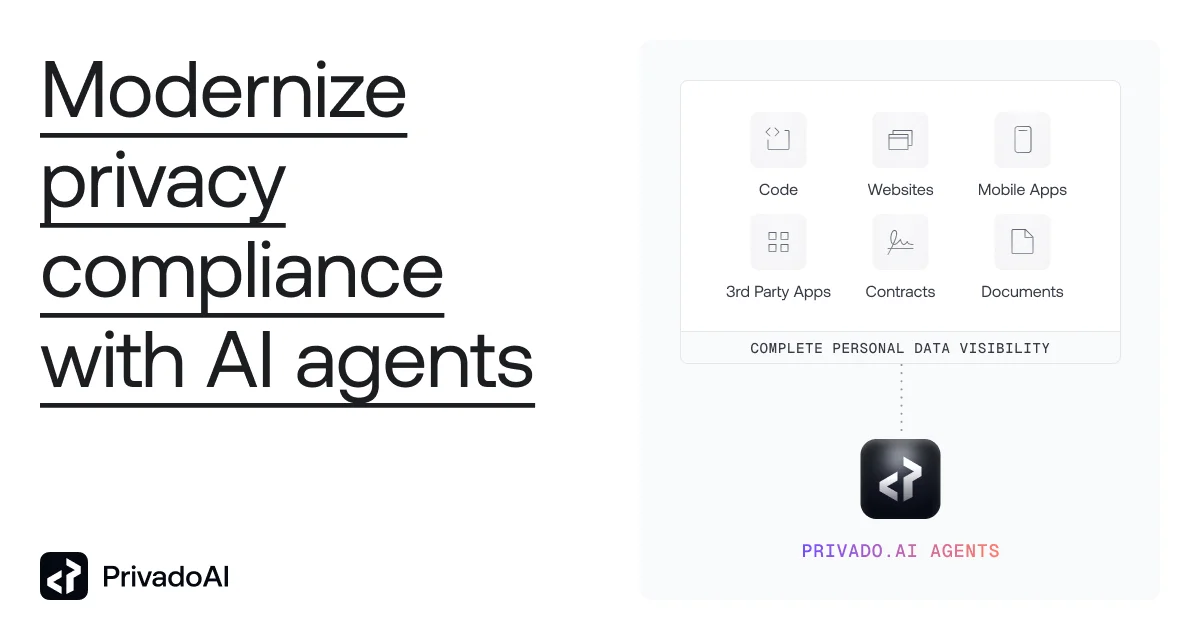
Privado AI modernizes privacy compliance by combining complete personal data visibility with AI agent automation. Traditional privacy tools rely on manual questionnaires and periodic audits that can't keep pace with rapidly evolving tech stacks — Privado AI solves this by continuously scanning first-party code, third-party integrations, contracts, mobile apps, and websites to build and maintain accurate, real-time data maps without human input. At the core of the platform is Wren, an AI privacy analyst that powers Agentic Assessments — automatically populating PIAs, DPIAs, and RoPAs by analyzing product requirement documents, Jira tickets, technical specs, contracts, and business proposals. Dynamic Data Maps are generated from this scanning and stay synchronized as data flows evolve, eliminating blind spots across all processing activities. The Web Auditor continuously verifies that consent banners, cookies, pixels, and data flows are compliant with CCPA, GDPR, CIPA, VPPA, and other regional laws. The App Auditor performs equivalent compliance checks on iOS and Android app files after every update. The Code Risk Scanner identifies privacy vulnerabilities pre- and post-release, enabling engineering teams to catch issues early in the SDLC. Privado AI is purpose-built for enterprise privacy teams, data protection officers, and privacy engineers who need scalable, automated governance without constant manual overhead. It supports use cases across consent monitoring, digital tracking governance, RoPA automation, and auto-risk discovery.
Key Features
- Agentic Assessments: AI agents automatically populate 100% of PIAs, DPIAs, and RoPAs by analyzing imported documents such as product requirements, Jira tickets, contracts, and technical specs.
- Dynamic Data Maps: Build and maintain comprehensive, real-time data maps for all processing activities by scanning first-party software, third-party tools, contracts, and documentation — no questionnaires required.
- Web Auditor: Continuously monitors websites to verify that consent banners, cookies, tracking pixels, and data flows comply with CCPA, GDPR, CIPA, VPPA, and other regional privacy regulations.
- App Auditor: Scans iOS and Android app files after each release to verify SDK usage, consent mechanisms, and data flows meet applicable privacy law requirements in each jurisdiction.
- Privacy Code Scanning: Identifies privacy risks in source code pre- and post-release, enabling engineering teams to catch compliance issues early in the software development lifecycle.
Use Cases
- Automating GDPR and CCPA compliance by having AI agents populate privacy impact assessments and records of processing activities from existing documentation.
- Building and maintaining real-time data maps for enterprise organizations without manual questionnaires, ensuring accuracy as products and data flows evolve.
- Continuously monitoring websites for consent banner compliance, unauthorized tracking pixels, and cookie policy violations across multiple jurisdictions.
- Scanning iOS and Android mobile apps after each release to catch privacy regulation violations before they result in enforcement actions or fines.
- Integrating privacy code scanning into the software development lifecycle to identify personal data risks in source code before deployment.
Pros
- Full Compliance Automation: AI agents eliminate the manual effort of filling out privacy assessments and maintaining data maps, dramatically reducing resource strain on privacy teams.
- Real-Time Data Visibility: Continuously updated data maps reflect current data flows across all software layers, ensuring accurate compliance posture even as products evolve rapidly.
- Broad Coverage: Covers the entire tech stack — web, iOS, Android, backend code, third-party integrations, and documents — providing holistic privacy risk discovery in one platform.
- Multi-Regulation Support: Supports compliance monitoring for CCPA, GDPR, CIPA, VPPA, and other regional laws from a single unified platform.
Cons
- Enterprise-Oriented Pricing: The platform is designed for enterprise privacy teams and requires a demo to access pricing, making it potentially inaccessible for small businesses or individual practitioners.
- Integration Setup Required: Deriving maximum value requires connecting Privado AI to your codebase, app binaries, and third-party tooling, which demands initial technical setup effort.
- Steep Learning Curve: The breadth of features — from code scanning to agentic assessments — may require onboarding time for privacy and engineering teams unfamiliar with automated compliance tooling.
Frequently Asked Questions
What is Wren in Privado AI?
Wren is Privado AI's AI privacy analyst agent. It powers automated assessments by analyzing imported documentation (e.g., PRDs, contracts, Jira tickets) to automatically populate PIAs, DPIAs, and RoPAs, and to generate data flow diagrams.
How does Privado AI build data maps without questionnaires?
Instead of relying on manual input, Privado AI scans first-party source code, third-party SDKs, mobile app binaries, contracts, and other documents to automatically identify personal data elements, third parties, data flows, and purposes of processing — then synthesizes these into a live data map.
Which privacy regulations does Privado AI support?
Privado AI supports compliance monitoring for multiple regulations including CCPA, GDPR, CIPA, and VPPA, and can verify compliance requirements specific to each law across different geographic locations.
Can Privado AI scan mobile apps for privacy compliance?
Yes. The App Auditor scans iOS and Android app files after each update to verify that consent banners, SDKs, and data flows are compliant with applicable privacy laws in each relevant jurisdiction.
Is there an open-source version of Privado AI?
Privado AI offers an open-source code scanning tool as a community resource for privacy engineers. The full enterprise platform with agentic assessments, dynamic data maps, and web/app auditing is a commercial product available via a demo request.