P
About
Quivr is a production-ready, open-source RAG (Retrieval-Augmented Generation) framework designed to help developers quickly integrate Generative AI into their existing applications. With over 39,000 GitHub stars, it has become one of the most popular self-hosted AI memory and knowledge retrieval solutions available. The framework takes an opinionated approach to RAG, meaning it ships with sensible defaults and best practices baked in — so engineering teams can focus on building their product rather than wrestling with retrieval pipelines. Quivr is highly flexible: it supports any LLM backend including OpenAI's GPT-4, Groq, and open-source Llama models, and integrates with popular vectorstores like PGVector and Faiss. Developers can ingest virtually any file type, connect to their preferred storage or database layer, and expose the resulting AI capabilities through a clean API. Quivr is designed for easy integration into existing products, with customisation options at every level of the stack. Whether you're building an internal knowledge-base assistant, a document Q&A tool, a customer-facing AI chatbot, or a second-brain productivity app, Quivr provides the foundational RAG infrastructure to ship faster. It is self-hostable, privacy-friendly, and actively maintained by the open-source community.
Key Features
- Opinionated RAG Pipeline: Ships with pre-configured, production-tested retrieval-augmented generation defaults so developers skip boilerplate and ship faster.
- Any LLM Support: Plug in GPT-4, Groq, Llama, or any other LLM backend with minimal configuration changes.
- Flexible Vectorstore Integration: Works with PGVector, Faiss, and other vectorstores, letting teams choose the storage backend that fits their infrastructure.
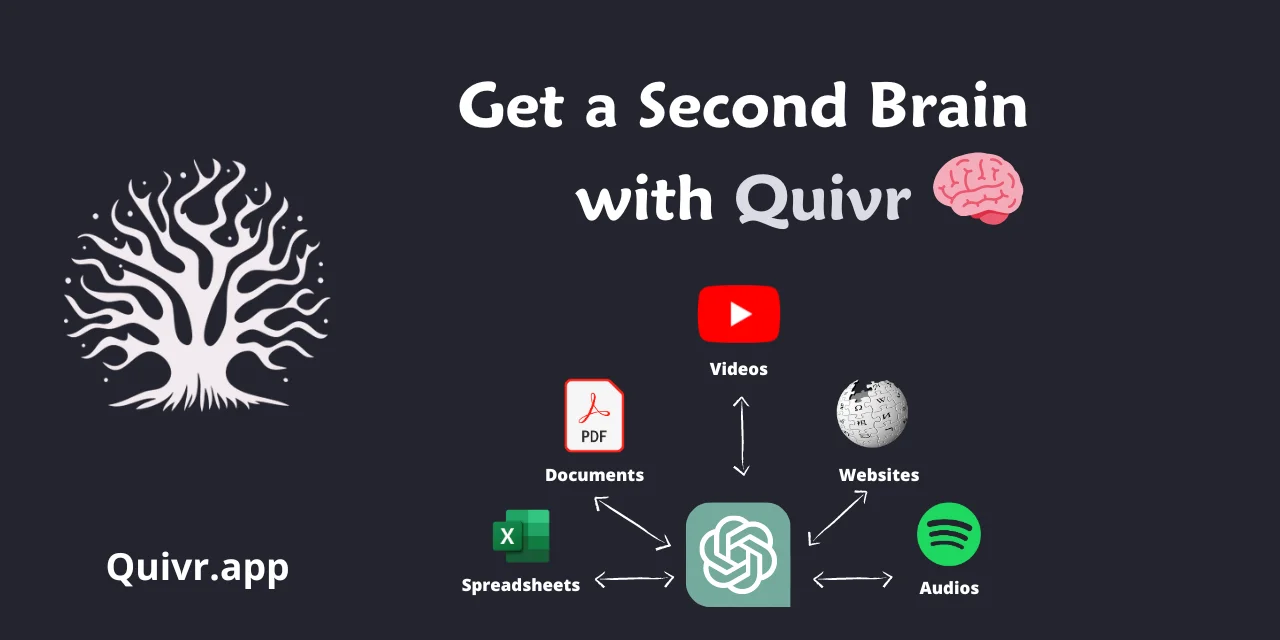
- Multi-Format File Ingestion: Ingest documents, PDFs, text files, and more to build rich, queryable knowledge bases for your AI application.
- Easy Product Integration: Designed to drop into existing products via API, with extensive customisation options at every layer of the RAG stack.
Use Cases
- Building an internal company knowledge base where employees can query documents, policies, and wikis using natural language.
- Creating a customer-facing AI support chatbot that retrieves answers from product documentation and FAQs.
- Developing a personal second-brain productivity app that indexes notes, articles, and research for intelligent retrieval.
- Integrating document Q&A capabilities into SaaS products to let users ask questions about their own uploaded files.
- Prototyping and deploying RAG pipelines for enterprise applications that require data privacy via self-hosted infrastructure.
Pros
- Massive community & proven in production: With 39k+ GitHub stars and thousands of forks, Quivr is battle-tested and backed by a large active open-source community.
- LLM and vectorstore agnostic: Avoid vendor lock-in by swapping LLM providers or vectorstores without rewriting your RAG logic.
- Self-hostable and privacy-friendly: Run entirely on your own infrastructure, keeping sensitive data in-house and compliant with your organisation's policies.
- Fast integration path: Opinionated defaults mean teams can have a working RAG pipeline in hours rather than weeks.
Cons
- Requires developer expertise: Not a no-code solution — teams need Python and infrastructure knowledge to deploy and customise Quivr effectively.
- Self-hosting operational overhead: Running Quivr in production means managing your own hosting, scaling, and maintenance, which adds DevOps burden.
- Opinionated defaults may not fit all use cases: The framework's opinionated design speeds up common scenarios but may require extra effort for highly custom retrieval architectures.
Frequently Asked Questions
What is Quivr?
Quivr is an open-source RAG (Retrieval-Augmented Generation) framework that enables developers to integrate GenAI capabilities — like document Q&A and knowledge retrieval — into their applications using any LLM or vectorstore.
Which LLMs does Quivr support?
Quivr supports a wide range of LLMs including OpenAI GPT-4, Groq, Meta's Llama models, and other compatible backends, making it highly flexible for different cost and performance requirements.
Which vectorstores are supported?
Quivr natively supports PGVector (PostgreSQL-based) and Faiss, with the architecture designed to accommodate additional vectorstore integrations.
Is Quivr free to use?
Yes. Quivr is fully open-source and free under its open-source license. You are responsible for your own hosting infrastructure and any costs from third-party LLM APIs you connect.
What types of files can Quivr ingest?
Quivr supports ingesting a wide variety of file formats including PDFs, text files, and documents, allowing you to build comprehensive knowledge bases from diverse data sources.