

About
Railway is an intelligent, all-in-one cloud deployment platform designed to eliminate DevOps complexity for developers and engineering teams. Simply connect your Git repository and Railway auto-configures your environment, sets up instant networking (including SSL, load balancing, private endpoints, and WebSocket support), and deploys your application — no YAML wrangling or new tooling required. The platform features a visual canvas that gives teams a bird's-eye view of their entire stack, making it easy to edit settings in context and reason about service relationships. Railway supports seamless horizontal and vertical scaling — from a single instance to a globally distributed deployment — with 100 Gbps internal networking and zero VPC setup. For development workflows, Railway enables unlimited environments, automatic PR preview deployments, and one-click rollbacks. Teams can ship simultaneously without conflicts. On the observability side, Railway offers unified logs, custom metric dashboards, and alerts via Slack, Discord, or email. Railway is trusted by over 2 million developers and companies ranging from startups to enterprises, often delivering significant cost savings over traditional cloud providers like AWS. It supports HTTP, TCP, gRPC, and WebSocket protocols out of the box, making it suitable for virtually any modern web application stack.
Key Features
- Auto-Configuration from Code: Railway reads your repository and automatically sets the correct build and runtime settings, eliminating manual configuration and reducing setup time.
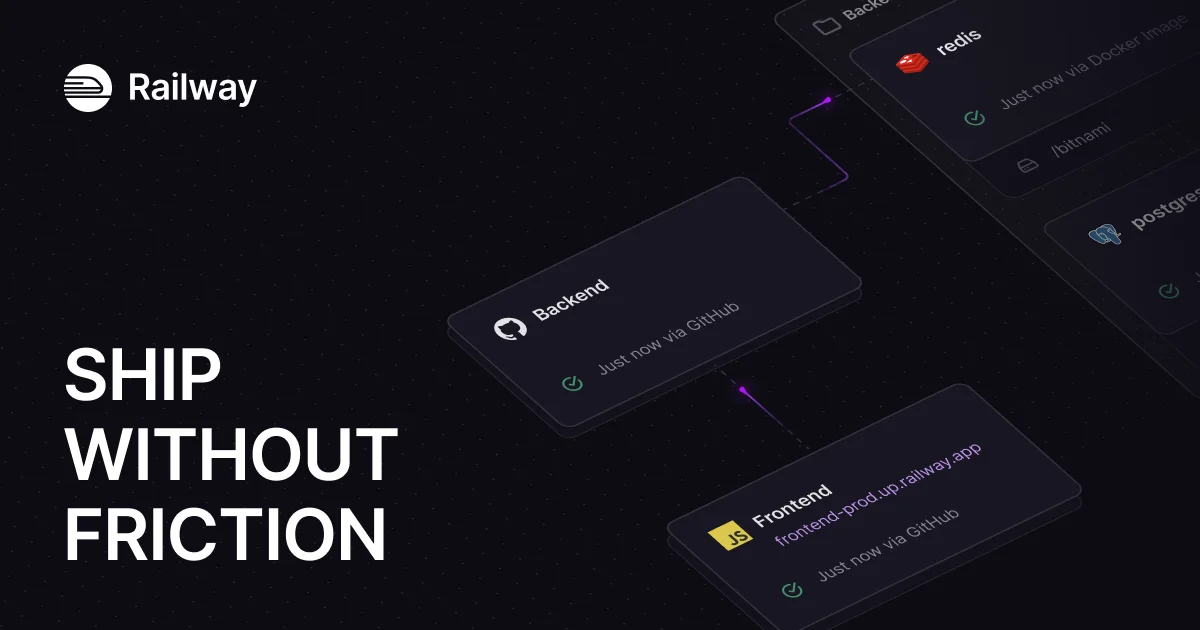
- Visual Infrastructure Canvas: A real-time visual canvas lets you see your entire stack at a glance, modify service settings in context, and understand service relationships without digging through config files.
- Instant Networking & SSL: Private connections, public endpoints, SSL certificates, and load balancing are provisioned automatically at deploy time. Supports HTTP, TCP, gRPC, and WebSockets with 100 Gbps internal networking.
- Unified Observability: All logs, metrics, and custom dashboards in one place. Set threshold-based alerts that notify you via Slack, Discord, or email the moment an issue arises.
- PR Previews & Rollbacks: Every pull request automatically gets its own isolated preview environment. One-click rollbacks let you instantly revert to any previous deployment if something goes wrong.
Use Cases
- Deploying full-stack web applications (frontend + backend + database) from a single Git repository with zero DevOps overhead.
- Running isolated preview environments for every pull request to catch bugs before they reach production.
- Hosting self-managed open-source tools (e.g., n8n, Supabase, Plausible) with minimal configuration effort.
- Startups and SaaS companies scaling from MVP to production without migrating cloud platforms or hiring a dedicated DevOps team.
- Engineering teams replacing costly AWS or GCP setups with a developer-friendly alternative that reduces infrastructure spend by up to 90%.
Pros
- Dramatically Faster Setup: Services that take a week to configure on other platforms can be deployed in a day on Railway, thanks to smart auto-configuration and zero-friction networking.
- Significant Cost Savings: Teams migrating from AWS have reported up to 90% cost reduction while gaining a better developer experience and equivalent or improved performance.
- Developer-Friendly Workflow: Unlimited environments, automatic PR previews, and instant rollbacks mean the entire team can ship confidently and independently without stepping on each other.
- No Infrastructure Expertise Required: Railway abstracts away VPC setup, load balancer configuration, and SSL management, making cloud deployment accessible even to developers without DevOps backgrounds.
Cons
- Less Granular Control Than AWS/GCP: Teams with highly specialized infrastructure needs may find Railway's abstraction layer limits the fine-grained control available on hyperscalers like AWS or GCP.
- Vendor Lock-In Risk: The tight integration with Railway's platform and canvas-based config can make migrating away more complex over time compared to using standard IaC tools like Terraform.
- Costs Can Escalate at Scale: While Railway is cost-efficient for most teams, very high-traffic workloads may eventually become more expensive compared to reserved-instance pricing on major cloud providers.
Frequently Asked Questions
How do I deploy an app on Railway?
Connect your GitHub repository to Railway, and the platform automatically detects your language and framework, configures the build settings, and deploys your app. No Dockerfile or YAML configuration is required to get started.
Does Railway support databases?
Yes. Railway supports popular databases including PostgreSQL (with PostGIS), MySQL, MongoDB, and Redis. You can provision a database alongside your app in the same project with shared environment variables configured automatically.
Is Railway suitable for production workloads?
Absolutely. Railway is trusted by production teams handling thousands of requests per second. It offers horizontal scaling with load balancing, global deployment regions, 100 Gbps private networking, and uptime monitoring.
What does Railway's free tier include?
Railway offers a Starter plan with a free monthly credit, suitable for hobby projects and experimentation. Paid Pro and Team plans unlock higher resource limits, team collaboration features, and priority support.
How does Railway compare to Heroku or Render?
Railway offers similar ease-of-use to Heroku but with more flexible infrastructure, a visual canvas, better networking options, and generally more competitive pricing. It also provides more advanced observability features than most comparable platforms.