

About
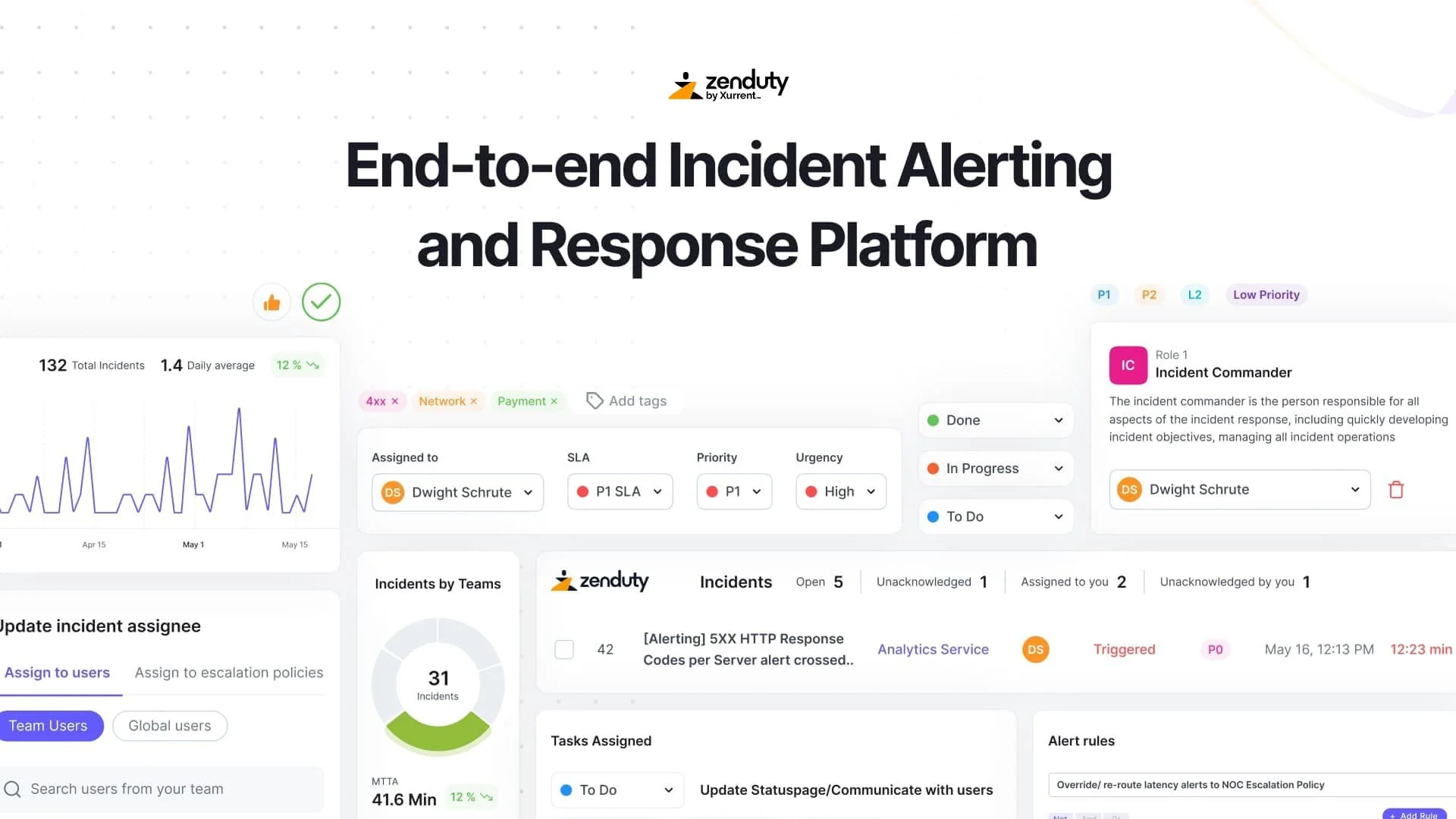
Zenduty is a comprehensive incident management and response orchestration platform trusted by 1,000+ businesses worldwide. Designed for engineering and DevOps teams, it provides end-to-end coverage from initial alert to post-incident review, all in a single pane of glass. Powered by ZenAI, Zenduty automates complex scheduling, extracts insights from alert payloads, generates real-time incident summaries, and produces detailed postmortems — drastically reducing manual overhead and mean time to resolution (MTTR) by up to 60%. Key capabilities include intelligent on-call schedule management with customizable rotations, multi-channel alerting via Phone, SMS, Email, Slack, Microsoft Teams, and push notifications, and frictionless incident response directly from Slack. Teams can bring in pre-built playbooks, delegate tasks, manage stakeholder communications, and fine-tune alert routing to suppress noise and surface only critical issues. The platform supports mobile incident response through iOS and Android apps, enabling engineers to acknowledge and act on alerts from anywhere. With deep bidirectional integrations with tools like Jira, PagerDuty, and Opsgenie alternatives, Zenduty positions itself as a cost-effective, developer-friendly alternative. It is best suited for SaaS companies, e-commerce platforms, and engineering organizations seeking reliable uptime and a strong on-call culture.
Key Features
- ZenAI-Powered Incident Intelligence: Automatically generates incident summaries, extracts insights from alert payloads, simplifies on-call scheduling, and produces detailed postmortems to reduce manual effort.
- Multi-Channel Alerting: Notifies the right on-call engineer via Phone, SMS, Email, Slack, Microsoft Teams, and mobile push notifications to ensure no critical alert is missed.
- On-Call Schedule Management: Create data-driven, customizable on-call rotations and escalation policies to ensure 24/7 operational coverage for your production systems.
- Slack-Native Incident Response: Manage the full incident lifecycle — from acknowledgment to resolution — directly within dedicated Slack channels, enabling rapid collaborative triaging.
- Playbooks & Post-Incident Management: Automatically attach runbooks to incidents, log tasks and action items, and generate detailed root cause analyses (RCAs) to continuously improve reliability.
Use Cases
- A SaaS engineering team uses Zenduty to manage on-call rotations and ensure the right engineer is paged immediately when a production service goes down.
- An e-commerce platform integrates Zenduty with its monitoring stack to suppress noisy alerts and only escalate critical incidents during peak sales events.
- A DevOps team uses Zenduty's Slack integration to coordinate incident response, assign tasks, and communicate resolution status to stakeholders without leaving their chat workspace.
- An engineering manager uses ZenAI-generated postmortems to identify recurring failure patterns and drive reliability improvements across the team.
- A startup uses Zenduty as a cost-effective alternative to PagerDuty, gaining enterprise-grade incident management features while reducing tooling costs by over 60%.
Pros
- Significant MTTA/MTTR Reduction: Organizations report up to 60% improvement in mean time to acknowledge and resolve, directly reducing downtime and its business impact.
- Deep Integration Ecosystem: Connects with 150+ monitoring, ticketing, and communication tools including Jira, PagerDuty, Splunk, and Slack for a truly unified incident workflow.
- Mobile-First Incident Response: iOS and Android apps allow engineers to receive, acknowledge, and act on alerts from anywhere, including smartwatches.
- Cost-Effective Alternative: Customers like Razorpay have reported 60% reductions in incident management costs compared to alternatives like PagerDuty and Opsgenie.
Cons
- Enterprise-Focused Pricing: Advanced features and higher team tiers may be cost-prohibitive for very small teams or solo developers.
- Learning Curve for Full Configuration: Setting up complex escalation policies, custom alert routing, and playbook integrations can require significant initial configuration time.
- AI Features May Require Onboarding: Getting the most from ZenAI capabilities like automated postmortems and payload insights may require structured data and some team training.
Frequently Asked Questions
What is Zenduty used for?
Zenduty is an end-to-end incident management platform used by engineering teams to detect, respond to, and resolve critical production outages. It handles on-call scheduling, multi-channel alerting, collaborative incident response, playbook management, and post-incident reviews.
How does Zenduty compare to PagerDuty?
Zenduty offers comparable or superior features to PagerDuty — including bidirectional Jira/Slack integrations, customizable on-call schedules, and AI-powered postmortems — at a significantly lower cost. Many organizations report 50%+ reductions in MTTA/MTTR after switching.
Does Zenduty integrate with Slack?
Yes. Zenduty has one of the most comprehensive Slack integrations in the incident management space, allowing teams to manage the entire incident lifecycle — acknowledgment, escalation, task delegation, and resolution — directly from a Slack channel.
Is there a free trial available?
Yes, Zenduty offers a free trial so teams can explore its features before committing to a paid plan. A live product walkthrough is also available for prospective customers.
What is ZenAI?
ZenAI is Zenduty's built-in AI layer that automates complex on-call scheduling, generates real-time incident summaries, extracts structured insights from alert payloads, and produces customizable postmortems — helping teams reduce MTTR and eliminate repetitive manual tasks.