

About
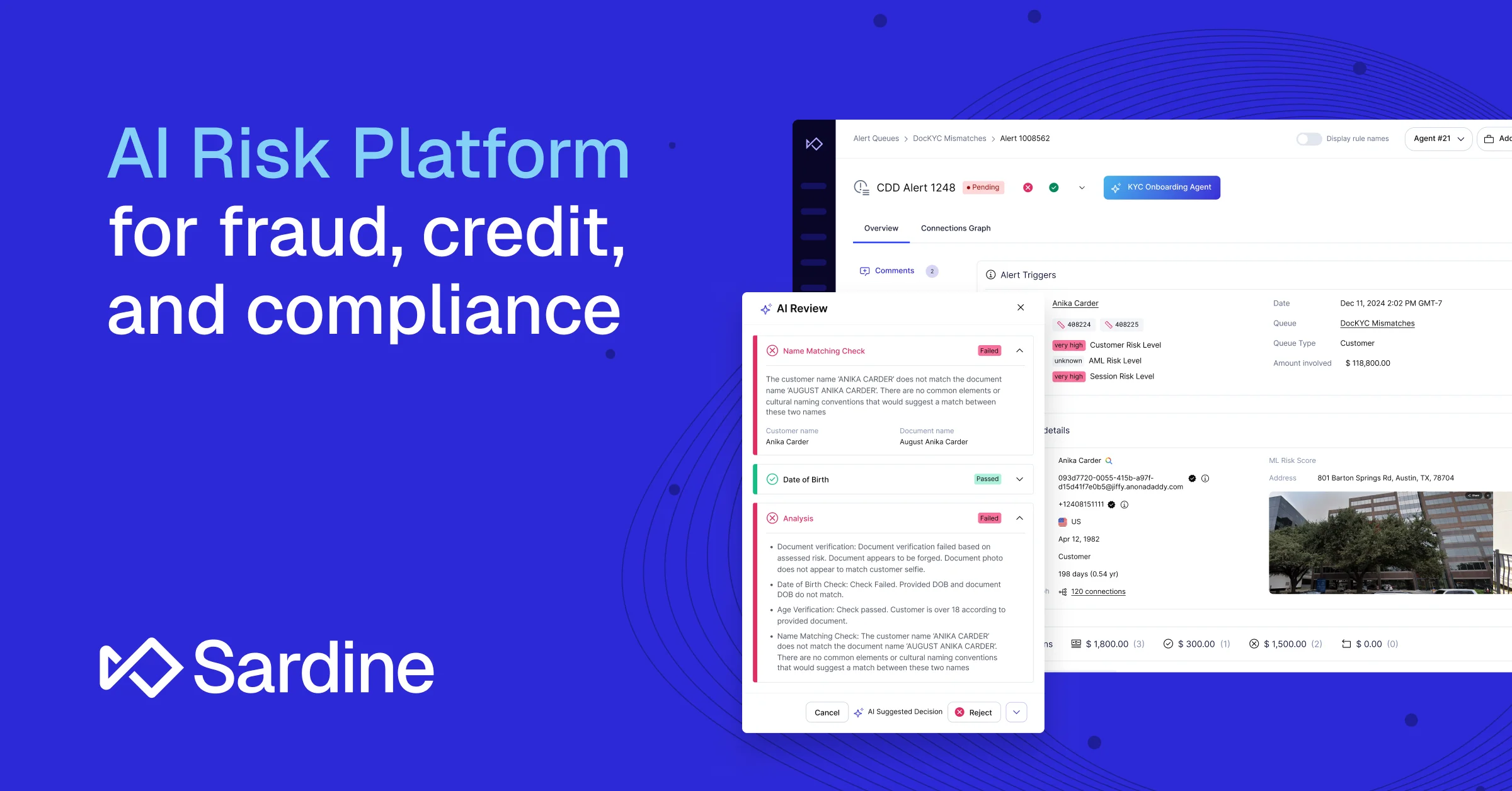
Sardine is an enterprise-grade AI risk platform purpose-built for financial services, fintech, and e-commerce organizations. It combines behavior-based fraud prevention with full KYC/AML compliance tooling, enabling teams to stop fraud, detect money laundering, and protect customers from scams—all from one unified platform. At its core, Sardine uses proprietary device intelligence and behavior biometrics to unmask fraudsters across the entire customer lifecycle. The platform offers modular building blocks including identity fraud detection, bank account validation, payment fraud prevention, AML transaction monitoring, advanced bot detection, card issuing fraud scoring, and B2C credit underwriting. For compliance teams, Sardine provides customer due diligence (CDD), business verification (KYB), sanctions screening, and streamlined SAR/UAR case management. Its ultra-low-latency risk scoring engine processes transactions in real-time, enabling instant decisioning without sacrificing accuracy or customer experience. Sardine's Consortium feature allows enterprises to share fraud signals across the network for stronger collective detection, while Risk Data Packs enrich risk decisions with curated third-party data. A Sponsor Bank OS module supports compliance and risk management across fintech partner ecosystems. Hundreds of enterprises across 70+ countries rely on Sardine to consolidate vendors, reduce false positives, and improve operational efficiency. It is designed for risk, compliance, and fraud teams at leading banks, payment processors, and digital fintechs seeking to unify data and automate risk workflows at scale.
Key Features
- Device & Behavior Intelligence: Proprietary device fingerprinting and behavior biometrics analyze signals such as typing patterns, mouse movements, and device characteristics to unmask fraudsters before transactions complete.
- KYC/KYB & AML Compliance: Perform customer due diligence, business verification, sanctions screening, and document verification in one platform, with automated case management and SAR/UAR filing support.
- Real-Time Payment Fraud Prevention: Block fraudulent card and bank payments instantly, and predict and prevent chargebacks and ACH returns with ultra-low-latency risk scoring at the point of transaction.
- Advanced Bot Detection: Detect 70+ sophisticated bot types including carding attacks, credential stuffing, web scraping, reseller bots, and fake account creation to protect platforms at scale.
- AML Transaction Monitoring: Identify complex illicit money movement patterns and streamline compliance operations with automated alert triage, case management, and regulatory filing workflows.
Use Cases
- A fintech company uses Sardine to detect synthetic identity fraud during new account onboarding, blocking money mules before they gain platform access.
- An online retailer integrates Sardine's payment fraud module to reduce chargebacks and ACH return rates by scoring every transaction in real-time.
- A bank deploys Sardine's AML transaction monitoring to detect complex illicit money movement and automate SAR filing workflows for its compliance team.
- A sponsor bank uses Sardine's Sponsor Bank OS to manage compliance and fraud risk across its fintech partner ecosystem from a single unified dashboard.
- A payment processor leverages Sardine's advanced bot detection to stop carding attacks and credential stuffing campaigns at scale across millions of daily transactions.
Pros
- Unified Risk Platform: Consolidates fraud prevention, KYC/AML compliance, and transaction monitoring into one system, reducing vendor sprawl, integration overhead, and operational complexity.
- Real-Time Decisioning at Scale: Ultra-low-latency risk scoring delivers instant fraud decisions across millions of transactions without degrading the customer experience.
- Global Enterprise Track Record: Trusted by hundreds of enterprises in 70+ countries, with a fraud consortium that strengthens detection through shared network-wide signals.
- Modular and Flexible Architecture: Organizations can adopt only the modules they need—from identity fraud to credit underwriting—enabling phased rollouts tailored to their risk stack.
Cons
- Enterprise-Only Pricing: Sardine targets large enterprises and does not offer self-serve plans or transparent pricing, making it inaccessible for small businesses or early-stage startups.
- Implementation Complexity: The breadth of the platform means initial integration and configuration can require significant technical and compliance resources to deploy effectively.
- Vertical-Specific Focus: Highly specialized for financial services and fintech use cases; organizations outside these verticals may find limited applicability or require heavy customization.
Frequently Asked Questions
What types of fraud does Sardine detect?
Sardine detects a wide range of fraud including identity fraud, synthetic identities, payment fraud, card issuing fraud, account takeover (ATO), bot attacks, merchant fraud, and social engineering scams such as pig butchering, deepfake impersonation, and voice cloning.
Does Sardine support AML compliance?
Yes. Sardine includes AML transaction monitoring, sanctions screening, KYC/KYB verification, and case management for SAR/UAR filings, providing a full-stack compliance solution alongside its fraud prevention capabilities.
Which industries does Sardine serve?
Sardine primarily serves banks, fintechs, online retailers, payment processors, card issuers, and sponsor banks. It operates across more than 70 countries globally, supporting enterprise clients of all sizes in financial services.
How does Sardine's behavior biometrics technology work?
Sardine analyzes device signals and real-time user behavior patterns—including typing cadence, mouse dynamics, touch pressure, and device attributes—to build a behavioral fingerprint that distinguishes legitimate users from fraudsters without adding friction to genuine customers.
Can Sardine integrate with existing risk and compliance systems?
Yes. Sardine provides a developer API and modular Risk Data Packs that integrate with existing risk workflows, core banking systems, data warehouses, and compliance platforms, allowing teams to enrich current decision engines rather than replace them entirely.