
About
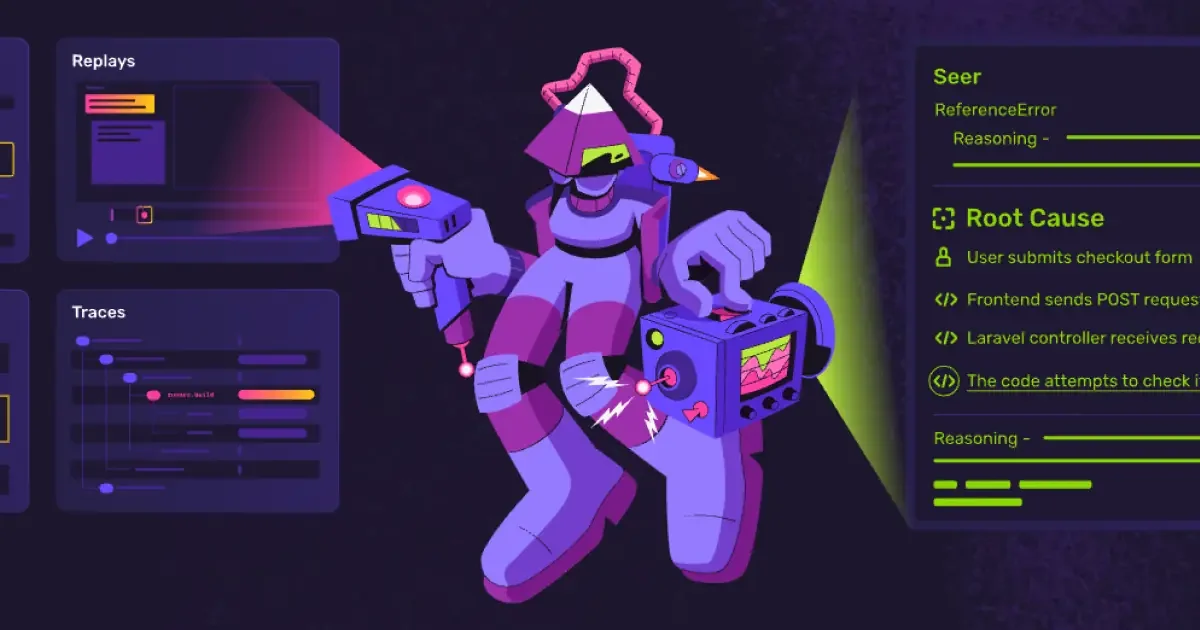
Sentry is a comprehensive application monitoring platform designed to help development teams detect, diagnose, and resolve software issues faster. At its core, Sentry connects errors, logs, session replays, distributed traces, and performance profiles into a unified view — so engineers can go from spotting an issue to shipping a fix without ever losing context. The platform features Seer, an AI debugging agent that automatically root-causes issues and surfaces fixes when problems hit production. Its AI Code Review feature proactively analyzes code before it merges, predicting errors before they ever reach users. These AI tools integrate directly into existing developer workflows via GitHub, Slack, Jira, Linear, and Sentry's own MCP server for use with coding agents. Sentry supports virtually every major language and framework through lightweight SDKs — JavaScript, Python, React, Next.js, Laravel, and dozens more — with no agents to install and minimal setup. Additional capabilities include Session Replay for debugging frontend failures, Distributed Tracing to catch slow queries and N+1s, Profiling for CPU/memory analysis, Cron Monitoring, and Uptime Monitoring. Sentry is ideal for web, mobile, and game development teams of all sizes — from solo developers on its free tier to large enterprise engineering organizations. It is also open source and available for self-hosting. With SDKs, an MCP server, and deep integrations, Sentry fits seamlessly into any modern development workflow.
Key Features
- AI Debugging with Seer: Seer is Sentry's AI debugging agent that automatically root-causes issues, surfaces relevant code context, and suggests fixes when errors hit production.
- AI Code Review: Proactively analyzes pull requests to predict and prevent errors before they ever reach production, reducing the number of bugs that make it to users.
- Connected Observability: Errors, logs, session replays, distributed traces, and performance profiles are all linked by the same trace — enabling fast, context-rich debugging in one platform.
- Session Replay & Distributed Tracing: Replay frontend failures frame by frame and trace slow requests, N+1 queries, and timeouts across your entire stack with full request-level context.
- Deep Integrations & MCP Server: Integrates natively with GitHub, Slack, Jira, and Linear, and exposes a Model Context Protocol (MCP) server so AI coding agents can access full production context.
Use Cases
- Automatically detect and diagnose production errors in web and mobile applications, with full stack traces and session replay context to reproduce and fix bugs quickly.
- Monitor application performance to identify slow database queries, N+1 issues, and API timeouts before they impact end users.
- Use AI Code Review to catch potential bugs in pull requests before they are merged, preventing production incidents proactively.
- Track uptime, cron job execution, and frontend performance metrics across distributed systems from a single observability dashboard.
- Integrate error and performance context directly into AI coding agents via the Sentry MCP server, enabling AI-assisted debugging with full production awareness.
Pros
- Developer-First Setup: Install via a lightweight SDK in five lines of code — no agents to install, no complex infrastructure, and support for every major language and framework.
- All-in-One Observability: Combines error tracking, logs, replays, traces, profiling, and uptime into a single connected platform, eliminating the need to stitch together multiple tools.
- Powerful AI Features: Seer and AI Code Review help teams debug and prevent issues proactively, reducing mean time to resolution and preventing production incidents before they occur.
- Broad Ecosystem Support: SDKs for JavaScript, Python, React, Next.js, mobile, and many more, plus integrations with all major developer tools and an MCP server for AI coding agents.
Cons
- Can Be Noisy at Scale: Without proper alert tuning and issue grouping configuration, high-traffic applications can generate overwhelming volumes of notifications and events.
- Costs Scale with Volume: Pricing is based on event and replay volume, so costs can grow quickly for large applications or teams without careful quota management.
- Learning Curve for Advanced Features: Distributed tracing, profiling, and performance analysis features have a steeper learning curve and may require significant configuration to get maximum value.
Frequently Asked Questions
Is Sentry free to use?
Yes, Sentry offers a free Developer plan with generous limits for individual developers and small projects. Paid plans unlock higher event volumes, more team members, additional data retention, and advanced features like AI Code Review.
Is Sentry open source?
Yes, Sentry is open source and available on GitHub. You can self-host it on your own infrastructure. The hosted version at sentry.io offers a managed, always-updated experience with a free tier.
What is Seer?
Seer is Sentry's AI debugging agent. It automatically analyzes errors and performance issues, identifies the root cause using code context, and suggests actionable fixes — helping teams resolve incidents faster.
What languages and frameworks does Sentry support?
Sentry supports a wide range of languages and frameworks including JavaScript, TypeScript, Python, React, Next.js, Vue, Angular, Laravel, Ruby, Go, Java, .NET, iOS, Android, and many more via its SDK library.
How does Sentry integrate with my existing workflow?
Sentry integrates natively with GitHub (for code linking and PRs), Slack (for alerts), Jira and Linear (for issue tracking), and provides an MCP server so AI coding agents like Cursor and others can access full production context during development.