
O
About
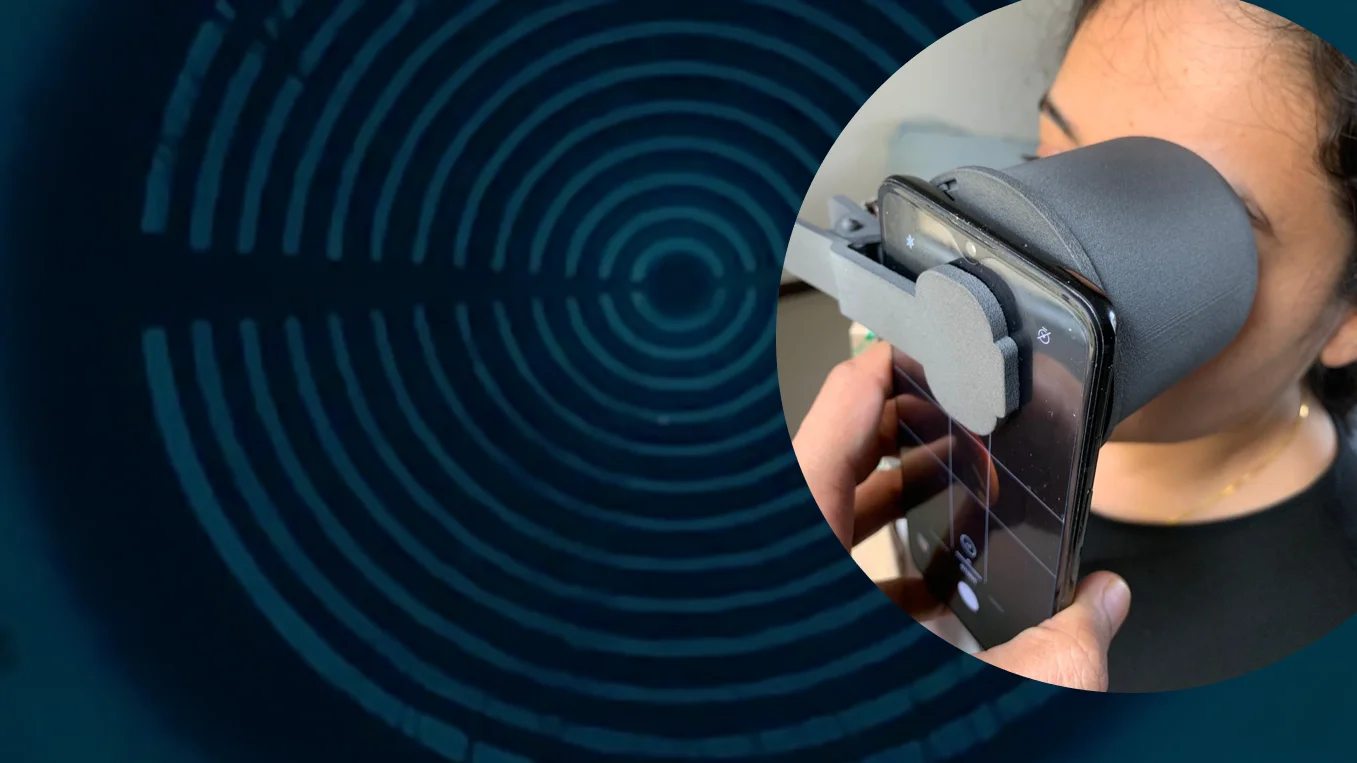
SmartKC is an open-source, low-cost keratoconus diagnosis system developed by Microsoft Research in collaboration with Sankara Eye Hospital in Bengaluru, India. Keratoconus is a serious progressive corneal disease that, if undetected, can lead to near-complete blindness. Traditional diagnosis relies on expensive, non-portable ophthalmic corneal topographers that are inaccessible to large populations in low- and middle-income countries. SmartKC addresses this gap with a three-component system: a 3D-printed placido disc attachment, an LED light strip, and a smartphone app. The app captures the reflection of placido rings on the cornea and feeds the images into an advanced processing pipeline. Using the smartphone camera's intrinsic parameters, the 3D position of the placido rings, pixel-level ring reflection locations, and working distance, the system reconstructs the corneal surface using the Arc-Step method combined with Zernike polynomial surface fitting. In a pilot clinical study, SmartKC achieved a sensitivity of 94.1% and a specificity of 100%, demonstrating clinical-grade reliability at a fraction of the cost. The project is fully open-source on GitHub, making it accessible to researchers, clinicians, and developers worldwide. Microsoft Research is now working toward large-scale deployment across health centers in India for mass keratoconus screening. SmartKC is ideal for global health researchers, ophthalmologists, and engineers working on accessible medical diagnostics.
Key Features
- 3D-Printed Placido Disc Attachment: A low-cost, 3D-printable hardware add-on that works with any standard smartphone to capture placido ring reflections on the cornea.
- AI-Powered Image Processing Pipeline: Analyzes corneal images using the Arc-Step method and Zernike polynomial surface fitting to reconstruct a detailed corneal topography map.
- High Clinical Accuracy: Demonstrated 94.1% sensitivity and 100% specificity in pilot clinical trials, matching the performance of expensive traditional topographers.
- Open-Source Codebase: Fully open-source on GitHub, enabling researchers, engineers, and clinicians worldwide to adapt, deploy, and improve the system.
- Designed for Low-Resource Settings: Purpose-built to bring early keratoconus screening to low- and middle-income countries where traditional ophthalmic equipment is unavailable.
Use Cases
- Mass screening for keratoconus at community health centers in low-resource settings across India and other developing countries.
- Research and academic studies on low-cost corneal topography and AI-assisted ophthalmology diagnostics.
- Ophthalmology clinics seeking affordable supplementary diagnostic tools for early-stage keratoconus triage.
- Global health organizations deploying portable eye disease screening programs in rural or underserved populations.
- Medical device researchers and engineers prototyping and validating smartphone-based diagnostic systems for vision care.
Pros
- Clinical-Grade Accuracy: Achieves 94.1% sensitivity and 100% specificity, making it a reliable diagnostic tool despite its low cost.
- Extremely Affordable: Uses only a smartphone and an inexpensive 3D-printed attachment, reducing the cost barrier to keratoconus screening dramatically.
- Fully Open Source: The complete codebase is publicly available on GitHub, supporting research collaboration, adaptation, and independent deployment.
- Portable and Field-Ready: Unlike traditional corneal topographers, SmartKC is compact and can be used in community health centers and remote clinics.
Cons
- Requires Hardware Fabrication: Users must 3D-print the placido disc attachment and assemble the LED strip, which requires access to fabrication resources.
- Research-Stage Deployment: The system is still in pilot/research phases and has not yet received broad regulatory clearance for clinical use.
- Limited Platform Documentation: As a research project, end-user documentation and support are minimal compared to commercial medical devices.
Frequently Asked Questions
What is SmartKC and what problem does it solve?
SmartKC is a smartphone-based corneal topographer developed by Microsoft Research to enable early detection of keratoconus — a progressive eye disease — in resource-limited settings where traditional expensive topographers are unavailable.
How accurate is SmartKC compared to traditional topographers?
In a pilot clinical study at Sankara Eye Hospital in Bengaluru, SmartKC achieved a sensitivity of 94.1% and a specificity of 100%, demonstrating strong diagnostic accuracy comparable to conventional clinical equipment.
Is SmartKC free to use?
Yes. SmartKC is fully open source. The code is available on GitHub at https://github.com/microsoft/SmartKC-A-Smartphone-based-Corneal-Topographer at no cost.
What hardware is needed to use SmartKC?
SmartKC requires a smartphone, a 3D-printed placido disc attachment, and an LED light strip. The 3D model and instructions are provided in the open-source repository.
Who is SmartKC designed for?
SmartKC is designed for clinicians, public health workers, and researchers — particularly in low- and middle-income countries — who need affordable, portable tools for large-scale keratoconus screening.