

About
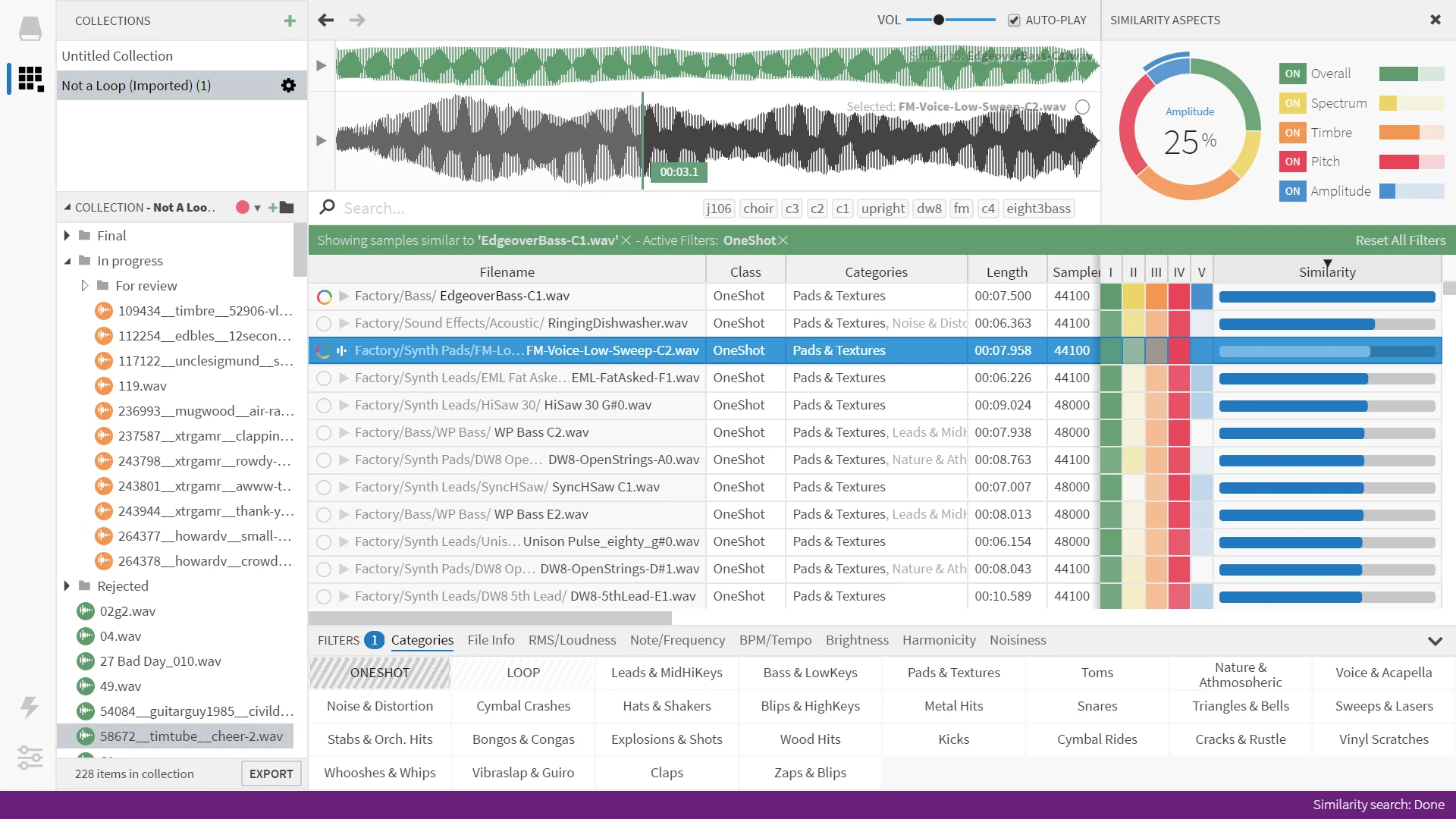
Sononym is a powerful, AI-driven sample browser available for Windows, macOS, and Linux, designed to transform how musicians, sound designers, and producers interact with their audio libraries. Instead of relying solely on file names or folder structures, Sononym analyzes each sample and extracts rich acoustic properties — including perceived brightness, crest factor, and timbre — making it possible to search and filter sounds by how they actually sound. The standout Similarity Search feature lets you pick any sample and instantly surface acoustically similar sounds across your entire library, even supporting live audio input as a search query. AI-Based Categorization uses machine learning to classify samples into meaningful groups like snare drums, synth pads, or one-shots versus loops, without any manual tagging. Duplicate Detection goes beyond exact matches, identifying near-identical files using the same similarity engine — helping users reclaim disk space and declutter sprawling sample packs. The Projects system lets users bookmark, organize, and batch-export selected sounds while maintaining file origin metadata and naming conventions. Noteably, Sononym is fully offline — no internet connection, cloud upload, or online activation required. It is aimed at music producers, composers, sound designers, and audio professionals who manage large sample collections and need a smarter way to navigate them.
Key Features
- Similarity Search: Pick any sample — or record live audio — and instantly find acoustically similar sounds across your entire library, making variation discovery effortless.
- AI-Based Categorization: Machine learning automatically classifies your samples into meaningful groups (e.g., snare drums, synth pads, one-shots) without any manual tagging required.
- Duplicate Detection: Identifies both exact and near-identical duplicate samples across libraries, helping you declutter collections and free up disk space.
- Deep Audio Property Extraction: Analyzes exotic acoustic properties like perceived brightness, crest factor, and timbre to enable precise filtering and sorting beyond basic metadata.
- Offline & Cloudless Operation: Fully functional without an internet connection — no online activation, no cloud uploads, and no deauthorization headaches.
Use Cases
- A music producer quickly finds kick drums similar to a reference sample across thousands of files without manual auditioning.
- A sound designer uses live audio recording as a search query to locate matching or complementary sounds in their library.
- A studio manager uses Duplicate Detection to clean up redundant files across multiple hard drives, reclaiming disk space.
- A composer organizes exported sample selections into Projects with consistent naming conventions for use in a film scoring session.
- A library owner uses AI categorization to automatically tag and sort a newly purchased sample pack without any manual effort.
Pros
- Powerful similarity-based discovery: The similarity search engine is widely praised as a breakthrough feature that eliminates tedious manual browsing and quickly surfaces relevant sounds.
- Works completely offline: No internet dependency means Sononym is reliable in any studio environment, including those with strict data privacy requirements.
- Cross-platform support: Available natively on Windows, macOS (both Intel and Apple Silicon), and Linux, covering virtually all professional desktop workflows.
Cons
- Paid-only product: There is no free tier; users must purchase a license to use the software beyond any trial period.
- Categories tuned for electronic music: The default AI categorization is broadly oriented around electronic music production, which may be less relevant for orchestral, acoustic, or foley-focused workflows.
- Desktop-only application: Sononym has no web or mobile interface, so it cannot be accessed remotely or on portable devices.
Frequently Asked Questions
What platforms does Sononym support?
Sononym is available for Windows (64-bit), macOS (both Intel and Apple Silicon/Arm64), and Linux (64-bit).
Does Sononym require an internet connection?
No. Sononym is fully offline and cloudless — there is no online activation, no mandatory sign-in, and no cloud syncing of your samples.
How does the Similarity Search work?
You select any sample (or record live audio) as a reference, and Sononym uses machine learning to analyze its acoustic properties and surface the most similar-sounding files from your library.
Can Sononym detect duplicate samples across different formats?
Yes. Duplicate Detection can find both exact duplicates and near-identical sounds, including the same sample saved in different formats (e.g., .wav and .aiff).
Who is Sononym best suited for?
Sononym is ideal for music producers, sound designers, composers, and audio professionals who manage large sample libraries and want a smarter, AI-assisted way to search and organize their sounds.