
About
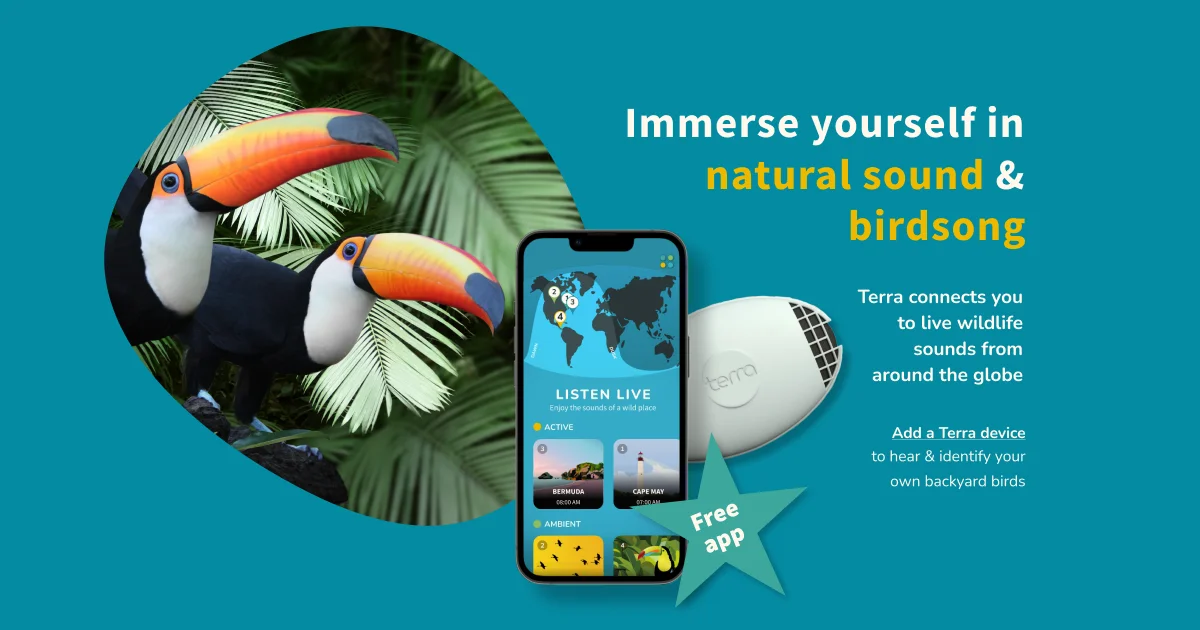
Terra Listens bridges citizen science and conservation technology through the Terra Station, an AI-powered listening and radio-monitoring device. At its core, the station uses Cornell Lab of Ornithology's BirdNET model to automatically identify bird calls and other animal sounds with professional-grade audio capture — a 16-bit stereo ADC with 80dB SNR and a 20Hz–20kHz frequency response. Beyond sound, Terra uniquely detects wildlife radio tags (via the Motus Wildlife Tracking System), enabling users to follow the migration journeys of individual tagged birds, animals, and even butterflies. Every Terra Station is part of the Terra Network, which aggregates species identifications from around the world into a unified conservation database for researchers and scientists. Optional wireless environmental sensors let users monitor soil moisture, sunlight, and temperature to optimize local wildlife habitats. The Terra app — available on iOS, Android, Web, Roku, Apple TV, Fire TV, and Android TV — lets anyone stream live nature audio from rainforests, beaches, and watering holes globally, entirely for free. Full AI identification and radio tracking features require the Terra Station hardware. Designed to operate in extreme conditions (tested to −40°C), Terra is purpose-built for bird watchers, nature enthusiasts, conservation researchers, and educators who want to connect with and actively contribute to wildlife science.
Key Features
- AI Bird & Wildlife Sound Identification: Automatically identifies hundreds of bird species and other animals using Cornell Lab's BirdNET model with professional-grade 16-bit stereo audio capture.
- Radio Wildlife Tracking: Built-in Motus antenna detects radio-tagged birds, mammals, and insects, enabling real-time tracking of individual animals during migration.
- Global Conservation Network: All species detections are contributed to the Terra Network's shared database, supporting wildlife research and conservation efforts worldwide.
- Live Nature Audio Streaming: Stream live audio from curated wild locations — Amazonian rainforests, Galápagos beaches, Pacific Northwest forests — free and unlimited via the Terra app.
- Environmental Sensor Integration: Optional wireless sensors monitor soil moisture, sunlight, and temperature, helping users create and maintain optimal wildlife habitats.
Use Cases
- Backyard birding enthusiasts setting up a personal Terra Station to automatically log and identify every bird species visiting their yard.
- Conservation researchers leveraging the Terra Network's aggregated global detection data to study bird migration patterns and population trends.
- Nature educators using the free Terra app to bring live rainforest, ocean, or forest soundscapes into classrooms for immersive environmental lessons.
- Wildlife biologists monitoring Motus radio-tagged animals across a regional network of Terra Stations to track individual migration routes.
- Nature lovers and wellness seekers using the Terra app to relax with uninterrupted live audio from wild places around the world.
Pros
- Dual Detection: Sound & Radio: Uniquely combines AI sound identification with Motus radio-tag detection, providing a more complete picture of local wildlife than audio-only tools.
- Contributes to Real Conservation Science: Every Terra Station feeds into a global research database, turning everyday backyard listening into meaningful citizen science.
- Free App with No Commitment: The Terra app's live streaming feature is completely free, letting users explore nature audio worldwide before investing in hardware.
- Rugged & Reliable Hardware: Community-tested in conditions as extreme as −40°C near Fairbanks, Alaska, with consistent performance and straightforward setup.
Cons
- AI Features Require Hardware Purchase: Bird identification, radio tracking, and personal station streaming all depend on buying the Terra Station device, adding an upfront cost.
- Limited Urban Utility: Radio wildlife tracking is most valuable in areas with tagged animal populations, reducing its appeal for dense urban users.
- Network Coverage Dependent: The power of the Terra Network grows with the number of deployed stations; in regions with few units, collective data contribution is limited.
Frequently Asked Questions
What is the Terra Station and do I need it to use Terra?
The Terra Station is a dedicated hardware device that records nature sounds, runs Cornell's BirdNET AI for species identification, and listens for Motus radio tags. You don't need it to use the app — the free app lets you stream live nature audio from curated wild locations globally — but AI identification and personal-station features require the hardware.
How does Terra identify birds and animals?
Terra uses Cornell Lab of Ornithology's BirdNET model, which is trained on thousands of species. The Terra Station's professional-grade stereo microphone captures audio, which is analyzed in real time to identify species by their calls and songs.
What is Motus radio tracking and how does Terra use it?
Motus is a collaborative wildlife tracking network that uses small radio transmitters attached to animals. Terra Stations include a built-in antenna that detects signals from these tags, automatically logging and sharing detections of tagged birds, mammals, and even butterflies with the global Motus network.
Which platforms and devices is the Terra app available on?
The Terra app is available on iOS, Android, and Web, as well as Roku, Android TV, Amazon Fire TV, and Apple TV — making it easy to enjoy nature audio on mobile, desktop, or your living room television.
Is the Terra app really free to use?
Yes. Streaming live audio from Terra's curated global locations (rainforests, beaches, watering holes, etc.) is completely free and unlimited. Connecting to your own Terra Station and accessing AI species identifications requires the purchased hardware device.