
About
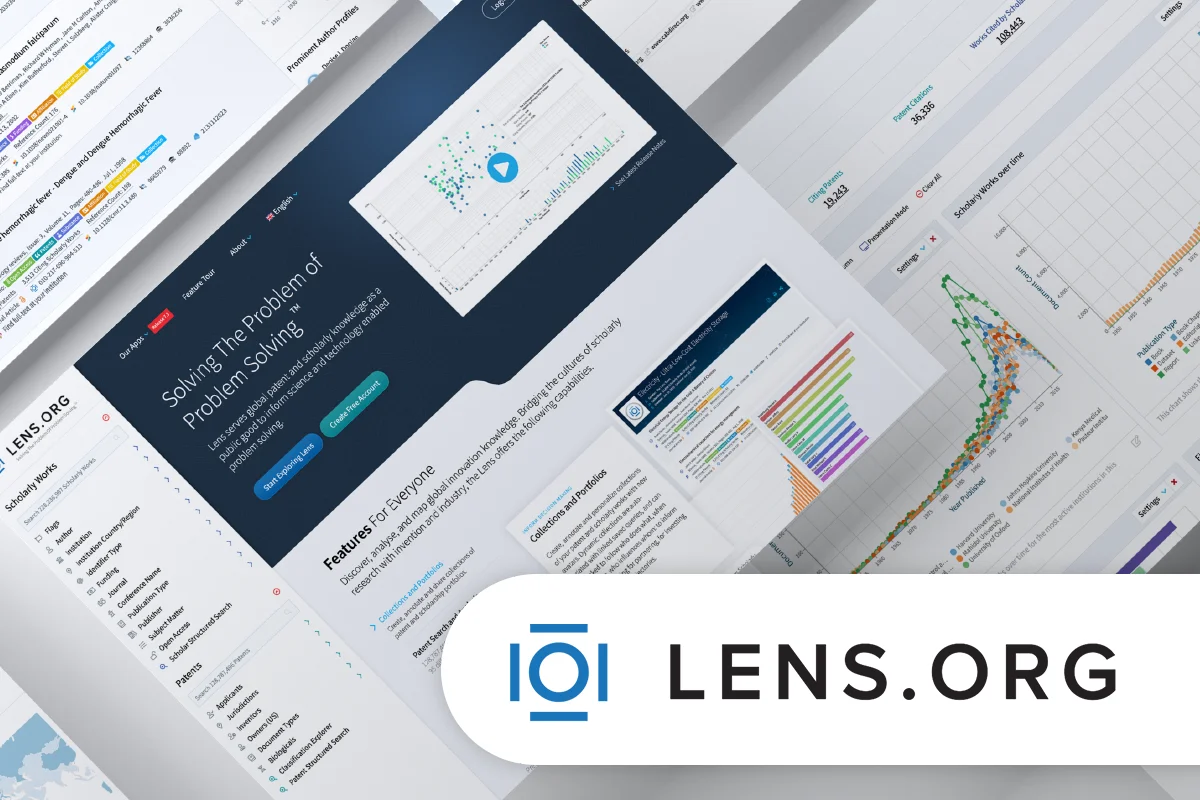
The Lens is a powerful research and intelligence platform that serves as a unified gateway to the world's patent and scholarly knowledge. It aggregates over 200 million scholarly records from sources including Microsoft Academic, PubMed, Crossref, OpenAlex, and Unpaywall, and provides access to a comprehensive global patent database with advanced boolean, biological, and classification search capabilities. Key capabilities include patent search and analysis with alerts, collections, and visualizations; scholarly works discovery with full citation graph access; and PatSeq, the world's largest publicly available biological sequence database derived from patents. The PatCite tool enables users to trace linkages between academic research and inventions, revealing how science influences industry. Lens Profiles aggregate author and inventor data from ORCID and other sources, while Lens Reports provides a flexible, data-driven report-building interface tied to live Lens analytics. The In4M (International Industry & Innovation Influence Mapping) module uses citation-based metrics to measure and rank the influence of scholarly work on both academia and enterprise. A robust API and bulk data download system gives developers and data scientists programmatic access to the full corpus. The Lens is ideal for academic researchers, patent analysts, innovation strategists, R&D teams, and developers building knowledge tools. Its open, privacy-first mission makes it a trusted resource for institutions worldwide.
Key Features
- Patent Search & Analysis: Advanced boolean, biological, and classification-based patent search with filtering, sorting, collections, alerts, and shareable visualizations.
- Scholarly Works Discovery: Access over 200 million scholarly records harmonized from PubMed, Crossref, OpenAlex, and more, including the full open scholarly citation graph.
- API & Bulk Data Access: Programmatically retrieve scholarly works, patents, and biological sequences via a flexible API or bulk download for large-scale research and tool development.
- PatSeq Biological Sequence Search: Explore the world's largest publicly available database of DNA, RNA, and protein sequences disclosed in patents, with built-in transparency metrics.
- PatCite & In4M Influence Mapping: Analyze citation linkages between scholarly research and patents, and map the real-world influence of academic work on industry and innovation.
Use Cases
- Academic researchers performing prior art searches and literature reviews across patents and scholarly publications simultaneously.
- Innovation analysts and R&D strategists mapping how university research influences industry patents and commercial products.
- Developers and data scientists building research intelligence tools using The Lens API and bulk patent or scholarly datasets.
- Institutions and libraries providing faculty and students with access to comprehensive, privacy-respecting scientific knowledge infrastructure.
- Bioinformaticians and biotech researchers searching and analyzing biological sequences disclosed in global patent filings via PatSeq.
Pros
- Unmatched Coverage: Combines 200M+ scholarly records with global patent data in a single platform, enabling cross-domain research unavailable elsewhere for free.
- Open & Privacy-First: Operates as a public good with strong user privacy commitments, making it trustworthy for sensitive institutional and academic research.
- Powerful API for Developers: Full API and bulk data access enables developers and data scientists to build custom research pipelines and tools on top of the Lens corpus.
- Unique Cross-Domain Analytics: Tools like PatCite and In4M uniquely bridge academia and industry by surfacing how scholarly work drives patents and commercial innovation.
Cons
- Learning Curve for Advanced Features: The breadth of tools — PatSeq, In4M, Reports, API — can be overwhelming for casual users or those unfamiliar with patent literature.
- Premium Features Require Paid Plans: Institutional toolkits and certain advanced analytics capabilities are gated behind paid or institutional subscription tiers.
- No AI-Generated Synthesis: The Lens focuses on search and structured analysis; it does not offer AI-powered summarization or natural-language synthesis of retrieved documents.
Frequently Asked Questions
Is The Lens free to use?
The Lens offers free access to its core search and analysis tools for patents and scholarly works. Paid plans and institutional toolkits are available for organizations that need advanced features, higher API quotas, or dedicated support.
How many scholarly records does The Lens cover?
The Lens aggregates over 200 million scholarly records sourced from Microsoft Academic, PubMed, Crossref, OpenAlex, and Unpaywall, including open-access links and the full scholarly citation graph.
Can I access Lens data programmatically?
Yes. The Lens provides a comprehensive API for scholarly works, patents, and biological sequences, as well as bulk download options for large-scale data analysis and research tool development.
What is PatSeq?
PatSeq is a suite of five apps within The Lens for searching and analyzing biological sequences (DNA, RNA, and protein) disclosed in patents. It is the world's largest publicly available patent biological sequence database.
What is PatCite and how is it different from standard citation tools?
PatCite analyzes the linkages between academic publications and patents, showing which scholarly works have influenced specific inventions and who is using research to build products. Unlike standard citation tools, it bridges academic and commercial innovation landscapes.