
About
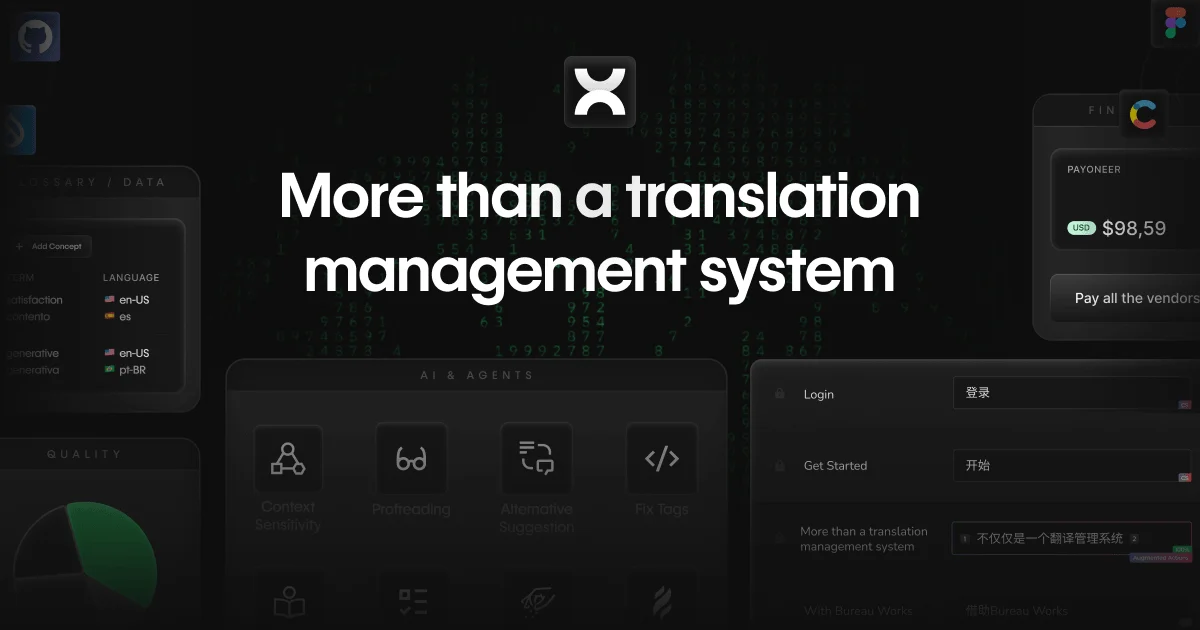
Bureau Works, branded as wxrks, is a modern AI-native Translation Management System (TMS) built to streamline the entire localization process for businesses, agencies, translators, and developers. At its core, the platform unifies Translation Memory, Machine Translation, Glossaries, and Generative AI-powered tools into a single context-sensitive feed, enabling teams to translate twice as fast while maintaining high quality. Key innovations include Free-Flow, a context-first editor that lets translators think beyond segments; Sous-Chef, an AI assistant that adapts tone and intent for each target market; and Smells, a semantic QA feature that surfaces risks traditional quality checks miss. Augmented Actions power every step of the workflow with Generative AI. Bureau Works supports over 54 file formats—including code, videos, apps, websites, documents, eLearning, and marketing assets—across 200+ languages. It integrates natively with GitHub, Adobe AEM, Drupal, Slack, Zendesk, and more via an open API. The platform caters to diverse users: translators get a smart editor with built-in MT; developers get API and GitHub automation; enterprises get end-to-end localization program management; agencies get auto-quoting and project tracking; and SMBs get fast, cost-effective translation with smart automation. Financial tracking, quality management, and auto job assignments are all built in, making it a true end-to-end localization operating system.
Key Features
- Context-Sensitive AI Translation: Merges Translation Memory, Machine Translation, and Glossaries into a single smart, contextualized feed so every translation decision is informed by prior knowledge.
- Free-Flow Editor: A context-first translation editor that lets translators work in natural context rather than segment-by-segment, enabling faster and more natural translations.
- Sous-Chef AI Tone Adaptation: An AI layer that reads intent, understands target audiences, and adapts tone and style for each market—going beyond literal translation.
- Semantic QA with Smells: Detects semantic risks and nuanced quality issues that traditional rule-based QA misses, turning vague concerns into clear, actionable signals.
- Workflow Automation & Integrations: Automates job assignments, quoting, financial tracking, and delivery with native connectors to GitHub, AEM, Drupal, Slack, and Zendesk.
Use Cases
- Localizing mobile apps and software products across multiple languages with automated version control and GitHub integration.
- Running multilingual help centers on Zendesk with automated, in-context translations that stay current without manual updates.
- Managing large-scale enterprise localization programs with automated job assignments, financial tracking, and quality oversight.
- Translation agencies providing instant quotes and automated workflows to clients across diverse content types.
- eLearning platforms localizing training materials quickly with built-in automation and translation memory to maintain consistency.
Pros
- All-in-One Localization OS: Combines translation editing, memory, machine translation, QA, financial tracking, and automation in a single platform, eliminating tool fragmentation.
- Broad File & Language Support: Supports 54+ file types and 200+ languages, covering software, video, eLearning, marketing, and document content in one system.
- Strong Developer Integration: Native GitHub integration and open API allow development teams to automate the full localization pipeline without manual handoffs.
- AI-Native Quality Management: Generative AI powers both translation speed improvements and semantic risk detection, offering quality safeguards beyond traditional TMS tools.
Cons
- Complexity for Small Teams: The platform's breadth of features—financial tracking, enterprise automation, multi-role workflows—may feel overwhelming for freelancers or very small teams.
- Pricing Transparency: Specific pricing tiers are not prominently displayed on the website, requiring a demo or direct contact to understand costs for your use case.
- Learning Curve for Advanced Features: Features like Smells, Sous-Chef, and workflow automation require setup and familiarity with localization concepts to use effectively.
Frequently Asked Questions
What types of content can Bureau Works translate?
Bureau Works supports 54+ file types including code, videos, apps, websites, documents, emails, marketing assets, eLearning content, presentations, and spreadsheets across 200+ languages.
How does Bureau Works use AI in the translation process?
Bureau Works uses Generative AI through Augmented Actions to speed up translation, Sous-Chef for tone and audience adaptation, and Smells for semantic quality detection. It also blends Translation Memory and Machine Translation into a single context-sensitive feed.
Can developers integrate Bureau Works into their CI/CD pipeline?
Yes. Bureau Works offers a native GitHub integration and an open API so developers can automate sending and receiving translations as part of their development workflow.
Is Bureau Works suitable for translation agencies?
Absolutely. The platform includes auto-quoting, project tracking, financial management, and automated workflows specifically designed to help translation agencies scale operations efficiently.
What is the Free-Flow editor?
Free-Flow is Bureau Works' context-first translation editor that lets translators work in natural reading context rather than segment-by-segment, making the translation process more intuitive and faster.