
About
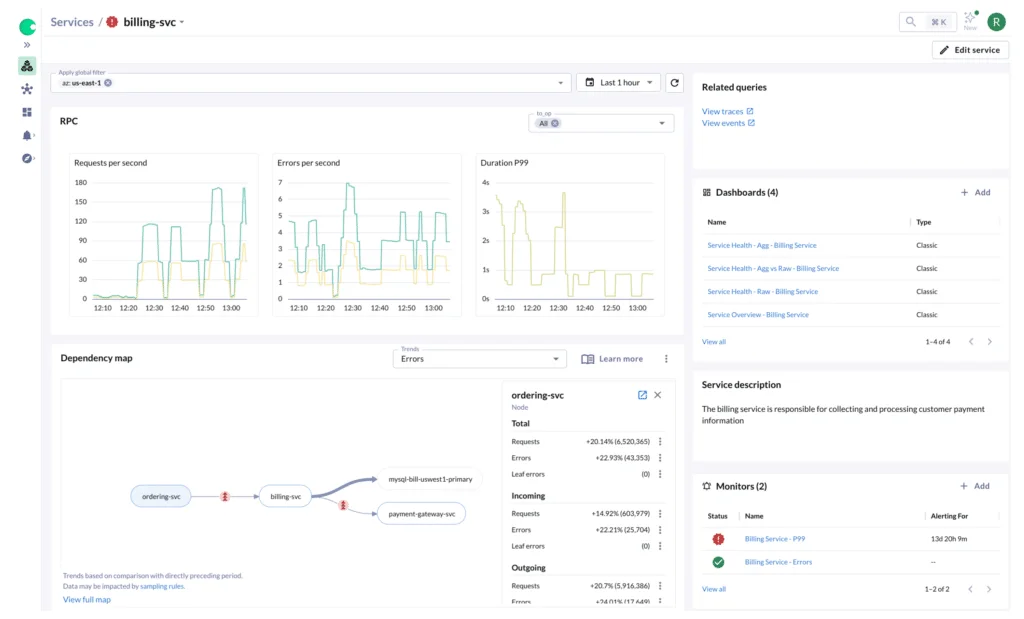
Chronosphere is a cloud native observability platform purpose-built for modern, containerized architectures running on Kubernetes and microservices. It provides deep, actionable insights across every layer of the stack — from infrastructure health to application performance to business-level metrics — all in one unified platform. At its core, Chronosphere ingests telemetry data via open standards like Prometheus and OpenTelemetry and provides a powerful control plane for analyzing and refining data to align costs with value. The platform delivers industry-leading 99.99% reliability, even at tens of millions of data points per second. Key capabilities include Chronosphere Lens for accelerated incident response, Differential Diagnosis (DDx) for queryless guided troubleshooting, SLO management for dynamic containerized environments, and a full Telemetry Pipeline for collecting, transforming, and routing logs from any source to any destination using Fluent Bit. Chronosphere is designed for platform engineering, SRE, and DevOps teams at high-growth companies who need enterprise-scale observability without runaway costs. It supports AI workload observability, Prometheus scaling, Kubernetes workload monitoring, and business observability use cases. Named a Leader in the 2025 Gartner® Magic Quadrant™ for Observability Platforms for the second consecutive year, Chronosphere is a top-tier choice for enterprises serious about operational excellence.
Key Features
- Unified MELT Data Platform: Centralizes metrics, events, logs, and traces (MELT) in a single platform with ingestion via Prometheus, OpenTelemetry, and other open standards.
- Chronosphere Lens for Incident Response: Integrated, contextual data throughout the incident response workflow to help teams identify and resolve issues faster.
- Differential Diagnosis (DDx): Queryless, guided troubleshooting using metrics or traces — no deep expertise required — to quickly pinpoint root causes.
- Telemetry Pipeline: Turnkey log collection, aggregation, transformation, and routing from any source to any destination using Fluent Bit with a low-code/no-code interface.
- Cost Control & Observability Governance: A control plane that lets teams analyze, refine, and manage telemetry data volumes to align observability costs with actual business value.
Use Cases
- Platform engineering and SRE teams managing large-scale Kubernetes clusters need unified visibility into infrastructure, application, and business health in a single platform.
- DevOps teams responding to production incidents can use Chronosphere Lens and DDx to quickly correlate signals and identify root causes without sifting through disparate tools.
- Enterprises running high-cardinality metrics workloads from containerized microservices need a scalable alternative to self-managed Prometheus at scale.
- Security operations teams can leverage the Telemetry Pipeline to pre-process and route security logs from any source to a SIEM, reducing ingestion costs and improving signal quality.
- Engineering leaders looking to reduce observability costs can use Chronosphere's control plane to audit, govern, and optimize telemetry data spend across the organization.
Pros
- Enterprise-Grade Reliability: Industry-leading 99.99% uptime SLA, proven at tens of millions of data points per second — reliable even under extreme load.
- Open Standards Compatibility: Natively supports Prometheus, OpenTelemetry, and Fluent Bit, making it easy to integrate into existing cloud native stacks without vendor lock-in.
- Gartner Magic Quadrant Leader: Recognized as a Leader in the 2025 Gartner® Magic Quadrant™ for Observability Platforms for two consecutive years, validating its enterprise credibility.
- Cost Governance Built-In: Unique control plane features help teams actively manage and reduce observability spend — a critical differentiator vs. other platforms.
Cons
- Enterprise Pricing: Chronosphere is primarily targeting large enterprises and high-growth tech companies; pricing may be prohibitive for small teams or startups.
- Complexity for Simple Use Cases: The platform's depth and breadth can be overkill for teams with simpler observability needs or smaller, less complex environments.
- No Public Pricing Transparency: Pricing details are not publicly listed and require contacting sales, making it harder to evaluate cost upfront.
Frequently Asked Questions
What types of telemetry data does Chronosphere support?
Chronosphere supports all four core telemetry signal types: metrics, events, logs, and distributed traces (MELT). Data can be ingested via Prometheus, OpenTelemetry, Fluent Bit, and other open source formats.
Is Chronosphere suitable for Kubernetes environments?
Yes. Chronosphere is purpose-built for cloud native, containerized architectures including Kubernetes. It offers dedicated Kubernetes Workload Observability features and deep support for microservices-based systems.
How does Chronosphere help control observability costs?
Chronosphere includes a Control Plane that lets teams analyze and refine incoming telemetry data, filter out low-value signals, and match data ingestion costs with business value — preventing runaway observability spend.
What is Differential Diagnosis (DDx)?
DDx is a queryless, guided troubleshooting feature that uses metrics or traces to walk teams through identifying the root cause of an issue — without requiring deep expertise in writing complex queries.
Does Chronosphere support AI workload observability?
Yes. Chronosphere includes AI Workload Observability capabilities, allowing teams to monitor and scale AI operations without proportionally increasing observability costs.